“For example” is a common phrase used to introduce an example that supports or illustrates an idea. The comma rule depends on where “for example” appears in the sentence.
The basic rule is:
For example, at the beginning of a sentence, use a comma after it.
At the end of a sentence, for example usually needs a comma before it when it introduces an example.
In the middle of a sentence, for example is often set off with commas when it is an interrupter.
Quick Answer
At the beginning
Use a comma after for example:
For example, you could try restarting the computer.
In the middle
Usually use commas around for example when it interrupts the sentence:
Some fruits, for example, apples and oranges, are rich in fiber.
At the end
Usually use a comma before for example:
You could try eating more fruit, for example.
However, the punctuation can change depending on how for example functions in the sentence.
What Does “For Example” Mean?
For example means as an illustration or to give a specific instance of something just mentioned.
For example:
Many animals can swim. For example, dolphins can swim very well.
The second sentence provides a specific example of an animal that can swim.
Comma After “For Example” at the Beginning
When for example starts a sentence, it is normally followed by a comma.
For example, you can use this method to solve the problem.
For example, apples contain fiber.
For example, she could take the train instead.
The comma separates the introductory phrase from the main clause.
Correct
For example, you could call him tomorrow.
Incorrect
❌ For example you could call him tomorrow.
For standard writing, include the comma.
“For Example” in the Middle of a Sentence
When for example appears in the middle of a sentence as an interrupter, it is usually surrounded by commas.
Some vegetables, for example, carrots and spinach, are highly nutritious.
Many countries, for example, Canada and Australia, use this system.
You can use several methods, for example, email or phone calls.
The commas show that for example is parenthetical or interrupting the main sentence.
A useful test
Remove for example from the sentence.
Some vegetables, for example, carrots and spinach, are nutritious.
Remove it:
Some vegetables are nutritious.
The sentence still works grammatically. This is a good indication that for example is functioning as an interrupter and should be set off with commas.
“For Example” Before a List
When for example introduces specific examples within a sentence, punctuation depends on the sentence structure.
For example:
You can eat several fruits, for example, apples, bananas, and oranges.
Here, for example introduces the examples.
Another option is:
You can eat several fruits, such as apples, bananas, and oranges.
Such as is often more concise when introducing examples directly within a sentence.
“For Example” at the End of a Sentence
When for example appears at the end, a comma often comes before it.
You could try a different approach, for example.
There are several ways to save money, for example.
This construction is possible when for example refers back to the idea in the sentence.
However, it can sometimes sound incomplete or awkward. In many cases, it is clearer to provide the example directly.
Instead of:
You could try a different approach, for example.
You could write:
You could try a different approach, for example, by asking for help.
“For Example” After a Semicolon
You can use for example after a semicolon when introducing a related example.
There are many ways to exercise; for example, you could walk or swim.
Here, the semicolon separates two closely related independent clauses, while the comma follows the introductory for example.
You could also write:
There are many ways to exercise. For example, you could walk or swim.
This is often simpler.
“For Example” After a Colon
A colon can introduce an example or list, but you do not always need for example.
There are several healthy snacks you can choose from: for example, apples, yogurt, and nuts.
However, this can be unnecessarily wordy.
A cleaner version is:
There are several healthy snacks you can choose from: apples, yogurt, and nuts.
Or:
There are several healthy snacks you can choose from, for example, apples, yogurt, and nuts.
For Example vs Such As
For example and such as are closely related but have different punctuation patterns.
For example
Some pets, for example, dogs and cats, require regular care.
Such as
Some pets, such as dogs and cats, require regular care.
Notice that such as does not normally require commas merely because it introduces examples.
Compare:
Some fruits, for example, apples and oranges, are nutritious.
Some fruits, such as apples and oranges, are nutritious.
Both are correct, but the punctuation differs.
“For Example” vs “E.g.”
E.g. is an abbreviation of the Latin phrase exempli gratia, meaning for example.
For example:
Several fruits, e.g., apples and oranges, contain fiber.
In American English, e.g. is commonly written with a comma after it:
e.g.,
However, for example is usually clearer for general readers.
Common Comma Mistakes
Mistake 1: Missing the comma after introductory “for example”
❌ For example you could take the bus.
✅ For example, you could take the bus.
Mistake 2: Using only one comma around a parenthetical “for example”
❌ Some animals, for example, dogs are easy to train.
This sentence needs punctuation that clearly separates the example from the main clause.
Better:
Some animals, for example, dogs, are easy to train.
Or more naturally:
Some animals, such as dogs, are easy to train.
Mistake 3: Adding unnecessary commas with “such as”
❌ Some fruits, such as, apples and oranges, are nutritious.
✅ Some fruits, such as apples and oranges, are nutritious.
There should not be a comma immediately after such as.
Quick Comparison Table
| Position | Typical punctuation | Example |
|---|---|---|
| Beginning | Comma after | For example, you could call her. |
| Middle, parenthetical | Commas around it | Some pets, for example, dogs, need exercise. |
| Before an example | Usually comma before | There are many options, for example, walking. |
| End | Often comma before | You could try another method, for example. |
| After semicolon | Comma after | There are many choices; for example, you could walk. |
Easy Rule to Remember
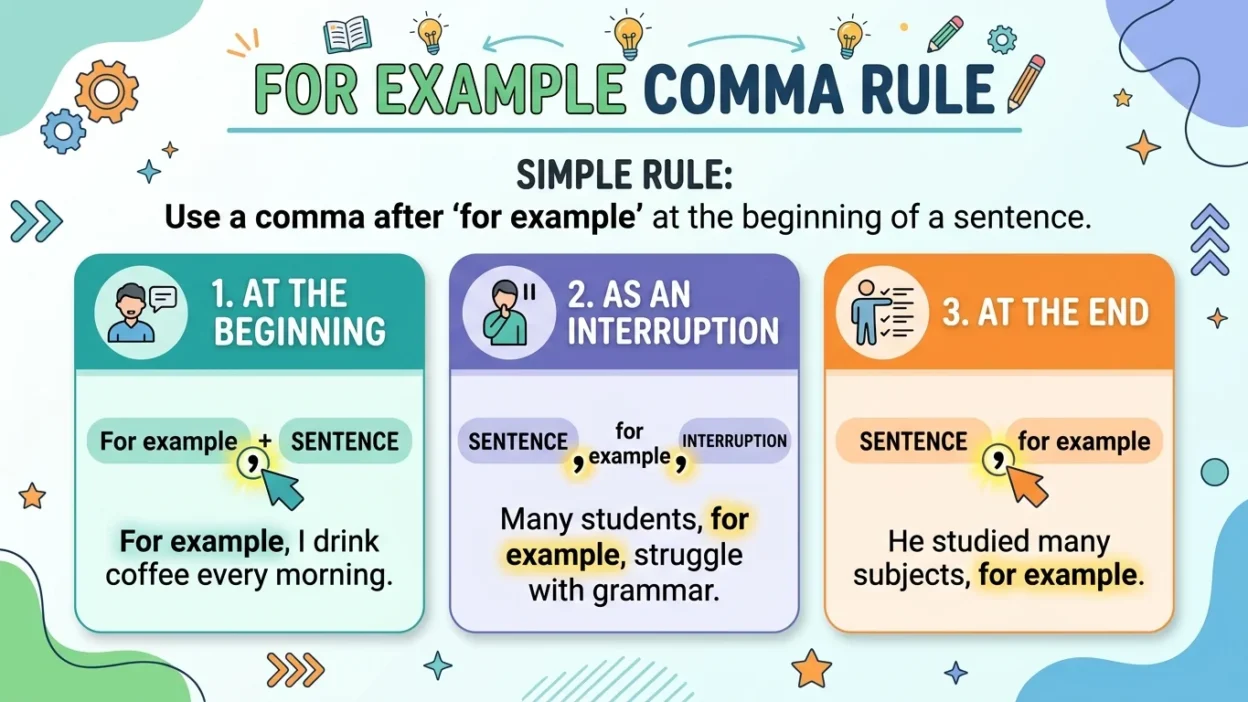
Remember these three patterns:
For example, + sentence
sentence, for example, + interruption, + sentence
sentence, for example
The most important rule is:
When “for example” starts a sentence, put a comma after it.
For example, this sentence is correctly punctuated.
When it interrupts a sentence, use commas to set it off if it is parenthetical:
This rule, for example, applies to formal writing.
Final Verdict
The comma rule for “for example” depends on its position and function.
At the beginning of a sentence:
For example, she could take the train.
In the middle as an interrupter:
She could, for example, take the train.
When introducing examples within a sentence:
She could take several forms of transportation, for example, a train or bus.
At the end:
She could take another form of transportation, for example.
The safest general rule is:
For example, at the beginning → comma after it.
, for example, in the middle as an interrupter → commas around it.
For formal writing, such as can often be a cleaner alternative when directly introducing examples.
FAQs
Do you put a comma after “for example”?
Yes, when for example begins a sentence, use a comma after it.
For example, you could try again.
Do you put a comma before “for example”?
Often, yes, particularly when for example introduces an example at the end or functions as an interrupter.
There are several options, for example, walking or cycling.
Is it “for example,” or “for example”?
When for example begins a sentence, write:
For example,
The comma normally follows the phrase.
Should “for example” have commas around it?
When it is a parenthetical interruption, yes:
This method, for example, is very effective.
Can I use “for example” after a semicolon?
Yes:
There are many options; for example, you could take the train.
What is the difference between “for example” and “such as”?
For example can introduce a complete example or sentence, while such as typically introduces examples within a noun phrase.
Some animals, such as dogs and cats, make good pets.
Some animals make good pets. For example, dogs and cats are popular choices.

Daniel Charles is a dedicated author and dream interpretation enthusiast at DrameyHut. He specializes in analyzing dream symbols and meanings, offering clear and insightful content for readers. His work aims to help individuals understand their subconscious thoughts, gain clarity, and explore the deeper messages hidden within their dreams.