Many English learners confuse impatient and inpatient because they are spelled almost the same. However, these words have completely different meanings and belong to different parts of speech. Using the wrong one can lead to confusion, especially in everyday conversations and healthcare settings.
Understanding the difference between impatient vs inpatient will help you use the correct word with confidence. This guide explains their meanings, pronunciation, examples, common mistakes, and an easy memory trick.
Quick Answer
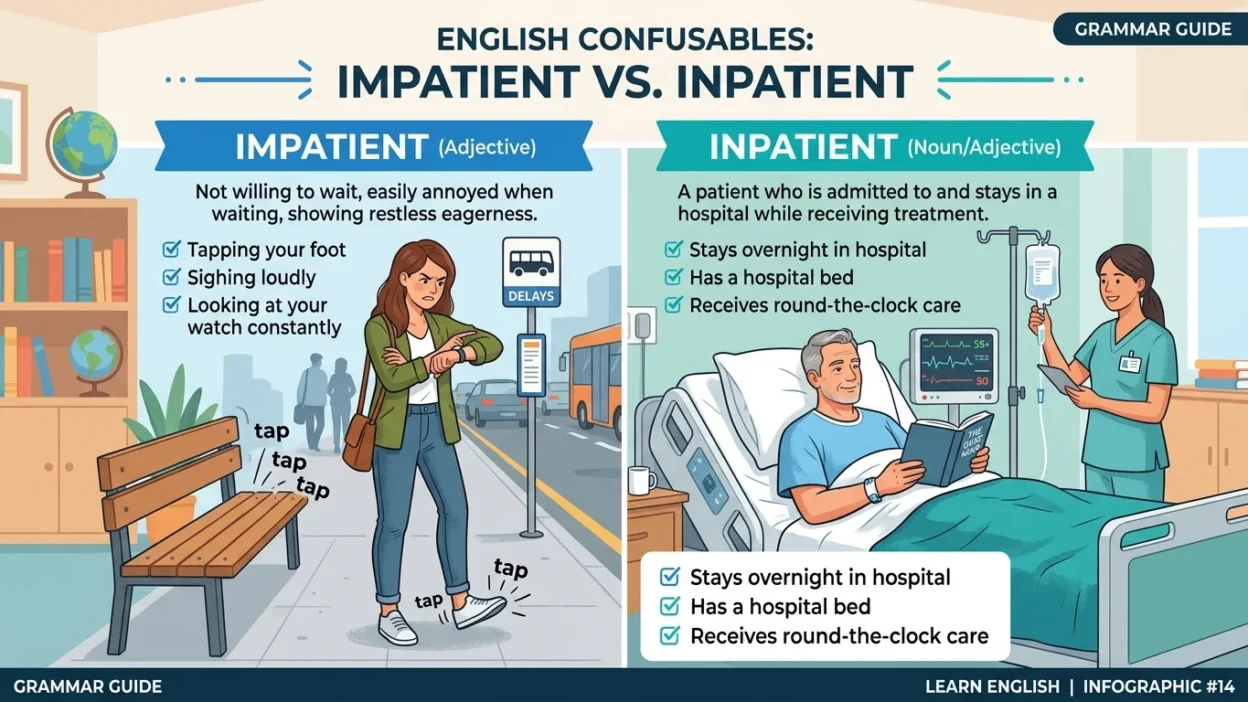
Impatient is an adjective that means unable to wait calmly or becoming easily annoyed by delays. Inpatient is a noun that refers to a patient who stays in a hospital for treatment. Although they look similar, they are not interchangeable.
Why People Confuse It
The confusion happens because impatient and inpatient differ by only one letter.
However, impatient describes a person’s attitude or feeling, while inpatient refers to someone receiving medical care in a hospital.
Impatient
Impatient is an adjective.
Meaning
It describes someone who:
- Cannot wait calmly.
- Becomes frustrated by delays.
- Wants something to happen quickly.
Examples
- She became impatient while waiting for the bus.
- The children were impatient to open their gifts.
- Don’t be impatient with beginners.
- He grew impatient during the long meeting.
- We were impatient for the results.
Inpatient
Inpatient is a noun.
Meaning
An inpatient is a patient who is admitted to a hospital and stays overnight or longer for treatment.
Examples
- The inpatient received excellent care.
- The hospital has a new inpatient wing.
- She remained an inpatient for three days.
- Doctors monitored the inpatient closely.
- The inpatient recovered quickly after surgery.
Comparison Table
| Feature | Impatient | Inpatient |
|---|---|---|
| Part of speech | Adjective | Noun |
| Meaning | Unable to wait calmly | A patient staying in a hospital |
| Related to emotions | ✅ Yes | ❌ No |
| Related to healthcare | ❌ No | ✅ Yes |
| Common in everyday conversation | ✅ Yes | ✅ Yes |
When to Use Each
Use impatient when:
- Talking about feelings or emotions.
- Describing frustration caused by waiting.
- Explaining someone’s attitude.
Use inpatient when:
- Referring to a hospital patient.
- Discussing medical treatment.
- Talking about healthcare services.
Examples
- She became impatient after waiting an hour.
- The students were impatient for the holidays.
- He sounded impatient during the call.
- Try not to be impatient with yourself.
- We grew impatient because of the delay.
- The inpatient stayed at the hospital overnight.
- Every inpatient received a medical examination.
- The doctor visited each inpatient every morning.
- The hospital expanded its inpatient facilities.
- She was admitted as an inpatient after surgery.
- His impatient attitude caused unnecessary stress.
- The inpatient was discharged the following week.
Common Mistakes
Many learners make these errors.
- Writing inpatient when they mean impatient.
- Using impatient to describe someone admitted to a hospital.
- Assuming both words have similar meanings because of their spelling.
Correct:
- She is impatient with slow internet.
- He is an inpatient at the local hospital.
Incorrect:
- She is inpatient with slow internet.
- He is an impatient at the hospital.
Memory Trick
Remember this simple rule:
Impatient = I can’t wait.
Inpatient = In the hospital.
If someone is waiting impatiently, use impatient.
If someone is staying in a hospital, use inpatient.
American vs British English
There is no significant difference between American and British English.
Both varieties use impatient and inpatient with the same meanings.
Similar Words
You may also confuse these word pairs:
- Inpatient vs Outpatient
- Patient vs Patience
- Imply vs Infer
- Accept vs Except
- Affect vs Effect
- Stationary vs Stationery
- Principal vs Principle
- Complement vs Compliment
- Adapt vs Adopt
- Advice vs Advise
Final Verdict
The difference between impatient and inpatient is simple once you know their meanings. Impatient describes someone who cannot wait calmly, while inpatient refers to a person who stays in a hospital for medical treatment.
Because these words are similar in spelling but unrelated in meaning, remembering their definitions will help you avoid a common English vocabulary mistake.
Remember This
Impatient = Unable to wait calmly. ✅
Inpatient = Hospital patient. ✅
Think:
I’m impatient because the bus is late.
The inpatient is recovering in the hospital.
FAQs
What is the difference between impatient and inpatient?
Impatient means unable to wait calmly, while inpatient refers to a patient staying in a hospital for treatment.
Is inpatient one word?
Yes. Inpatient is written as one word when used as a noun.
Can inpatient be an adjective?
Yes. It can also function as an adjective before a noun, such as inpatient care or inpatient treatment.
Is impatient an adjective?
Yes. It describes someone’s feelings or attitude.
What is an inpatient?
An inpatient is someone admitted to a hospital who stays there for treatment.
Do British and American English use these words differently?
No. Both varieties use impatient and inpatient in the same way.
What is the opposite of inpatient?
The opposite is outpatient, which refers to a patient who receives treatment without staying overnight in the hospital.
Conclusion
Although impatient and inpatient differ by only one letter, they have completely different meanings. Impatient describes a feeling of frustration or an inability to wait, while inpatient refers to someone who is admitted to a hospital for medical care.
By remembering Impatient = Can’t wait and Inpatient = In the hospital, you’ll choose the correct word every time and make your English clearer and more accurate.

Daniel Charles is a dedicated author and dream interpretation enthusiast at DrameyHut. He specializes in analyzing dream symbols and meanings, offering clear and insightful content for readers. His work aims to help individuals understand their subconscious thoughts, gain clarity, and explore the deeper messages hidden within their dreams.