Accent, ascent, and assent are three different English words that sound somewhat similar but have completely different meanings.
The easiest way to remember them is:
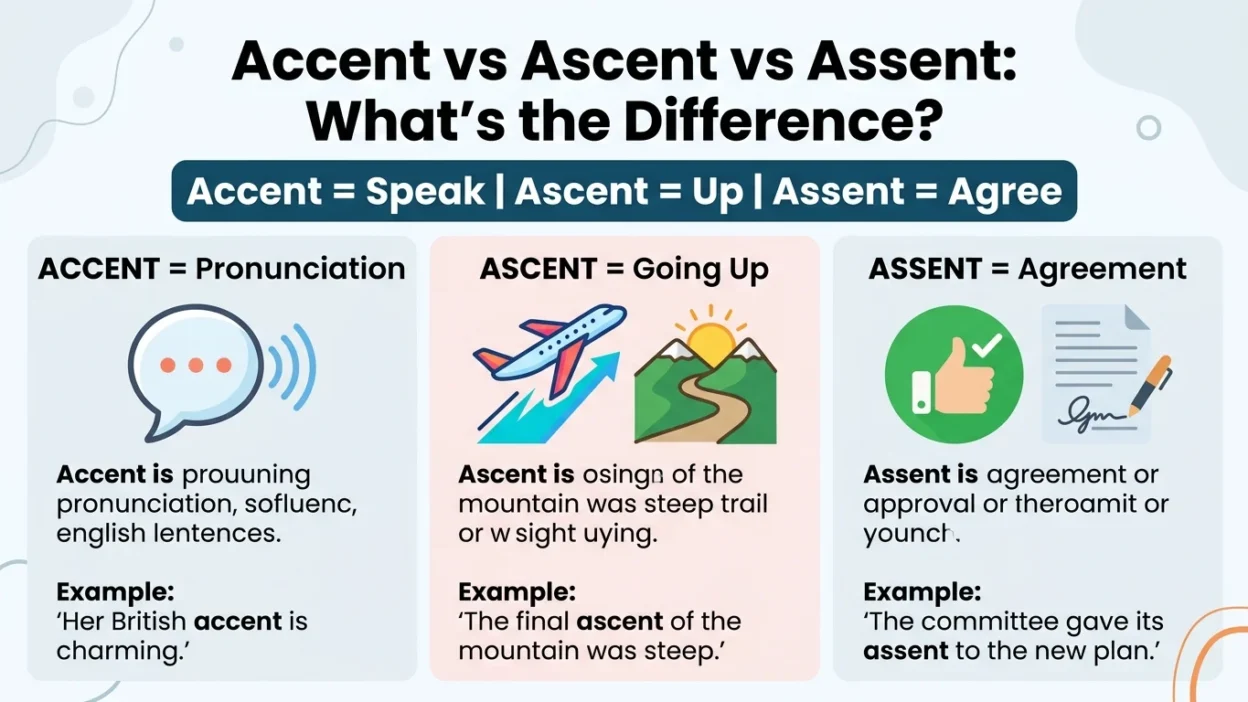
Accent = pronunciation or emphasis
Ascent = going upward or climbing
Assent = agreement or approval
Although these words are often confused because of their similar spelling and pronunciation, understanding their meanings makes the difference easy to remember.
Quick Answer
| Word | Meaning | Example |
|---|---|---|
| Accent | A way of pronouncing words; emphasis | She has a British accent. |
| Ascent | The act of going upward | The climbers began their ascent. |
| Assent | Agreement or approval | He gave his assent to the plan. |
What Does “Accent” Mean?
Accent has several meanings, but the most common refers to the way someone pronounces words.
For example:
She has a strong American accent.
I could tell from his accent that he was from Scotland.
Her English accent is easy to understand.
An accent can also mean emphasis placed on a particular word, syllable, note, or feature.
For example:
The word has an accent on the second syllable.
The designer added an accent color to the room.
What Does “Ascent” Mean?
Ascent means the act of moving upward or climbing.
It is usually associated with physical movement toward a higher position.
For example:
The climbers began their ascent up the mountain.
The plane began its ascent shortly after takeoff.
The difficult ascent took several hours.
The opposite of ascent is descent, which means moving downward.
A useful pair to remember is:
Ascent = up
Descent = down
What Does “Assent” Mean?
Assent means agreement, approval, or acceptance.
As a noun:
The proposal was approved with the manager’s assent.
As a verb:
She assented to the proposal.
In simpler words, if someone assents, they agree with something or give their approval.
For example:
The parents gave their assent to the decision.
He assented to the terms of the agreement.
Accent vs Ascent vs Assent
The three words can be distinguished by their meanings:
Accent
Think speech or emphasis.
He speaks with a noticeable accent.
Ascent
Think upward movement.
The mountain’s ascent was challenging.
Assent
Think agreement.
She gave her assent to the proposal.
Accent: Meaning and Examples
Accent is commonly used when talking about pronunciation.
What kind of accent does he have?
She speaks English with a French accent.
His accent became stronger after living abroad.
It can also describe emphasis:
The speaker put an accent on the importance of education.
Another meaning relates to decoration or visual emphasis:
The blue pillows provide an accent in the room.
Ascent: Meaning and Examples
Ascent refers to movement from a lower position to a higher one.
Mountain climbing
Their ascent of the mountain took two days.
Air travel
The aircraft began its ascent into the clouds.
Figurative use
Ascent can also describe progress toward a higher position or status.
His rapid ascent to the top of the company surprised everyone.
The athlete’s ascent to international fame was remarkable.
So ascent does not always have to involve physically climbing.
Assent: Meaning and Examples
Assent is related to agreement.
As a noun:
The plan cannot proceed without her assent.
As a verb:
He assented to the proposed changes.
You can think of assent as being close in meaning to:
- Agreement
- Approval
- Acceptance
- Consent
For example:
The committee gave its assent to the proposal.
Accent vs Assent
These two are especially easy to confuse because they both relate to communication, but their meanings are completely different.
Accent refers to pronunciation or emphasis:
She has a distinctive accent.
Assent means agreement:
He gave his assent to the proposal.
A simple memory trick:
Accent = how you speak
Assent = agreeing
Ascent vs Assent
These words are also commonly confused.
Ascent means moving upward:
The climbers began their ascent.
Assent means agreement:
The board gave its assent.
A useful memory trick is:
Ascent = climb
Assent = agree
Accent vs Ascent
These words differ by only one letter, but their meanings are very different.
Accent:
She has a strong accent.
Ascent:
The ascent was difficult.
Think:
Accent → pronunciation
Ascent → upward movement
Pronunciation of Accent, Ascent, and Assent
These words are pronounced differently in standard English.
Accent is commonly pronounced:
AK-sent
Ascent is commonly pronounced:
uh-SENT
Assent is commonly pronounced:
uh-SENT
This means ascent and assent are typically pronounced the same, making them homophones.
Accent is pronounced differently.
Ascent and Assent Are Homophones
Ascent and assent sound the same but have different meanings and spellings.
For example:
The climber began his ascent.
The manager gave his assent.
The pronunciation is essentially the same, but the meaning is completely different.
This is why context is important when hearing these words.
Accent vs Ascent vs Assent: Parts of Speech
| Word | Part of Speech | Example |
|---|---|---|
| Accent | Noun / Verb | She has an unusual accent. |
| Ascent | Noun | The ascent was difficult. |
| Assent | Noun / Verb | He gave his assent. |
Notice that ascent is primarily used as a noun, while accent and assent can also function as verbs.
Common Mistakes
Mistake 1: Using “ascent” for agreement
❌ He gave his ascent to the proposal.
✅ He gave his assent to the proposal.
Assent means agreement.
Mistake 2: Using “assent” for climbing
❌ The climbers began their assent up the mountain.
✅ The climbers began their ascent up the mountain.
Ascent means upward movement.
Mistake 3: Using “accent” for agreement
❌ She gave her accent to the plan.
✅ She gave her assent to the plan.
Mistake 4: Using “ascent” for pronunciation
❌ He has a strong British ascent.
✅ He has a strong British accent.
An accent refers to pronunciation.
Easy Memory Tricks
Here are three simple ways to remember these words.
Accent = Speak
Think about how someone speaks.
She has a Spanish accent.
Ascent = Up
Think about ascending.
The plane began its ascent.
Both ascend and ascent relate to going upward.
Assent = Agree
Think of assent as agreement.
He gave his assent.
A Simple Sentence for Each
You can remember the three words with these examples:
Accent: She has a British accent.
Ascent: The mountain ascent was difficult.
Assent: He gave his assent to the proposal.
Accent vs Ascent vs Assent: Quick Comparison
| Feature | Accent | Ascent | Assent |
|---|---|---|---|
| Main meaning | Pronunciation/emphasis | Upward movement | Agreement/approval |
| Pronunciation | AK-sent | uh-SENT | uh-SENT |
| Homophone | No | Assent | Ascent |
| Common context | Language | Mountains, planes, progress | Decisions, agreements |
| Memory word | Speak | Up | Agree |
How to Choose the Right Word
Ask yourself what you are trying to describe.
Are you talking about pronunciation?
Use accent.
She has an unusual accent.
Are you talking about moving upward?
Use ascent.
The plane began its ascent.
Are you talking about agreement or approval?
Use assent.
The committee gave its assent.
This three-question test will help you choose the correct word almost every time.
Final Verdict
Accent, ascent, and assent are different words with different meanings.
Accent = pronunciation, emphasis, or a distinctive feature
Ascent = upward movement or climbing
Assent = agreement or approval
The easiest memory trick is:
Accent = speak
Ascent = up
Assent = agree
Remembering these three keywords makes this commonly confused trio much easier to distinguish.
FAQs
What is the difference between accent, ascent, and assent?
Accent refers mainly to pronunciation or emphasis. Ascent means upward movement. Assent means agreement or approval.
Are ascent and assent pronounced the same?
Yes. Ascent and assent are generally pronounced the same, making them homophones.
Is it “accent” or “ascent” when talking about pronunciation?
Use accent.
She has a British accent.
Is it ascent or assent for agreement?
Use assent.
He gave his assent to the proposal.
Is it ascent or assent for climbing?
Use ascent.
The climbers began their ascent.
What is an easy way to remember ascent?
Think of ascend, which means to go upward.
Ascent = going up
What is an easy way to remember assent?
Think of agreement or approval.
Assent = agree
What is the opposite of ascent?
The opposite of ascent is descent, meaning movement downward.
Can accent be a verb?
Yes. Accent can be used as a verb meaning to emphasize something.
The lighting accented the artwork.
Conclusion
Although accent, ascent, and assent look and sound similar, their meanings are easy to separate once you know the key differences.
Accent relates to speech, pronunciation, or emphasis.
Ascent relates to going upward or climbing.
Assent relates to agreement or approval.
So remember:
Accent = speak
Ascent = up
Assent = agree
If you’re ever unsure, identify the meaning first rather than relying on pronunciation. That simple habit will help you choose the correct spelling every time.

Nancy Lisa is a passionate writer and contributor at DrameyHut, focused on uncovering the deeper meanings behind dreams. She creates engaging and insightful content that helps readers interpret their dreams and understand their subconscious thoughts. Her work inspires self-reflection, clarity, and a stronger connection to inner emotions.