Gluing and glueing are forms of the verb glue, but only one is normally considered the standard modern spelling.
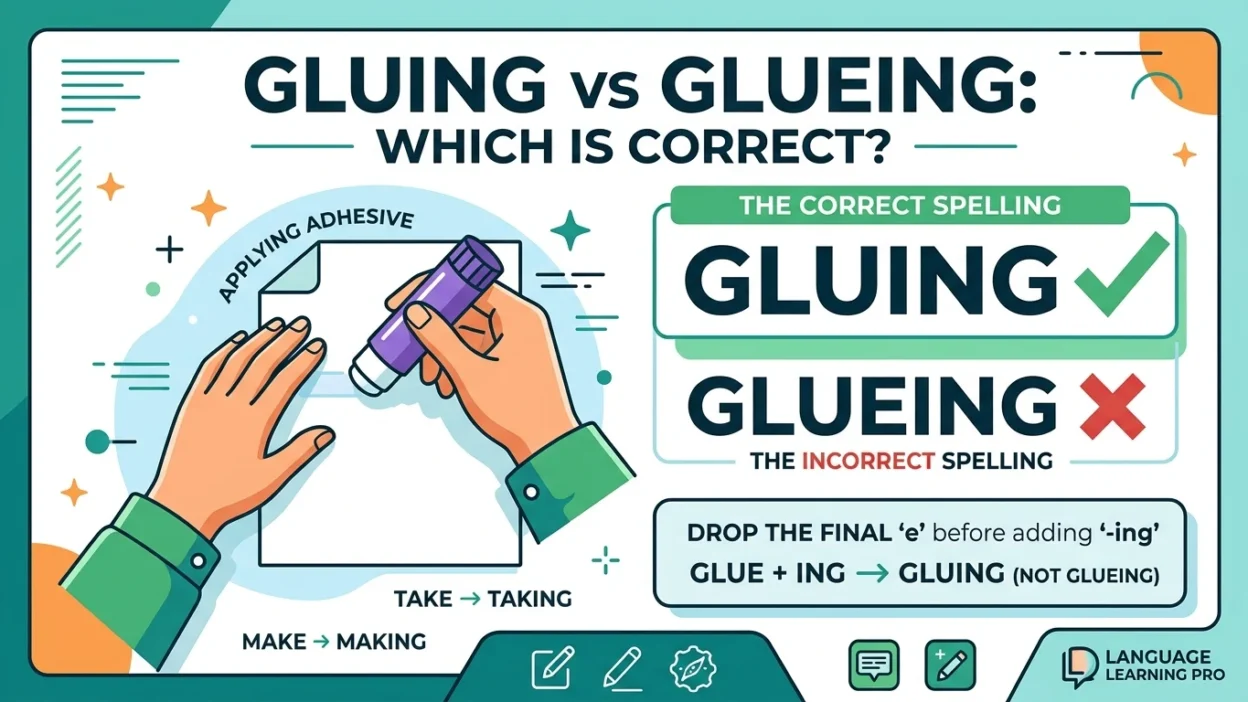
The correct and widely preferred form is gluing.
Gluing = correct and standard spelling ✅
Glueing = uncommon variant and generally best avoided ⚠️
The reason is that when glue takes the -ing ending, the final e is dropped:
glue + ing = gluing
Quick Answer
Gluing is the standard spelling in modern English.
She is gluing the pieces together.
Glueing is sometimes seen, but it is much less common and is generally not the preferred spelling.
So, if you’re writing an article, email, school assignment, or professional document, use gluing.
What Does “Gluing” Mean?
Gluing is the present participle or gerund form of the verb glue.
It means joining or attaching something to another surface using glue.
For example:
I am gluing the pieces together.
She spent the afternoon gluing pictures into her scrapbook.
He is gluing the broken parts back together.
The base verb is:
glue
The -ing form is:
gluing
What Does “Glueing” Mean?
Glueing is a spelling variant that can occasionally be found, but it is not the standard spelling most writers should use.
For example:
❌ She is glueing the pieces together.
The preferred form is:
✅ She is gluing the pieces together.
The spelling glueing can appear because people naturally think:
glue + ing = glueing
But English spelling rules do not always work by simply adding -ing to the unchanged base word.
Why Is “Gluing” Correct?
The spelling follows the usual rule for verbs ending in a silent e.
When many verbs ending in silent e take -ing, the final e is removed.
For example:
make → making
take → taking
write → writing
use → using
Similarly:
glue → gluing
The final e is removed before adding -ing.
Therefore:
glue + ing → gluing
Gluing vs Glueing: The Main Difference
| Spelling | Status | Example |
|---|---|---|
| Gluing | Standard and preferred | She is gluing the paper. |
| Glueing | Uncommon variant | She is glueing the paper. |
If you want the safest and most widely accepted spelling, choose gluing.
Is “Gluing” Correct?
Yes.
Gluing is the standard spelling.
Examples:
He is gluing the model together.
She was gluing the photographs to the page.
I enjoy gluing craft pieces together.
They are gluing the broken pieces back together.
Is “Glueing” Correct?
Glueing can be found as a variant spelling, but it is much less common than gluing.
For modern standard English, especially in formal or educational writing, gluing is the better choice.
So if you are unsure:
Use “gluing.”
Gluing in American and British English
Unlike many spelling differences between American and British English, gluing is generally preferred in both varieties.
American English
gluing ✅
British English
gluing ✅
Therefore, you do not normally need to switch between gluing and glueing based on whether you’re using American or British English.
Examples of “Gluing”
Here are some natural examples:
The children are gluing paper to cardboard.
She was gluing the broken vase back together.
He is gluing the labels onto the boxes.
We spent an hour gluing the pieces together.
The students practiced gluing different materials.
I am gluing the photograph into my notebook.
Gluing vs Glueing in a Sentence
Compare:
❌ I am glueing the pieces together.
✅ I am gluing the pieces together.
The second sentence uses the standard spelling.
Another example:
❌ She was glueing the paper to the cardboard.
✅ She was gluing the paper to the cardboard.
The Grammar Behind “Gluing”
Gluing can function as a present participle or gerund.
Present Progressive
She is gluing the pieces together.
Here, gluing forms the present progressive:
is + gluing
Past Progressive
She was gluing the pieces together.
Here:
was + gluing
Gerund
Gluing requires patience.
Here, gluing functions as a noun.
It refers to the activity of using glue.
Glue, Glued, Gluing
The main forms of the verb glue are:
Glue → Glued → Gluing
Examples:
I glue the pieces together.
I glued the pieces together yesterday.
I am gluing the pieces together now.
Notice that the spelling of gluing is different from simply adding -ing to the complete word.
Why Isn’t It “Glueing”?
The main reason is the standard spelling convention for words ending in a silent e.
With many such verbs, the e is dropped before -ing:
hope → hoping
move → moving
bake → baking
create → creating
And:
glue → gluing
So:
glue + ing = gluing
not:
glue + ing = glueing
Similar Examples
Understanding other verbs can make the rule easier to remember.
Make
make → making
Not:
❌ makeing
Take
take → taking
Not:
❌ takeing
Write
write → writing
Not:
❌ writeing
Use
use → using
Not:
❌ useing
Glue
glue → gluing
Not usually:
❌ glueing
A Note About “See” and “Agree”
Not every word ending in e behaves exactly the same way.
For example:
see → seeing
agree → agreeing
The e is retained in these forms because of the spelling and pronunciation patterns involved.
So it is better not to think of the rule as:
“Every word ending in e always drops e.”
Instead, remember that glue → gluing is the standard spelling.
Common Mistakes
Mistake 1: Writing “glueing”
A common spelling mistake is:
❌ glueing
Use:
✅ gluing
Mistake 2: Writing “glueing” because the pronunciation suggests it
English spelling is not always based directly on pronunciation.
Even though glueing might seem logical, the standard written form is:
gluing
Mistake 3: Confusing “gluing” with “glued”
These forms have different meanings.
She is gluing the pieces together.
The action is happening now.
She glued the pieces together.
The action happened in the past.
Gluing vs Glued
Gluing describes an ongoing action or activity.
He is gluing the model.
Glued is the simple past or past participle.
He glued the model yesterday.
You can also use glued as an adjective:
The pieces are glued together.
Gluing vs Glueing: Easy Memory Trick
Remember:
Glue + ing = gluing
Think of the word as:
GLU + ING
The final e disappears.
So whenever you are tempted to write glueing, remember:
Drop the e → gluing
Quick Comparison Table
| Word | Correct? | Example |
|---|---|---|
| Glue | ✅ | I will glue the pieces. |
| Glued | ✅ | I glued the pieces yesterday. |
| Gluing | ✅ | I am gluing the pieces now. |
| Glueing | ⚠️ Uncommon variant | Generally use gluing instead. |
Which One Should You Use?
If you’re writing in standard modern English, choose:
Gluing ✅
This is the safest choice for:
- School assignments
- Academic writing
- Websites
- Blog articles
- Business writing
- Emails
- Professional documents
- General communication
Although glueing may occasionally appear, gluing is much more familiar to modern readers.
Final Verdict
The correct and preferred spelling is:
Gluing ✅
The spelling:
Glueing ⚠️
is an uncommon variant and is generally best avoided in modern standard writing.
The reason is that glue normally drops its final e before the -ing ending:
glue + ing = gluing
So you should write:
She is gluing the pieces together.
not:
❌ She is glueing the pieces together.
The easiest rule to remember is:
Glue → Glued → Gluing
When in doubt, gluing is the right choice.
FAQs
Is it gluing or glueing?
Gluing is the standard and preferred spelling. Glueing is an uncommon variant.
Why is gluing spelled without an e?
The final e in glue is dropped before adding -ing:
glue → gluing
Is “glueing” grammatically correct?
Glueing can be found as a variant spelling, but gluing is the standard and much more common form.
Is gluing American or British English?
Gluing is commonly used in both American and British English.
What is the past tense of glue?
The past tense is glued.
She glued the pieces together.
What is the present participle of glue?
The present participle is gluing.
She is gluing the pieces together.
Is “I am gluing” correct?
Yes.
I am gluing the pieces together.
This is the correct present progressive form.
Is “I am glueing” correct?
It may be encountered as a variant, but I am gluing is the standard and preferred form.
What is the easiest way to remember gluing vs glueing?
Remember:
Glue + ing = gluing
Drop the final e and write gluing.
Conclusion
The difference between gluing vs glueing is primarily a matter of standard spelling and usage. Gluing is the correct and widely preferred modern form, while glueing is an uncommon variant.
The verb forms are:
Glue → Glued → Gluing
When glue takes the -ing ending, the final e is dropped.
Therefore:
She is gluing the paper to the cardboard. ✅
is the preferred form.
If you’re writing for school, work, a website, or any other formal setting, gluing is the spelling you should choose.

Nancy Lisa is a passionate writer and contributor at DrameyHut, focused on uncovering the deeper meanings behind dreams. She creates engaging and insightful content that helps readers interpret their dreams and understand their subconscious thoughts. Her work inspires self-reflection, clarity, and a stronger connection to inner emotions.