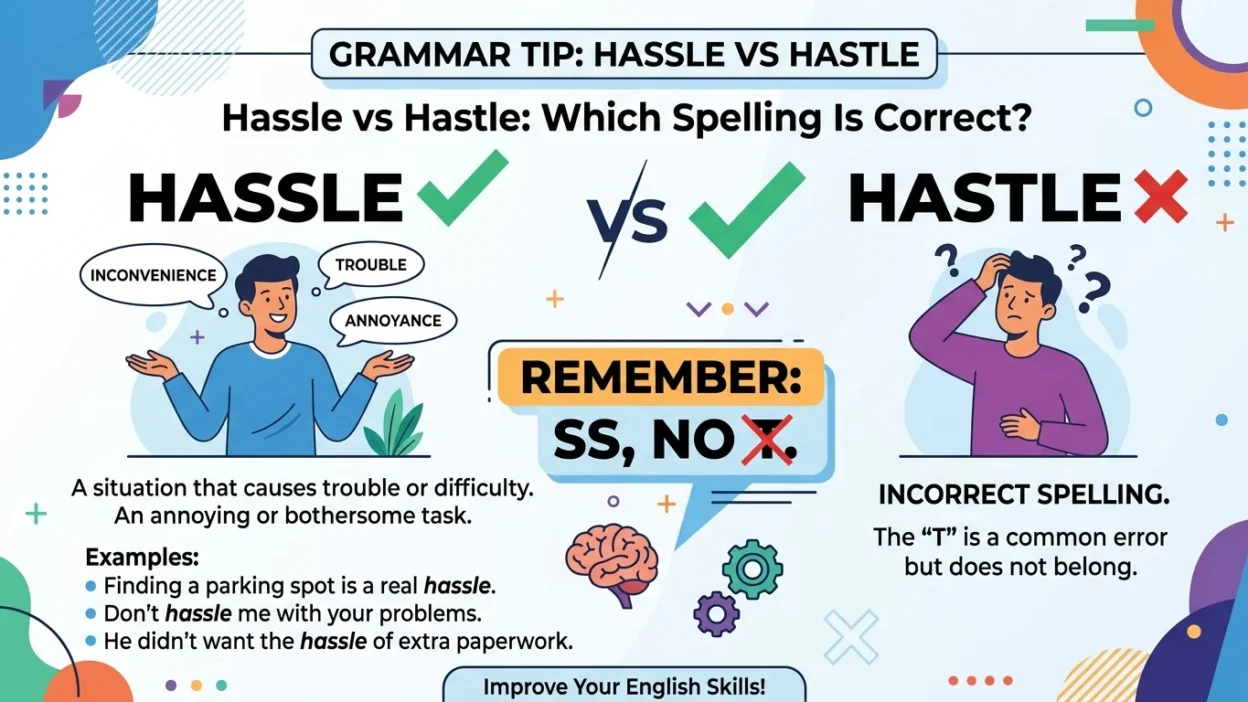
Hassle and hastle are commonly confused because they look almost identical. However, there is a clear difference between them:
Hassle = the correct standard spelling ✅
Hastle = a misspelling ❌
Hassle can be used as both a noun and a verb. It generally refers to trouble, inconvenience, annoyance, or a difficult situation.
For example:
Traveling during rush hour can be a hassle.
Don’t hassle me while I’m working.
If you’re wondering whether to write hassle or hastle, always choose hassle.
Quick Answer
Hassle ✅ = trouble, inconvenience, annoyance, or to bother someone
Hastle ❌ = incorrect spelling in standard English
Example
Getting a refund was such a hassle. ✅
Not:
Getting a refund was such a hastle. ❌
What Does “Hassle” Mean?
Hassle has several closely related meanings.
As a noun, it means trouble, inconvenience, difficulty, or an annoying situation.
Finding parking downtown is a hassle.
Moving to a new house can be a hassle.
I don’t want the hassle of returning the product.
As a verb, hassle means to annoy, bother, pressure, or repeatedly disturb someone.
Stop hassling me.
The salesperson kept hassling us.
Don’t hassle him while he’s working.
What Does “Hastle” Mean?
Hastle is not the standard spelling of the word meaning trouble or annoyance.
If you see:
❌ What a hastle!
the writer almost certainly means:
✅ What a hassle!
Similarly:
❌ Don’t hastle me.
should be:
✅ Don’t hassle me.
Hassle vs Hastle: Main Difference
| Word | Correct? | Meaning |
|---|---|---|
| Hassle | ✅ | Trouble, inconvenience, annoyance; to bother someone |
| Hastle | ❌ | Misspelling of hassle |
There is no standard English word hastle with the meaning of hassle.
Why Do People Spell Hassle as “Hastle”?
The mistake is understandable because hassle can sound as though it contains a t.
People may incorrectly pronounce or spell it as:
hastle
instead of:
hassle
But the correct spelling contains ss, not st:
ha + ssle = hassle
Remember:
HASSLE ✅
HASTLE ❌
Hassle as a Noun
When hassle is a noun, it refers to an annoying problem, inconvenience, or difficult situation.
Examples
Getting a visa can be a hassle.
Parking in the city is a real hassle.
I don’t want the hassle of changing hotels.
The paperwork was more hassle than it was worth.
Shopping online saves me a lot of hassle.
Hassle as a Verb
As a verb, hassle means to bother, annoy, pressure, or harass someone, usually repeatedly.
Examples:
Stop hassling me.
The reporters hassled the actor for an interview.
He kept hassling his brother.
Customers were hassled by aggressive salespeople.
The meaning depends on context, but the basic idea is unwanted pressure or annoyance.
“A Hassle” Meaning
The phrase a hassle means an inconvenience or annoying difficulty.
For example:
Traveling with too much luggage is a hassle.
Dealing with all this paperwork is a hassle.
Finding a parking space was a hassle.
In these sentences, hassle is a noun.
“Such a Hassle” Meaning
Such a hassle means very inconvenient, troublesome, or annoying.
Getting a refund is such a hassle.
Moving furniture is such a hassle.
Dealing with traffic is such a hassle.
This is a very common expression in informal English.
“What a Hassle!” Meaning
What a hassle! is an expression used when something is annoying or inconvenient.
I had to fill out five forms just to return the item. What a hassle!
It essentially means:
What an annoying or troublesome situation!
“No Hassle” Meaning
No hassle means without trouble, difficulty, or inconvenience.
For example:
You can cancel your subscription with no hassle.
We offer no-hassle returns.
The process was quick and hassle-free.
“Hassle-Free” Meaning
Hassle-free is a very common adjective meaning easy, convenient, and without unnecessary problems.
Examples:
We provide a hassle-free experience.
The return process is hassle-free.
Online banking makes payments hassle-free.
The standard spelling is:
hassle-free ✅
Hassle vs Trouble
Hassle and trouble can be synonyms in many contexts.
Getting a refund was a hassle.
Getting a refund was trouble.
However, hassle often emphasizes annoyance or inconvenience, while trouble has a broader meaning.
For example:
The broken car caused a lot of trouble.
The paperwork was a hassle.
Hassle vs Inconvenience
These words are also closely related.
Inconvenience is more formal:
We apologize for the inconvenience.
Hassle is more informal:
Sorry for the hassle.
So:
Hassle = informal
Inconvenience = more formal
Hassle vs Harass
These words can sometimes overlap, but they are not identical.
Hassle means to bother, annoy, or pressure someone.
The salesperson hassled me.
Harass generally suggests repeated unwanted behavior that causes distress or intimidation and can be more serious.
She was harassed at work.
Therefore, don’t automatically use the two words interchangeably.
Hassle vs Hastle Pronunciation
Hassle is generally pronounced approximately:
HAS-uhl
The word does not contain a pronounced t.
This may explain why some people mistakenly write hastle.
Remember:
Hassle → no t
Common Mistakes
Mistake 1: Writing “hastle”
❌ It was such a hastle.
✅ It was such a hassle.
Mistake 2: Writing “hastle free”
❌ We offer hastle free returns.
✅ We offer hassle free returns.
Mistake 3: Writing “hastling”
❌ Stop hastling me.
✅ Stop hassling me.
The correct forms are:
hassle → hassling
hassle → hassled
hassle → hassles
Hassle Verb Forms
The verb forms are:
hassle
hassles
hassled
hassling
Examples:
Don’t hassle me.
He hassles his coworkers.
They hassled me all day.
Stop hassling him.
Notice that hassling is spelled with ss:
hassling ✅
not:
❌ hastling
Hassle in Everyday English
Hassle is especially common in informal conversation.
You might hear:
That’s too much hassle.
I don’t need the hassle.
It’s not worth the hassle.
What a hassle!
No hassle.
Hassle-free.
These expressions are natural and widely understood.
“Not Worth the Hassle”
The phrase not worth the hassle means that something is not worth the trouble or inconvenience it would cause.
For example:
It’s only a small discount, so it’s not worth the hassle.
Returning the old furniture isn’t worth the hassle.
This is a very useful everyday expression.
“Don’t Need the Hassle”
Don’t need the hassle means that you don’t want to deal with an unnecessary problem or inconvenience.
I don’t need the hassle of changing flights.
We don’t need the hassle right now.
“More Trouble Than It’s Worth”
This expression has a similar meaning to not worth the hassle.
Fixing the old computer is more trouble than it’s worth.
Trying to get a refund is more trouble than it’s worth.
You could also say:
It’s not worth the hassle.
Easy Way to Remember Hassle vs Hastle
There is a very simple trick:
HASSLE has SS.
Think:
HASSLE = annoying situation
If you see a T in the middle:
HASTLE
you should recognize it as a spelling mistake.
Quick Comparison
| Expression | Correct? |
|---|---|
| Hassle | ✅ |
| Hastle | ❌ |
| Hassling | ✅ |
| Hastling | ❌ |
| Hassled | ✅ |
| Hastled | ❌ |
| Hassle free | ✅ |
| Hastle free | ❌ |
Final Verdict
The correct spelling is:
Hassle ✅
Hastle is a common misspelling and should not be used in standard English.
Hassle can be a noun meaning trouble, inconvenience, or annoyance:
Getting a refund was a hassle.
It can also be a verb meaning to bother, annoy, or pressure someone:
Stop hassling me.
Remember:
HASSLE = correct
HASTLE = incorrect
The easiest memory trick is:
Hassle has two S’s and no T.
FAQs
Is it hassle or hastle?
Hassle is the correct spelling. Hastle is a misspelling.
What does hassle mean?
Hassle means trouble, inconvenience, annoyance, or difficulty. As a verb, it can mean to bother or pressure someone.
Is hastle a word?
Hastle is not the standard spelling of the word hassle.
Is “such a hassle” correct?
Yes.
Getting a refund is such a hassle.
It means getting a refund is very inconvenient or annoying.
What does “no hassle” mean?
No hassle means without trouble, inconvenience, or difficulty.
The process was quick and involved no hassle.
What does “hassle-free” mean?
Hassle-free means easy, convenient, and without unnecessary problems.
We offer hassle-free returns.
Is “hassling” spelled with two s’s?
Yes.
Hassling ✅
The correct forms are hassle, hassled, hassling, and hassles.
What is the difference between hassle and trouble?
Both can mean a problem or difficulty, but hassle often emphasizes annoyance or inconvenience and is generally more informal.
What is the difference between hassle and harass?
Hassle means to bother or annoy someone, while harass generally describes repeated unwanted behavior and can imply more serious or distressing conduct.
Is hassle formal or informal?
Hassle is common in everyday and informal English. In formal writing, inconvenience or difficulty may sometimes be more appropriate.
Conclusion
Hassle vs hastle is an easy spelling choice once you know that hassle is the only standard form for the meaning of trouble, inconvenience, or annoyance.
Use:
Hassle ✅
Avoid:
Hastle ❌
For example:
Dealing with all this paperwork is such a hassle.
And when using the verb:
Stop hassling me.
The easiest way to remember the spelling is:
HASSLE has two S’s and no T.
So whenever you’re unsure, choose hassle.

Christopher Thomas is a passionate writer and dream researcher dedicated to exploring the meanings behind dreams. As an author at DrameyHut, he creates insightful and easy-to-understand interpretations that help readers connect with their subconscious mind. His work focuses on guiding individuals toward self-discovery, clarity, and a deeper understanding of their inner thoughts.