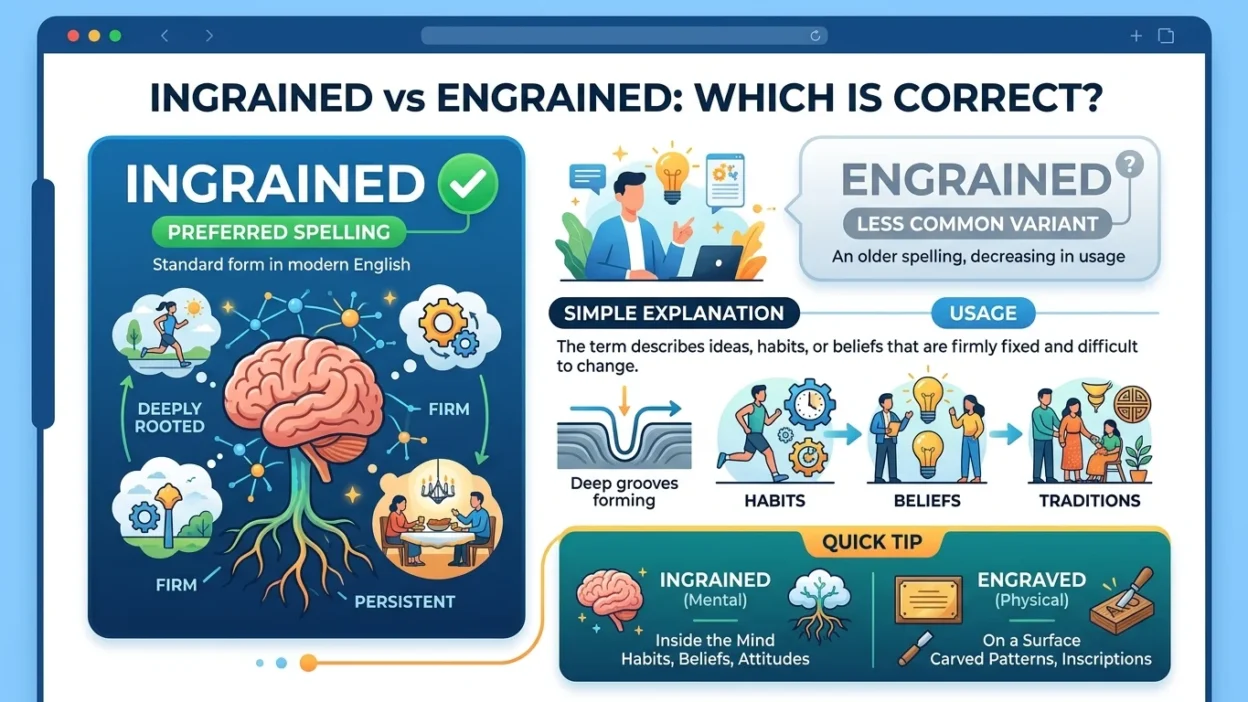
Ingrained and engrained are two words that are often confused because they look and sound very similar. Both can refer to something that is deeply established or firmly fixed, but ingrained is the standard and much more common spelling.
The simplest rule is:
Ingrained = standard and preferred ✅
Engrained = less common variant ⚠️
If you are writing for school, work, a website, or formal communication, ingrained is the safest choice.
Quick Answer
Ingrained means deeply established, firmly fixed, or difficult to change.
Her fear of failure is ingrained in her personality.
Engrained is sometimes used with the same meaning, but it is much less common. It is generally better to use ingrained in modern standard English.
Ingrained habits ✅
Ingrained beliefs ✅
Ingrained behavior ✅
What Does “Ingrained” Mean?
Ingrained is an adjective meaning deeply fixed or firmly established, especially as a habit, belief, attitude, behavior, or characteristic.
For example:
Honesty is ingrained in her character.
He has an ingrained habit of checking his phone.
These traditions are deeply ingrained in the culture.
The idea is that something has become so deeply established that changing it can be difficult.
What Does “Engrained” Mean?
Engrained is sometimes used as a variant of ingrained, particularly when people associate the word with grain or the idea of something being embedded in a material.
However, ingrained is the overwhelmingly more common spelling in contemporary English when referring to something deeply established.
For example, the preferred form is:
Deeply ingrained beliefs ✅
rather than:
Deeply engrained beliefs ⚠️
Ingrained vs Engrained: Main Difference
| Word | Meaning | Usage |
|---|---|---|
| Ingrained | Deeply established or firmly fixed | Standard and very common |
| Engrained | Usually used with the same meaning | Less common variant |
In most situations, there is no practical reason to choose engrained over ingrained.
Why Is “Ingrained” Preferred?
Ingrained comes from the idea of something becoming deeply fixed, historically associated with grain and dyeing material so that the color becomes difficult to remove.
Over time, the figurative meaning developed:
deeply fixed in someone’s mind, behavior, or character
For example:
The habit is ingrained.
This means the habit has become deeply established.
Ingrained Meaning in Simple English
You can think of ingrained as meaning:
- Deeply established
- Firmly fixed
- Deep-rooted
- Habitual
- Difficult to change
- Strongly established
For example:
Her ingrained habits are difficult to change.
This means her habits are so deeply established that changing them is difficult.
Examples of Ingrained
Here are some common examples:
The habit is deeply ingrained.
His ingrained fear of public speaking made presentations difficult.
These beliefs are ingrained in the culture.
Good manners were ingrained in him from childhood.
The company has an ingrained culture of innovation.
She has an ingrained tendency to worry.
The behavior became ingrained over many years.
Ingrained in a Sentence
Ingrained is frequently followed by in.
The tradition is deeply ingrained in the community.
This belief is ingrained in our culture.
The habit is ingrained in his personality.
Another common structure is:
ingrained + noun
For example:
ingrained habits
ingrained beliefs
ingrained attitudes
ingrained prejudice
ingrained behavior
Deeply Ingrained Meaning
The phrase deeply ingrained is extremely common.
It means that something is very firmly established and difficult to change.
For example:
She has a deeply ingrained fear of failure.
This means the fear has become a deeply established part of her thinking.
Other examples include:
deeply ingrained habits
deeply ingrained beliefs
deeply ingrained traditions
deeply ingrained attitudes
deeply ingrained behavior
Ingrained vs Deep-Rooted
Ingrained and deep-rooted are often similar.
His beliefs are deeply ingrained.
His beliefs are deep-rooted.
Both suggest that the beliefs are strongly established and difficult to change.
However, ingrained often emphasizes something becoming firmly established through repetition, experience, or conditioning.
Ingrained vs Embedded
These words can also overlap.
Ingrained usually describes something deeply established in a person’s mind, behavior, culture, or system.
The habit is ingrained in her behavior.
Embedded often emphasizes something being placed firmly within something else.
The image is embedded in the webpage.
Figuratively, however, embedded can also mean deeply established:
The tradition is embedded in the culture.
Ingrained vs Engraved
Don’t confuse ingrained with engraved.
Engraved means physically carved or cut into a surface.
Her name was engraved on the ring.
Ingrained usually means deeply established or fixed.
The habit was ingrained in his personality.
A useful distinction is:
Engraved = physically carved
Ingrained = deeply established
Is “Engrained” a Word?
Engrained can be found in dictionaries and published usage as a variant, but it is considerably less common than ingrained.
Therefore, if you are deciding which form to use, ingrained is the clear choice in most modern writing.
Is It “Deeply Ingrained” or “Deeply Engrained”?
The preferred expression is:
deeply ingrained ✅
For example:
The tradition is deeply ingrained in the community.
His fear is deeply ingrained.
These attitudes are deeply ingrained in society.
Deeply engrained can be encountered, but it is much less common.
Is It “Ingrained in” or “Ingrained Into”?
Both constructions can occur, but ingrained in is particularly common.
The belief is ingrained in the culture.
The habit is ingrained in his personality.
The phrase ingrained into can also be used, particularly when emphasizing a process:
The values were ingrained into the children from an early age.
However, ingrained in is often the more natural construction.
Common Mistakes
Mistake 1: Using “engrained” because it sounds like “engraved”
People sometimes write:
❌ deeply engrained beliefs
The preferred form is:
✅ deeply ingrained beliefs
Mistake 2: Confusing ingrained with engraved
Engraved = carved into a physical surface.
Ingrained = deeply established.
Mistake 3: Assuming ingrained only describes habits
Ingrained can describe many things, including:
- Habits
- Beliefs
- Values
- Attitudes
- Behaviors
- Traditions
- Fears
- Expectations
- Cultural practices
For example:
Ingrained cultural traditions
Ingrained social attitudes
Ingrained habits
Ingrained Habits
One of the most common uses of ingrained is with habits.
Checking his phone every few minutes has become an ingrained habit.
This means the behavior has become automatic or deeply established.
Another example:
Waking up early is an ingrained habit for her.
Ingrained Beliefs
Ingrained beliefs are beliefs that have become deeply established in someone’s thinking.
Some people have ingrained beliefs about success.
These ideas are deeply ingrained in the culture.
Changing an ingrained belief may require considerable time and reflection.
Ingrained Behavior
Ingrained behavior is behavior that has become deeply established.
His polite behavior is ingrained.
The organization has an ingrained way of doing things.
The word often suggests that changing the behavior would not be easy.
Ingrained in Culture
The phrase ingrained in the culture is very common.
The tradition is deeply ingrained in the culture.
This means the tradition is an established part of the culture.
You can also say:
The custom is deeply ingrained in society.
Ingrained vs Instilled
These words have related meanings but emphasize different things.
Instilled means that someone deliberately causes an idea, value, or quality to develop in another person.
Her parents instilled good manners in her.
Ingrained describes something that has become deeply established.
Good manners were ingrained in her.
So:
Instill = put an idea or quality into someone
Ingrain = make something deeply established
Ingrained vs Inherent
These words are also different.
Inherent means naturally existing as a permanent or essential characteristic.
Risk is inherent in the activity.
Ingrained means developed or established deeply over time.
The habit is ingrained.
So something can be inherent without having been learned or developed.
How to Remember Ingrained vs Engrained
The easiest rule is:
Use “ingrained” when you mean deeply established.
Think:
ingrained habits
ingrained beliefs
deeply ingrained traditions
ingrained behavior
If you are tempted to use engrained, ask whether you mean something is deeply established. If you do, ingrained is the safest choice.
Quick Comparison
| Expression | Preferred? |
|---|---|
| Deeply ingrained | ✅ |
| Ingrained habit | ✅ |
| Ingrained belief | ✅ |
| Ingrained behavior | ✅ |
| Ingrained in culture | ✅ |
| Deeply engrained | ⚠️ Less common |
| Engrained habit | ⚠️ Less common |
Final Verdict
Ingrained and engrained can both be encountered, but ingrained is the standard and much more common spelling when you mean deeply established, firmly fixed, or difficult to change.
For example:
Her fear of failure is deeply ingrained. ✅
These traditions are ingrained in the culture. ✅
Although engrained appears in some usage, it is generally better to choose ingrained in modern standard English.
The easiest rule to remember is:
Ingrained = deeply established
So when you’re writing about habits, beliefs, attitudes, behavior, traditions, or values, ingrained is almost always the better choice.
FAQs
Is ingrained or engrained correct?
Ingrained is the standard and much more common spelling. Engrained is sometimes used as a variant but is generally less preferred.
What does ingrained mean?
Ingrained means deeply established, firmly fixed, or difficult to change.
The habit is deeply ingrained.
Is “deeply ingrained” correct?
Yes. Deeply ingrained is a very common and natural expression.
His beliefs are deeply ingrained.
Is “deeply engrained” correct?
It can be found in English, but deeply ingrained is much more common and is the preferred form.
Is it ingrained in or ingrained into?
Ingrained in is very common.
The tradition is ingrained in the culture.
Ingrained into can also be used when emphasizing the process of establishing something deeply.
What is an ingrained habit?
An ingrained habit is a behavior that has become deeply established and often difficult to change.
What is the difference between ingrained and engraved?
Ingrained usually means deeply established in the mind, behavior, or culture. Engraved means physically carved or cut into a surface.
What is the difference between ingrained and instilled?
Instilled emphasizes deliberately developing an idea or quality in someone, while ingrained emphasizes that something has become deeply established.
Can beliefs be ingrained?
Yes.
Cultural beliefs can become deeply ingrained over time.
Can behavior be ingrained?
Yes. Ingrained behavior is behavior that has become deeply established or habitual.
Conclusion
The difference between ingrained vs engrained is mainly about standard usage and frequency.
When you mean deeply established, firmly fixed, or difficult to change, the preferred word is:
Ingrained ✅
For example:
The habit is deeply ingrained.
These traditions are ingrained in the culture.
She has deeply ingrained beliefs.
Engrained can be found as a variant, but it is much less common. In most modern writing, choosing ingrained will give you the clearest and most conventional result.
Easy rule:
Ingrained = deeply established

Nancy Lisa is a passionate writer and contributor at DrameyHut, focused on uncovering the deeper meanings behind dreams. She creates engaging and insightful content that helps readers interpret their dreams and understand their subconscious thoughts. Her work inspires self-reflection, clarity, and a stronger connection to inner emotions.