“Having” and “having had” can look very similar, but they perform different grammatical jobs. The main difference is time and sequence. “Having” usually describes something that is happening, existing, or being experienced in relation to another action, while “having had” shows that one experience or action happened before another past or present action.
For example, in “Having dinner, she watched TV,” the focus is on the activity of having dinner. In “Having had dinner, she watched TV,” the dinner was already finished before she watched TV. That small change from having to having had can therefore change the meaning of the whole sentence.
Understanding this distinction is especially useful when writing formal, academic, and professional English. Once you understand how the perfect participle works, “having had” becomes much easier to recognize and use correctly.
Quick Answer
Having is the present participle form of “have” and can describe an ongoing or related action or experience. Having had is the perfect participle and shows that the experience or action of “having” was completed before another action. Compare: “Having lunch, he called me” and “Having had lunch, he called me.”
Why People Confuse It
People often confuse “having” and “having had” because both begin with having and contain the verb “have.”
The difference becomes clearer when you look at the second word:
Having = having something or experiencing something
Having had = having already experienced or possessed something before another event
Consider these sentences:
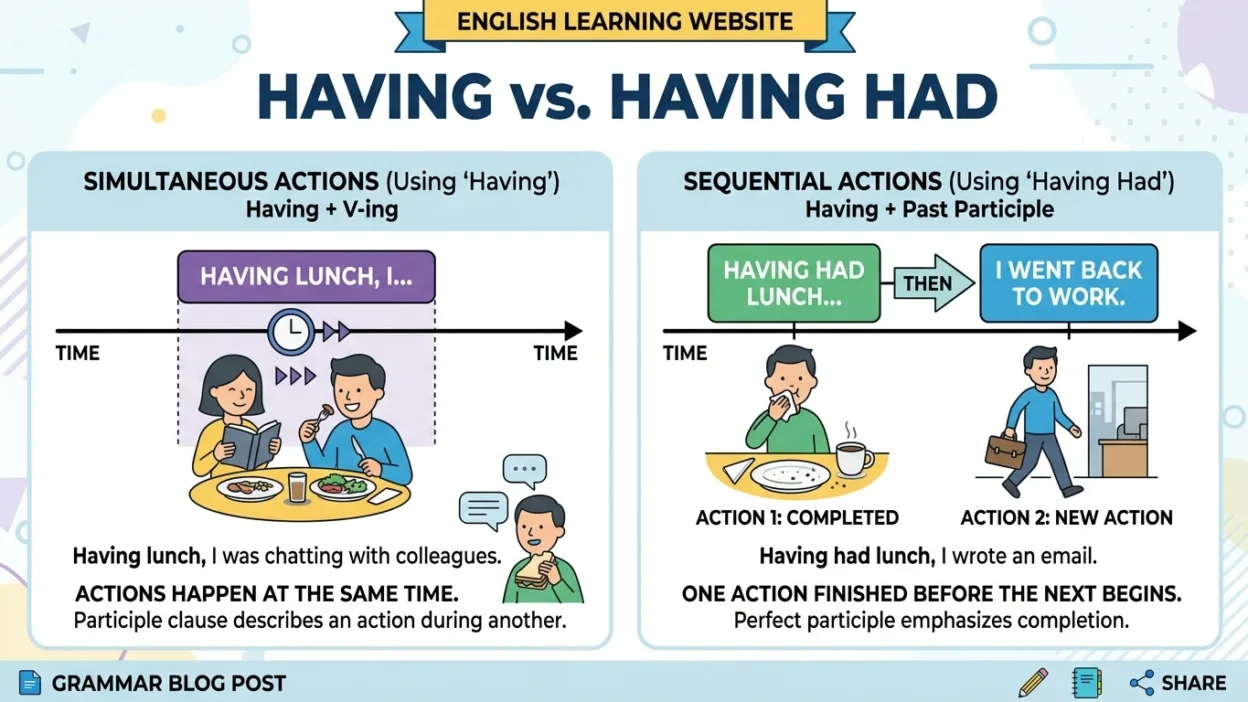
Having lunch, I answered the phone.
The sentence presents the two activities as related in time. The person was having lunch while answering the phone.
Now compare:
Having had lunch, I answered the phone.
Here, lunch happened first. After lunch was finished, the person answered the phone.
The word had creates the idea of an earlier completed action.
Having
Having is the present participle of have. It can appear in several grammatical structures.
It can describe an activity or experience:
I am having lunch.
Here, “having” is part of the present continuous tense.
It can also introduce a participial phrase:
Having lunch, I watched the news.
In this construction, “having lunch” is connected to the main action “watched.”
“Having” can also mean experiencing, possessing, or receiving something depending on the context.
Examples include:
She is having a difficult day.
We are having dinner at eight.
He is having trouble understanding the instructions.
They are having a meeting this afternoon.
Having + noun
“Having” is frequently followed by a noun.
Having breakfast early helps me concentrate.
She enjoys having coffee in the morning.
We are having a meeting tomorrow.
Having + object + past participle
“Having” can also appear in a causative structure.
She had difficulty having the documents translated.
Here, the exact meaning depends on the larger sentence.
Having Had
Having had is a perfect participle construction.
It is formed with:
having + past participle
Because the past participle of “have” is had, we get:
having had
This construction is used when an action or experience happened before another action.
For example:
Having had breakfast, she went to work.
The logical order is:
- She had breakfast.
- She finished breakfast.
- She went to work.
“Having had breakfast” makes that earlier sequence clear.
Another example:
Having had enough sleep, I felt much better.
The person first had enough sleep. After that, they felt better.
Having had does not mean “having” in the past tense
This is an important point.
“Having” is not simply the present version of “having had.”
Instead, having had emphasizes that the experience represented by “had” occurred before the main verb.
Compare:
Having dinner, she talked to her friend.
She was having dinner while talking.
Having had dinner, she talked to her friend.
She finished dinner before talking to her friend.
Having vs Having Had: Comparison Table
| Feature | Having | Having had |
|---|---|---|
| Basic form | having | having had |
| Grammatical idea | Present participle | Perfect participle |
| Main focus | An action or experience | An earlier completed action or experience |
| Time relationship | Often simultaneous or connected | Earlier than the main action |
| Example | Having lunch, he read the newspaper. | Having had lunch, he left the restaurant. |
| Meaning | He was having lunch while reading. | He finished lunch before leaving. |
| Common use | Ongoing or related activities | Completed action before another action |
When to Use Each
Use “having” for an activity happening at the same time
Use having when the action is ongoing or closely connected with the main action.
Having breakfast, she checked her emails.
This can suggest that she was eating breakfast while checking her emails.
Having a shower, he heard the phone ring.
The shower and hearing the phone are connected in time.
Use “having had” for an earlier completed action
Use having had when you want to show that one event happened before another.
Having had breakfast, she left for work.
First she had breakfast. Then she left.
Having had enough time to think, he made his decision.
First he had enough time to think. Then he made his decision.
Use “having had” when the sequence matters
If the order of events is important, “having had” can make that relationship especially clear.
Having had several years of experience, she applied for the senior position.
Her experience came before her application.
Having had no previous experience, he found the task difficult.
The lack of previous experience existed before he attempted the task.
Examples of Having
Here are some common examples of having:
- Having breakfast, I read the newspaper.
- She is having lunch with her colleagues.
- We are having a meeting this afternoon.
- He is having trouble with his computer.
- They enjoyed having dinner together.
- Having enough money is important when traveling.
- She was having a great time at the party.
- I dislike having to wait for long periods.
- Having regular breaks can improve concentration.
- He is having his car repaired today.
In these examples, “having” can describe an activity, experience, possession, requirement, or situation.
Examples of Having Had
Now consider examples where the earlier action is important:
- Having had breakfast, I left for work.
- Having had enough sleep, she felt energetic.
- Having had several opportunities, he decided to change careers.
- Having had dinner, they went for a walk.
- Having had no previous experience, she asked for help.
- Having had enough time to prepare, the team performed well.
- Having had a long conversation, they understood each other better.
- Having had several warnings, the employee knew the consequences.
- Having had a chance to review the document, I approved it.
- Having had enough of the argument, he walked away.
The general pattern is:
Having had + noun/object + main clause
For example:
Having had enough rest, she continued the journey.
Having vs Having Had in the Same Sentence
Putting the two forms side by side makes the difference easier to understand.
Example 1
Having lunch, John answered his emails.
John was eating lunch while answering emails.
Having had lunch, John answered his emails.
John finished lunch and then answered his emails.
Example 2
Having a shower, Maria heard someone knock.
The shower was in progress when she heard the knock.
Having had a shower, Maria went downstairs.
The shower was completed before she went downstairs.
Example 3
Having a car, he can travel easily.
He possesses or uses a car.
Having had a car for ten years, he knows a lot about maintenance.
His experience of owning a car began earlier and provides background for the main statement.
Common Mistakes
Mistake 1: Using “having” when you mean “after having”
Incorrect or unclear:
Having dinner, I went to bed.
This can suggest that you went to bed while eating dinner, although context may make the intended meaning obvious.
Clearer:
Having had dinner, I went to bed.
Or:
After having dinner, I went to bed.
Mistake 2: Thinking “having had” is redundant
Some learners think that using “having” and “had” together must be incorrect.
It is not.
Having had is a grammatically valid perfect participle construction.
Having had enough time to prepare, she felt confident.
The first “having” forms the perfect participle construction, while “had” is the past participle of “have.”
Mistake 3: Confusing “had” with the main verb
In:
Having had lunch, she left.
“Having had lunch” is a participial phrase. The main verb is left.
The phrase tells us what happened before she left.
Mistake 4: Using a dangling participle
The person performing the action in the participial phrase should normally be the same person who performs the main action.
Incorrect:
Having had breakfast, the bus arrived.
The sentence literally suggests that the bus had breakfast.
Better:
Having had breakfast, I boarded the bus.
Or:
After I had breakfast, the bus arrived.
Memory Trick
Use this simple rule:
Having = happening or existing
Having had = happened before
Think of had as a signal that the earlier experience is already completed.
Having dinner = eating dinner
Having had dinner = finished dinner already
A very easy memory sentence is:
Having lunch, I watched TV.
Both activities are connected in time.
Having had lunch, I watched TV.
Lunch came first.
Having Had vs After Having
These two structures often communicate a very similar idea.
Having had breakfast, she left.
After having breakfast, she left.
Both tell us that breakfast happened before she left.
The difference is mainly grammatical style.
Having had is a participial construction and can sound more concise or formal.
After having is more explicit and can be easier for learners to understand.
For example:
Having had enough time to prepare, the students began the exam.
After having enough time to prepare, the students began the exam.
Both are possible, although the first can sound more polished in formal writing.
Having Had vs Had
Do not confuse having had with simply had.
Compare:
I had breakfast before work.
This is a complete finite clause.
Having had breakfast, I went to work.
This is a participial phrase followed by a main clause.
The second structure emphasizes the relationship between the earlier action and the main action.
You can often rewrite:
Having had breakfast, I went to work.
as:
After I had had breakfast, I went to work.
The second sentence contains had had, which looks strange but is grammatically correct. The first “had” is the past perfect auxiliary, while the second “had” is the main verb.
American vs British English
There is essentially no major American versus British English difference in the grammar of “having” and “having had.”
Both forms are standard in American and British English.
For example:
Having had enough rest, she continued her journey.
This sentence is natural in both varieties.
British and American writers may differ in style preferences, but the underlying grammar is the same.
Similar Structures
Several structures are related to “having” and “having had.”
Having done
Having finished his work, he went home.
This means he finished his work before going home.
Having been
Having been warned, she was more careful.
She had received a warning before becoming more careful.
Having had
Having had enough rest, he continued the journey.
He had already experienced enough rest before continuing.
After having
After having finished the work, they went home.
This explicitly shows the earlier action.
After
After he finished the work, they went home.
This is often the clearest option when you want to avoid a participial construction.
Final Verdict
Having and having had are both correct, but they express different relationships between actions.
Use having when you are describing an activity, experience, possession, or situation that is ongoing or connected with another action.
Use having had when you want to show that something was already completed or experienced before the main action.
The easiest comparison is:
Having dinner, I watched TV.
I was having dinner while watching TV.
Having had dinner, I watched TV.
I finished dinner before watching TV.
So remember: having focuses on the activity or experience, while having had emphasizes that the experience happened earlier.
FAQs
Is “having had” grammatically correct?
Yes. “Having had” is a standard perfect participle construction. It is used to show that an action or experience happened before the main action.
What is the difference between “having” and “having had”?
“Having” usually presents an activity, experience, possession, or situation, while “having had” indicates that the experience or action was completed before another event.
Is “having had” past tense?
Not exactly. “Having had” is a perfect participle construction, not a simple past tense. It is used to express an earlier action in relation to another action.
Can I say “having had breakfast”?
Yes.
Having had breakfast, I went to work.
This means that you ate and finished breakfast before going to work.
Is “having had” formal?
It can sound somewhat formal, especially when used in participial phrases in written English. However, it is completely grammatical and can appear in both everyday and formal writing.
What is the difference between “having had” and “had had”?
“Having had” is a perfect participle phrase:
Having had breakfast, I left.
“Had had” is usually part of the past perfect tense:
I had had breakfast before I left.
Both can express an earlier experience, but their grammatical structures are different.
Can “having” and “having had” be used at the beginning of a sentence?
Yes.
Having a good plan, we felt confident.
Having had enough preparation, we felt confident.
The second sentence emphasizes that the preparation occurred before the main situation.
Conclusion
The difference between having and having had is mainly about how you present the relationship between actions. “Having” can describe an activity, experience, or situation, while “having had” shows that an experience or action was already completed before another event.
If you are unsure which one to use, ask yourself a simple question: Did the “having” action happen before the main action was completed? If yes, “having had” may be the better choice.
Once you recognize this time relationship, the construction becomes much easier. Instead of seeing “having had” as a strange combination of two forms of “have,” think of it as a useful grammatical structure for showing an earlier experience.
Remember This
Having = an activity, experience, or situation
Having had = an earlier completed experience or action
Having lunch, I watched TV = the activities are connected in time.
Having had lunch, I watched TV = lunch happened first.

Nancy Lisa is a passionate writer and contributor at DrameyHut, focused on uncovering the deeper meanings behind dreams. She creates engaging and insightful content that helps readers interpret their dreams and understand their subconscious thoughts. Her work inspires self-reflection, clarity, and a stronger connection to inner emotions.