
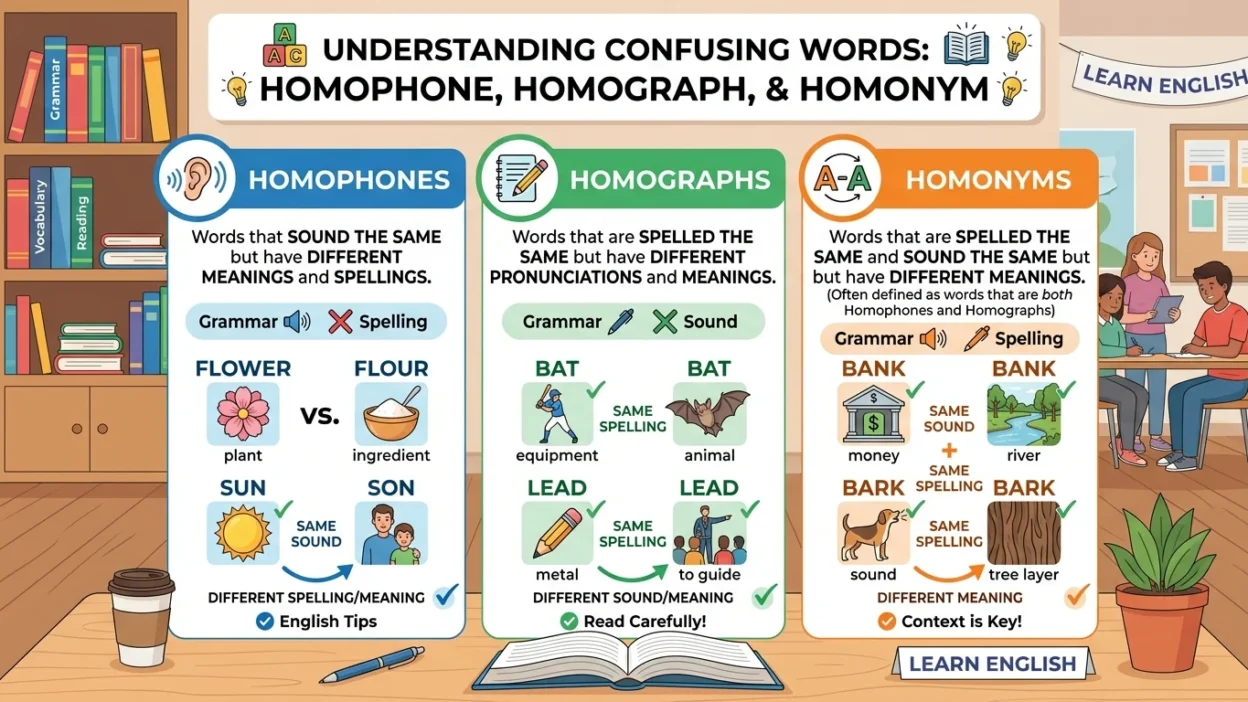
Many English learners struggle to understand the difference between homophone, homograph, and homonym because these grammar terms sound similar and are closely related.
While they all describe words that share either the same spelling, pronunciation, or both, each has a different meaning and use in English.
Knowing the difference between homophone vs homograph vs homonym will improve your vocabulary, spelling, pronunciation, and reading comprehension. This guide explains each term with simple definitions, comparison tables, examples, and memory tricks so you can easily tell them apart.
Quick Answer
A homophone is a word that sounds the same as another word but has a different meaning and often a different spelling. A homograph is a word that is spelled the same as another word but has a different meaning and sometimes a different pronunciation. A homonym is a broader term for words that have the same spelling or pronunciation but different meanings.
Why People Confuse Them
These three terms all begin with homo, a Greek word meaning same, so they look and sound alike.
The confusion also happens because some words belong to more than one category. For example, some homonyms are also homophones or homographs, making the distinctions seem unclear.
Homophone
A homophone is a word that has the same pronunciation as another word but a different meaning and usually a different spelling.
Meaning
Homophones sound alike but represent different words.
Examples
- Their and There
- Two and Too
- Flour and Flower
- Right and Write
- Sea and See
Homograph
A homograph is a word that has the same spelling as another word but a different meaning. Some homographs are pronounced differently.
Meaning
Homographs look the same in writing but may have different meanings and pronunciations.
Examples
- Lead (to guide) and Lead (a metal)
- Wind (moving air) and Wind (to twist)
- Tear (rip) and Tear (from the eye)
- Bass (fish) and Bass (low musical sound)
- Row (argument) and Row (a line)
Homonym
A homonym is a word that has the same spelling or pronunciation as another word but a different meaning.
It is a general term that includes many words classified as homophones or homographs.
Meaning
Homonyms share either the same spelling, the same pronunciation, or both.
Examples
- Bat (animal) and Bat (sports equipment)
- Bark (tree covering) and Bark (dog sound)
- Well (healthy) and Well (water source)
- Match (contest) and Match (for lighting a fire)
- Ring (jewellery) and Ring (telephone sound)
Comparison Table
| Feature | Homophone | Homograph | Homonym |
|---|---|---|---|
| Same pronunciation | ✅ Yes | Sometimes | Yes or sometimes |
| Same spelling | Usually No | ✅ Yes | Sometimes |
| Different meanings | ✅ Yes | ✅ Yes | ✅ Yes |
| Example | Two and Too | Lead and Lead | Bat and Bat |
When to Use Each
Use homophone when talking about words that sound alike.
Use homograph when discussing words that are spelled the same but have different meanings.
Use homonym when referring to words that share the same spelling or pronunciation but have different meanings.
Examples
- Their and there are homophones.
- Two and too are homophones.
- Sea and see are homophones.
- Lead (metal) and lead (guide) are homographs.
- Wind (air) and wind (twist) are homographs.
- Tear (rip) and tear (drop from the eye) are homographs.
- Bat (animal) and bat (sports equipment) are homonyms.
- Bark (tree) and bark (dog sound) are homonyms.
- Well (healthy) and well (water source) are homonyms.
- Match (contest) and match (fire starter) are homonyms.
- Right and write are homophones.
- Bass (fish) and bass (music) are homographs.
Common Mistakes
Many learners make these mistakes.
- Thinking homophones and homographs are the same.
- Calling every similar word a homonym.
- Confusing spelling with pronunciation.
- Forgetting that some words fit into more than one category.
Correct:
- Flower and flour are homophones.
Incorrect:
- Flower and flour are homographs.
Memory Trick
Remember these easy clues:
- Phone means sound, so homophones sound the same.
- Graph means writing, so homographs are written the same.
- Homonym is the umbrella term for words sharing the same spelling, pronunciation, or both.
American vs British English
There is no difference between American and British English in the definitions of homophone, homograph, and homonym.
The grammar terms and their meanings are the same in both varieties of English.
Similar Words
These language terms are also useful to know:
- Synonym
- Antonym
- Heteronym
- Polysemy
- Idiom
- Collocation
- Compound word
- Prefix
- Suffix
- Acronym
Final Verdict
Understanding homophone vs homograph vs homonym is easier when you focus on one key idea. Homophones sound the same, homographs are spelled the same, and homonyms are the broader category that includes words sharing the same spelling, pronunciation, or both while having different meanings.
Learning these terms will improve your spelling, pronunciation, reading, and overall English grammar skills.
Remember This
Phone = Sound → Homophone
Graph = Writing → Homograph
Homonym = General term for words with the same spelling, pronunciation, or both.
FAQs
What is a homophone?
A homophone is a word that sounds the same as another word but has a different meaning and often a different spelling.
What is a homograph?
A homograph is a word that is spelled the same as another word but has a different meaning and sometimes a different pronunciation.
What is a homonym?
A homonym is a word that shares the same spelling or pronunciation with another word but has a different meaning.
Is every homophone a homonym?
Generally, yes. Homophones are commonly treated as a type of homonym because they share the same pronunciation.
Are homographs always pronounced the same?
No. Some homographs have different pronunciations, such as lead and lead.
Which is easier to remember?
Think phone = sound and graph = writing. This simple trick helps you distinguish them quickly.
Why are homophones, homographs, and homonyms important?
They improve your spelling, pronunciation, reading comprehension, and vocabulary while helping you avoid common English mistakes.
Conclusion
Although homophone, homograph, and homonym sound similar, they describe different relationships between words.
Homophones share the same pronunciation, homographs share the same spelling, and homonyms serve as the broader category that covers words with the same spelling, pronunciation, or both but different meanings.
By remembering the simple connection between phone and sound, graph and writing, and homonym as the umbrella term, you’ll find it much easier to identify these words in everyday English. Mastering these concepts will strengthen both your grammar and communication skills.

Nancy Lisa is a passionate writer and contributor at DrameyHut, focused on uncovering the deeper meanings behind dreams. She creates engaging and insightful content that helps readers interpret their dreams and understand their subconscious thoughts. Her work inspires self-reflection, clarity, and a stronger connection to inner emotions.