Verbs that start with S are among the most commonly used action words in English. From everyday verbs like say, see, and sit to advanced verbs like substantiate and synchronize, these words help describe actions, thoughts, emotions, and processes.
If you’re improving your vocabulary, writing better essays, preparing for exams, or looking for strong action words, this list of verbs that start with S will help you expand your English skills with meanings and examples.
Quick Answer
Verbs that start with S are action or state words beginning with the letter S. Common examples include say, see, sell, send, smile, study, sleep, swim, sing, and support.
Why Learn Verbs That Start With S?
Learning more S verbs can help you:
- Improve your speaking and writing.
- Build a stronger vocabulary.
- Write more descriptive sentences.
- Perform better in school and competitive exams.
- Communicate more naturally in English.
Common Verbs That Start With S
Here are some of the most frequently used verbs beginning with S.
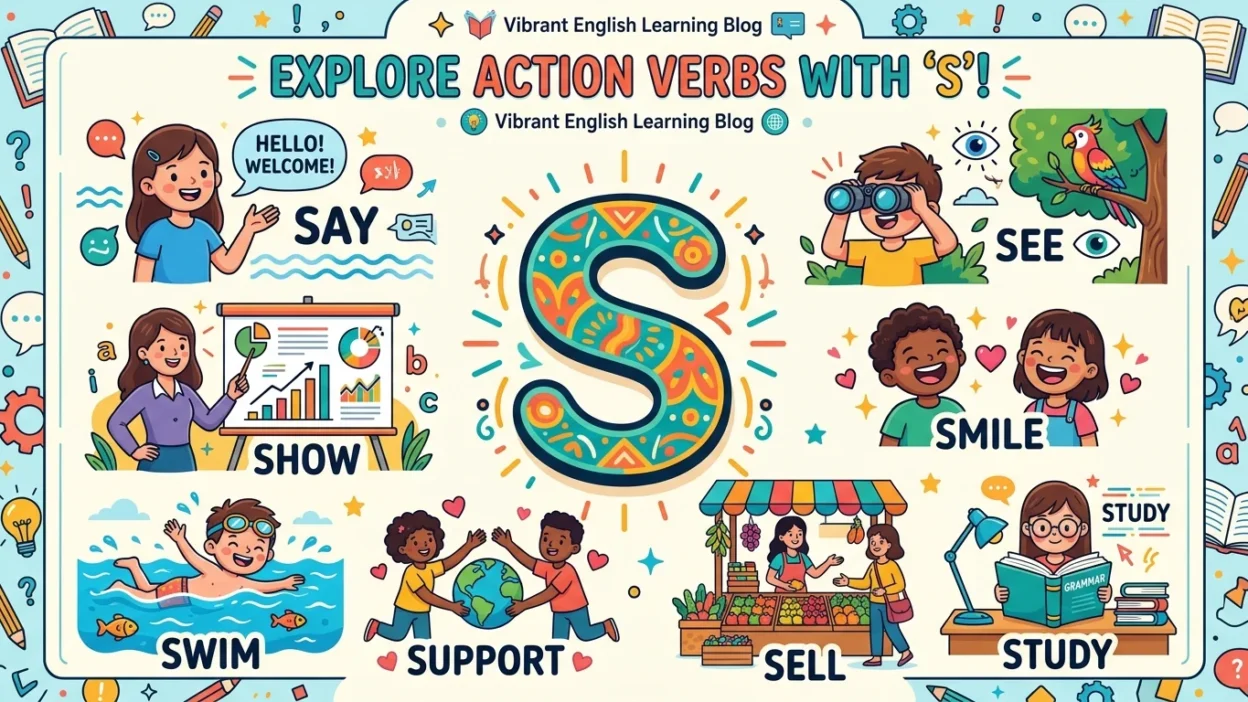
- Say
- See
- Sell
- Send
- Sit
- Stand
- Smile
- Speak
- Sleep
- Study
- Start
- Stop
- Show
- Sing
- Swim
- Save
- Serve
- Search
- Support
- Share
- Solve
- Spend
- Shine
- Shake
- Shoot
- Shut
- Skip
- Scream
- Scratch
- Sweep
Positive Verbs That Start With S
These verbs are useful for positive and encouraging writing.
- Smile
- Support
- Save
- Strengthen
- Succeed
- Share
- Shine
- Simplify
- Safeguard
- Sponsor
- Secure
- Soothe
- Sustain
- Spark
- Serve
Action Verbs That Start With S
These verbs describe physical or mental actions.
- Sprint
- Swing
- Swim
- Slice
- Stir
- Shake
- Skip
- Stretch
- Strike
- Search
- Scan
- Sew
- Scoop
- Scatter
- Spin
- Stack
- Slide
- Snap
- Sweep
- Sprint
Business Verbs That Start With S
Useful for professional and workplace communication.
- Sell
- Supply
- Ship
- Schedule
- Submit
- Sign
- Supervise
- Strategize
- Source
- Standardize
- Sponsor
- Strengthen
- Secure
- Simplify
- Scale
Advanced Verbs That Start With S
Expand your vocabulary with these higher-level verbs.
- Substantiate
- Synchronize
- Speculate
- Segregate
- Stimulate
- Summarize
- Synthesize
- Scrutinize
- Safeguard
- Stabilize
- Suppress
- Surpass
- Solidify
- Simplify
- Systematize
Comparison Table
| Verb | Meaning | Example Sentence |
|---|---|---|
| Say | To speak | Please say your name clearly. |
| See | To look at | I can see the mountains. |
| Sell | To exchange for money | They sell fresh fruit. |
| Smile | To show happiness | She smiled warmly. |
| Study | To learn | We study English daily. |
| Support | To help | Friends support each other. |
| Save | To keep safe | Save your work before closing. |
| Swim | To move through water | They swim every weekend. |
| Search | To look for | He searched for his keys. |
| Show | To display | Please show me the document. |
Examples in Sentences
- She said hello to everyone.
- We see the sunrise every morning.
- They sell handmade furniture.
- Please send me the details.
- He sat near the window.
- The children smiled happily.
- We study together every evening.
- Birds sing at dawn.
- They swam across the lake.
- She supports local charities.
- Please share your ideas.
- The teacher showed us a new method.
Common Mistakes
Many English learners make these mistakes when using S verbs.
- Confusing sit and set.
- Mixing say and tell.
- Using shown instead of showed in the simple past.
- Confusing sell with sale.
- Forgetting verb tense changes like sing → sang → sung.
Correct:
- She said thank you.
Incorrect:
- She told thank you.
Memory Trick
Remember this simple phrase:
S is for Speak, Smile, Study, and Succeed.
Learning a few new S verbs every day is an easy way to improve your English vocabulary.
American vs British English
Most verbs beginning with S are used the same way in American and British English.
However, spelling differences may appear in related forms, such as:
- Standardize (American English)
- Standardise (British English)
The verb meanings remain the same.
Similar Words
You may also want to learn:
- Action verbs
- Helping verbs
- Linking verbs
- Regular verbs
- Irregular verbs
- Phrasal verbs
- Strong verbs
- Dynamic verbs
- Transitive verbs
- Intransitive verbs
Final Verdict
Verbs that start with S are essential for everyday communication and advanced English writing. If you’re describing actions, expressing ideas, or improving your vocabulary, these verbs will make your sentences clearer and more engaging.
Practice using these words in conversations, writing exercises, and reading activities. The more often you use them, the more naturally they will become part of your English vocabulary.
Remember This
Learn these five everyday S verbs first:
- Say
- See
- Study
- Smile
- Support
Master these common verbs before moving on to advanced vocabulary.
FAQs
What are verbs that start with S?
They are action or state words that begin with the letter S, such as say, see, sell, and study.
What are the most common S verbs?
Some of the most common are say, see, show, sell, send, study, smile, sing, swim, and support.
What are positive verbs that start with S?
Examples include smile, support, save, succeed, strengthen, and shine.
Are there irregular verbs that start with S?
Yes. Examples include sing, speak, see, show, and swim.
Which S verbs are useful in business English?
Useful business verbs include sell, submit, schedule, supervise, sponsor, secure, and scale.
How can I remember S verbs easily?
Practice a few verbs every day and use them in your own sentences. Repetition is the best way to build vocabulary.
Conclusion
Building your vocabulary with verbs that start with S is a simple yet effective way to become a more confident English speaker and writer.
From basic verbs like say and see to advanced words like synchronize and substantiate, these verbs cover a wide range of everyday and professional situations.
The key to mastering new verbs is regular practice. Read them, write them in sentences, and use them in conversations. Over time, these S verbs will become a natural part of your English, helping you communicate with greater accuracy and confidence.

Christopher Thomas is a passionate writer and dream researcher dedicated to exploring the meanings behind dreams. As an author at DrameyHut, he creates insightful and easy-to-understand interpretations that help readers connect with their subconscious mind. His work focuses on guiding individuals toward self-discovery, clarity, and a deeper understanding of their inner thoughts.