
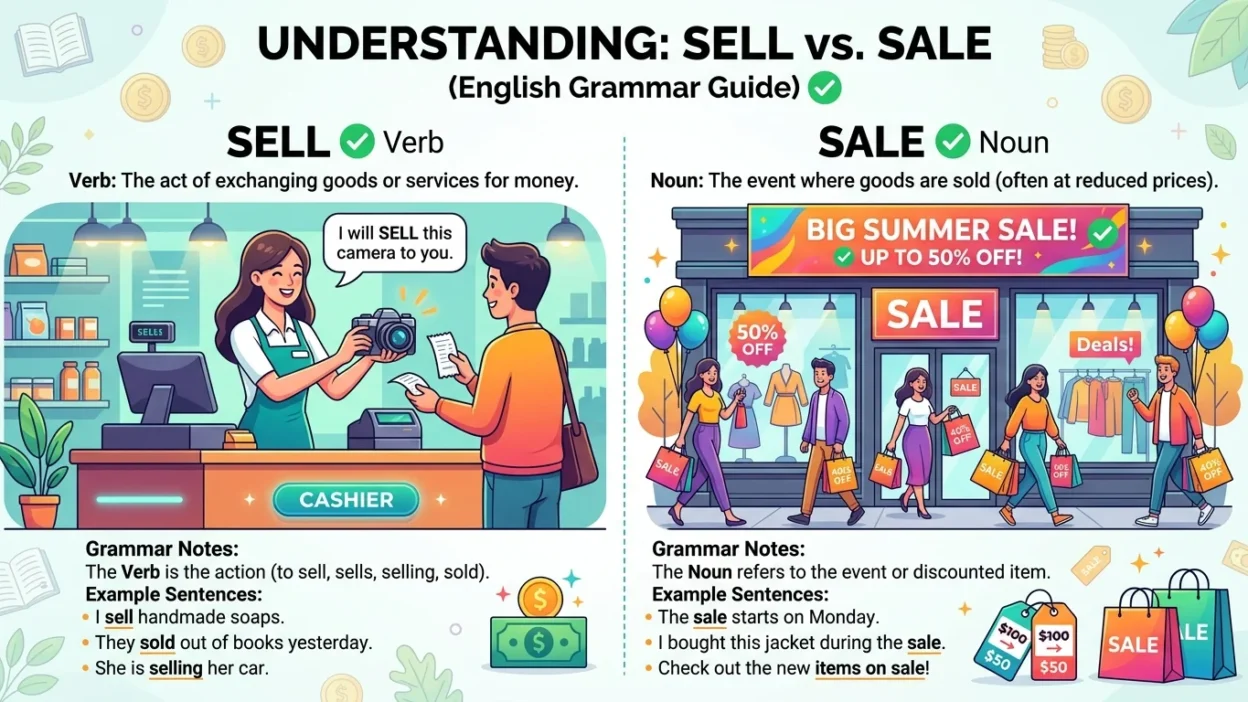
Many English learners confuse sell and sale because the words are closely related and often appear in shopping, business, and advertising. While they look similar and share the same root, they have different meanings and grammatical functions. Using the wrong one can make your writing sound unnatural or incorrect.
Understanding the difference between sell vs sale will help you communicate more confidently in everyday English. If you’re writing an email, creating a business advertisement, posting on social media, or simply talking about buying and selling, knowing when to use each word is essential.
This guide explains the difference with clear definitions, examples, and easy memory tricks.
Quick Answer
Sell is a verb that means to exchange something for money. Sale is a noun that refers to the act of selling or a period when items are offered at reduced prices. Use sell for actions and sale for things or events.
Why People Confuse It
The confusion happens because sell and sale have similar spellings and are related in meaning.
People often assume they can replace one with the other, but they belong to different parts of speech. Sell describes an action, while sale names an event or transaction.
Sell
Sell is a verb.
It means to give or exchange something for money.
Meaning
Sell refers to the action of offering goods or services in exchange for payment.
Examples
- I want to sell my old bicycle.
- They sell fresh vegetables every day.
- She plans to sell her car next month.
- The shop sells handmade gifts.
- We sell books online.
Sale
Sale is a noun.
It refers to the act of selling something or a special event where products are offered at lower prices.
Meaning
Sale means a transaction or a promotional event with discounted prices.
Examples
- The store is having a summer sale.
- The house is for sale.
- Laptop sales increased this year.
- The sale begins on Friday.
- We bought these shoes during the sale.
Comparison Table
| Feature | Sell | Sale |
|---|---|---|
| Part of speech | Verb | Noun |
| Describes an action | ✅ Yes | ❌ No |
| Refers to an event or transaction | ❌ No | ✅ Yes |
| Used with products or services | ✅ Yes | ✅ Yes |
| Example | I sell clothes. | The clothes are on sale. |
When to Use Each
Use sell when talking about the action of exchanging something for money.
Use sale when referring to:
- A discount event
- A business transaction
- Something available for purchase
- Commercial activity
- Marketing promotions
Examples
- I want to sell my old laptop.
- They sell handmade jewellery.
- She sells fresh flowers every morning.
- We sell our products worldwide.
- He decided to sell his motorcycle.
- The shop is having a huge sale.
- The jacket is on sale today.
- Their annual sale starts next week.
- The house is for sale.
- We found great bargains during the sale.
- Ticket sales have increased.
- The end-of-season sale attracted many customers.
Common Mistakes
Many learners make these errors.
- Saying I sale cars instead of I sell cars.
- Writing The shop is having a sell instead of The shop is having a sale.
- Confusing the verb with the noun.
- Using sale when an action is needed.
Correct:
- I sell handmade candles.
- The candles are on sale today.
Incorrect:
- I sale handmade candles.
- The candles are on sell today.
Memory Trick
Here’s an easy way to remember:
Sell = Action
Sale = Shopping event or transaction
If you can replace the word with offer or exchange, use sell.
If you’re talking about discounts or an event, use sale.
American vs British English
There is no difference between American and British English.
Both varieties use sell as the verb and sale as the noun with the same meanings and grammar rules.
Similar Words
These related words are commonly used with sell and sale:
- Buy
- Purchase
- Vendor
- Customer
- Retail
- Discount
- Bargain
- Market
- Price
- Commerce
Final Verdict
The difference between sell and sale is simple once you know their roles. Sell is a verb that describes the action of exchanging goods or services for money, while sale is a noun that refers to the transaction itself or a promotional event offering discounts.
Remembering this distinction will help you avoid common grammar mistakes and communicate more clearly in both spoken and written English.
Remember This
Sell = Verb = Action
Sale = Noun = Event or Transaction
Think:
I sell shoes. ✅
The shoes are on sale. ✅
FAQs
What is the difference between sell and sale?
Sell is a verb meaning to exchange something for money, while sale is a noun referring to the act of selling or a discount event.
Is sell a verb?
Yes. Sell is a verb.
Is sale a noun?
Yes. Sale is a noun.
Which is correct, I sell cars or I sale cars?
I sell cars is correct.
What does on sale mean?
It means an item is available at a reduced price or special discount.
Are sell and sale used the same way in British and American English?
Yes. Both varieties follow the same grammar rules.
How can I remember the difference?
Remember that sell is an action, while sale is an event or transaction.
Conclusion
Although sell and sale are closely connected, they have different grammatical roles. Sell is the action of exchanging goods or services for money, whereas sale refers to the event or transaction itself. Choosing the correct word makes your English clearer and more professional.
Whenever you’re unsure, ask yourself if you’re describing an action or a thing. If it’s an action, use sell. If it’s an event, transaction, or discount, use sale. With this simple rule, you’ll avoid one of the most common English vocabulary mistakes.

Daniel Charles is a dedicated author and dream interpretation enthusiast at DrameyHut. He specializes in analyzing dream symbols and meanings, offering clear and insightful content for readers. His work aims to help individuals understand their subconscious thoughts, gain clarity, and explore the deeper messages hidden within their dreams.