Many English learners get confused between shown and showed because both come from the verb show. Since they are closely related, it can be difficult to know which one to use in different sentences.
The confusion becomes even greater because both words are grammatically correct, but they serve different purposes.
Understanding the difference between shown vs showed will help you speak and write English more accurately. If you’re writing an email, school assignment, business document, or social media post, using the correct verb form makes your communication sound natural and professional.
This guide explains when to use showed and shown, with simple rules, examples, and memory tricks.
Quick Answer
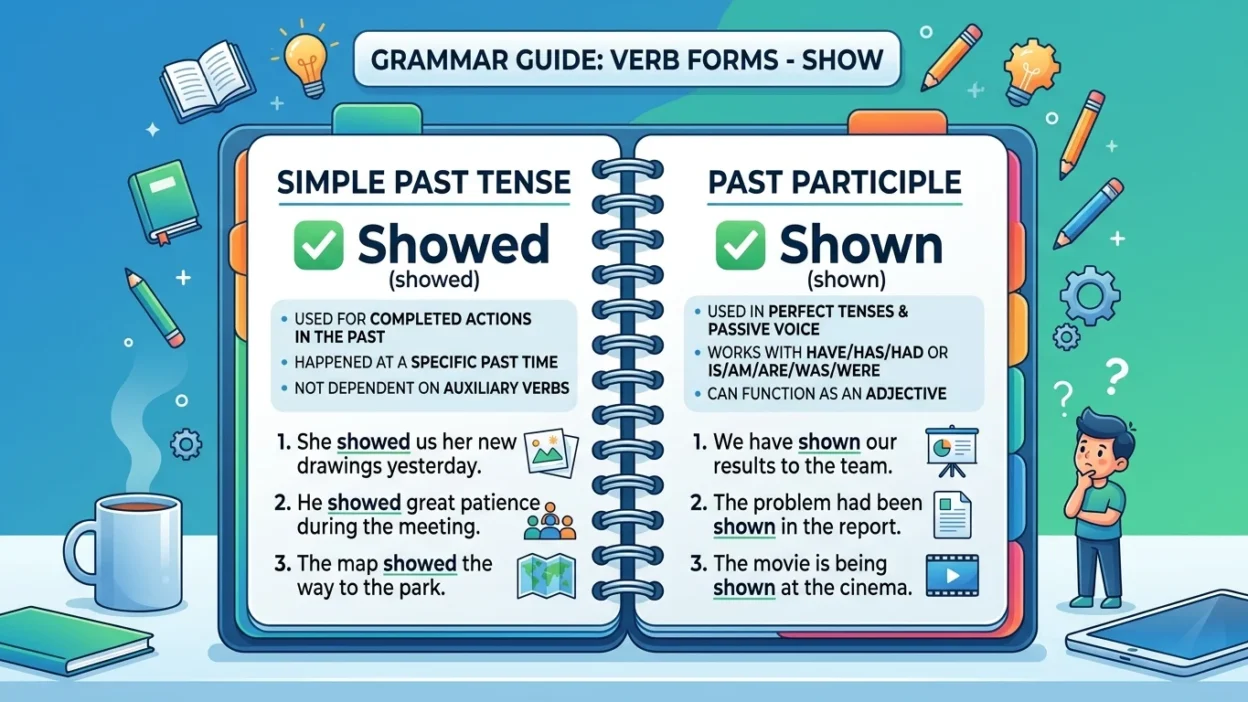
Both shown and showed are correct, but they are used differently. Showed is the simple past tense of show, while shown is the past participle and is usually used with helping verbs such as has, have, had, was, were, is, are, and been.
Why People Confuse It
The confusion happens because both words come from the same verb.
Many learners think they can replace one with the other, but English uses showed and shown in different grammatical structures. Knowing whether you need the simple past or the past participle makes choosing the correct word much easier.
Showed
Showed is the simple past tense of the verb show.
Use showed when talking about something that happened and finished in the past without a helping verb.
Meaning
Showed means displayed, presented, or revealed something in the past.
Examples
- She showed me her new phone.
- He showed us the way home.
- They showed great courage.
- I showed my passport at the airport.
- The teacher showed the class a video.
Shown
Shown is the past participle of show.
It is usually used with helping verbs such as has, have, had, was, were, is, are, or been.
Meaning
Shown describes something that has been displayed, presented, or revealed.
Examples
- She has shown remarkable progress.
- The results have been shown already.
- He had shown great patience.
- The film was shown yesterday.
- I have shown you the correct answer.
Comparison Table
| Feature | Showed | Shown |
|---|---|---|
| Correct English word | ✅ Yes | ✅ Yes |
| Simple past tense | ✅ Yes | ❌ No |
| Past participle | ❌ No | ✅ Yes |
| Used with helping verbs | ❌ Usually not | ✅ Yes |
| Common in passive voice | ❌ Rarely | ✅ Yes |
When to Use Each
Use showed when describing a completed action in the past.
Use shown when:
- Using has, have, or had
- Writing in the passive voice
- Using perfect tenses
- Using forms of be with the past participle
Examples
- She showed me her artwork yesterday.
- He showed everyone the new design.
- They showed kindness to the visitors.
- I showed my ticket at the entrance.
- The guide showed us around the museum.
- She has shown excellent leadership.
- I have shown you this before.
- The report was shown during the meeting.
- They had shown interest in the project.
- His work has been shown in many galleries.
- The results were shown on the screen.
- We have shown our appreciation.
Common Mistakes
Many learners make these errors.
- Saying I have showed instead of I have shown.
- Using shown without a helping verb.
- Mixing up the simple past and past participle.
Correct:
- I showed him the document yesterday.
- I have shown him the document.
Incorrect:
- I have showed him the document.
- I shown him the document yesterday.
Memory Trick
Remember this easy rule:
Showed works alone. Shown needs a helper.
If you see words like has, have, had, or been, choose shown.
If there is no helping verb and the action happened in the past, choose showed.
American vs British English
There is no difference between American and British English.
Both varieties use showed as the simple past tense and shown as the past participle.
The grammar rules are exactly the same.
Similar Words
These verbs follow a similar pattern:
- Write → Wrote → Written
- Break → Broke → Broken
- Choose → Chose → Chosen
- Speak → Spoke → Spoken
- Drive → Drove → Driven
- Give → Gave → Given
- Take → Took → Taken
- Show → Showed → Shown
Final Verdict
Both showed and shown are correct, but they are not interchangeable. Showed is used as the simple past tense, while shown is the past participle used with helping verbs and in passive constructions.
Learning this difference will make your grammar stronger and help you write more confidently in both formal and everyday English.
Remember This
Use showed for the simple past.
Use shown after has, have, had, is, are, was, were, or been.
Think:
Yesterday I showed it. ✅
I have shown it already. ✅
FAQs
Is showed correct?
Yes. Showed is the correct simple past tense of show.
Is shown correct?
Yes. Shown is the correct past participle of show.
Which is correct, I have showed or I have shown?
I have shown is correct.
Can I use shown without has or have?
Generally, shown should be used with a helping verb such as has, have, had, or a form of be.
Is showed used in British English?
Yes. British English and American English use showed in the same way.
Why do people confuse shown and showed?
Because both come from the verb show, but they have different grammatical functions.
What is the past participle of show?
The past participle of show is shown.
Conclusion
The difference between shown vs showed becomes simple once you understand verb forms. Use showed when talking about a completed action in the past without a helping verb, and use shown after helping verbs or in passive sentences.
By remembering that shown needs a helper, you can avoid one of the most common English grammar mistakes. Practising these forms in everyday writing will help you use them naturally and confidently.

Daniel Charles is a dedicated author and dream interpretation enthusiast at DrameyHut. He specializes in analyzing dream symbols and meanings, offering clear and insightful content for readers. His work aims to help individuals understand their subconscious thoughts, gain clarity, and explore the deeper messages hidden within their dreams.