
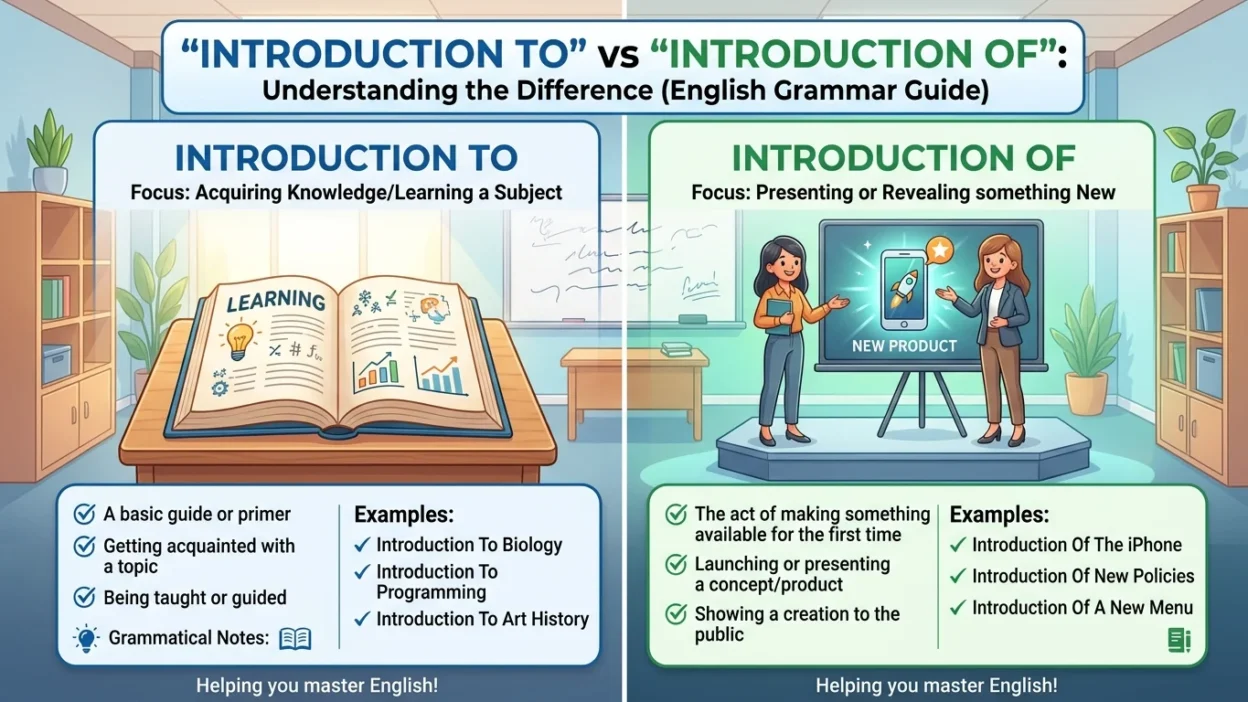
Many English learners confuse introduction to and introduction of because both phrases use the word introduction. However, they have different meanings and are used in different situations. Choosing the wrong one can make your sentence sound unnatural or even change its meaning.
Understanding the difference between introduction to vs introduction of will help you write and speak more confidently. This guide explains the meanings, correct usage, examples, common mistakes, and an easy memory trick.
Quick Answer
Introduction to is used when referring to something that begins learning about a subject or meeting someone. Introduction of is used when referring to the act of bringing, presenting, or inserting something new.
Why People Confuse It
The confusion happens because both expressions include the noun introduction.
The key difference is that to points toward what someone is being introduced to, while of refers to the thing being introduced.
Introduction To
Introduction to is the more common expression.
Meaning
It is used for:
- Learning a subject.
- Becoming familiar with something.
- Introducing one person to another.
Examples
- This book is an introduction to psychology.
- The course offers an introduction to programming.
- She gave me an introduction to her colleagues.
- This lesson is an introduction to photography.
- It serves as an introduction to the topic.
Introduction Of
Introduction of refers to bringing, presenting, or adding something.
Meaning
It is used for:
- Presenting a new product.
- Bringing in a new rule or system.
- Adding something for the first time.
Examples
- The introduction of electric cars changed the industry.
- The company announced the introduction of a new product.
- The introduction of new laws improved safety.
- Scientists welcomed the introduction of new technology.
- The introduction of online learning transformed education.
Comparison Table
| Feature | Introduction To | Introduction Of |
|---|---|---|
| Refers to learning a subject | ✅ Yes | ❌ No |
| Refers to meeting someone | ✅ Yes | ❌ No |
| Refers to presenting something new | ❌ No | ✅ Yes |
| Common in book titles | ✅ Yes | Sometimes |
| Used for new products or policies | ❌ No | ✅ Yes |
When to Use Each
Use introduction to when:
- Learning about a topic.
- Beginning a course.
- Meeting someone for the first time.
Use introduction of when:
- Launching a product.
- Implementing a policy.
- Bringing in a new idea, law, or technology.
Examples
- This is an introduction to economics.
- The course provides an introduction to coding.
- She gave me an introduction to the team.
- The book is an excellent introduction to biology.
- It was my first introduction to classical music.
- The introduction of smartphones changed communication.
- The introduction of stricter rules reduced accidents.
- The company celebrated the introduction of its latest model.
- The introduction of digital payments increased convenience.
- The government approved the introduction of new reforms.
- The workshop serves as an introduction to graphic design.
- The introduction of renewable energy has transformed the industry.
Common Mistakes
Many learners make these errors.
- Saying introduction of English instead of introduction to English when referring to a course.
- Using introduction to for new products or policies.
- Confusing learning with introducing something new.
Correct:
- An introduction to chemistry.
- The introduction of a new law.
Incorrect:
- An introduction of chemistry course.
- The introduction to a new policy.
Memory Trick
Remember this simple rule:
To = Learn or meet.
Of = Bring in something new.
If you’re learning about something, choose to.
If something new is being added or presented, choose of.
American vs British English
There is no significant difference between American and British English.
Both varieties use introduction to and introduction of in the same way.
Similar Words
You may also confuse these expressions:
- Introduction vs Overview
- Introduction vs Preface
- Introduce to vs Introduce into
- Launch vs Introduction
- Beginning vs Introduction
- Guide to vs Introduction to
- Addition of vs Introduction of
- Presentation of vs Introduction of
- Overview of vs Introduction to
- Explanation of vs Introduction to
Final Verdict
The difference between introduction to and introduction of is easy to remember once you know the purpose of each phrase. Introduction to is used for learning about a subject or meeting someone, while introduction of refers to bringing, presenting, or adding something new.
Choosing the correct phrase will make your English more natural and grammatically accurate.
Remember This
Introduction to = Learning or becoming familiar with something. ✅
Introduction of = Bringing in something new. ✅
Think:
An introduction to biology.
The introduction of a new policy.
FAQs
What is the difference between introduction to and introduction of?
Introduction to refers to learning about or becoming familiar with something, while Introduction of refers to bringing or presenting something new.
Which is correct, introduction to or introduction of?
Both are correct, but they are used in different contexts.
Is “Introduction to English” correct?
Yes. It refers to a course or guide that teaches the basics of English.
Is “Introduction of a new product” correct?
Yes. It refers to launching or presenting a new product.
Can I say “introduction of mathematics”?
Not when referring to a textbook or course. Use introduction to mathematics instead.
Do British and American English use these phrases differently?
No. Both varieties follow the same usage rules.
What is another way to say introduction to?
Depending on the context, you can use beginner’s guide to, overview of, basics of, or foundation in.
Conclusion
Although introduction to and introduction of look similar, they serve different purposes. Introduction to is used when someone is learning about a subject, becoming familiar with a topic, or meeting a person. Introduction of is used when something new is brought in, launched, or presented.
By remembering To = Learn and Of = Introduce something new, you’ll choose the correct expression with confidence and make your English sound more natural.

Nancy Lisa is a passionate writer and contributor at DrameyHut, focused on uncovering the deeper meanings behind dreams. She creates engaging and insightful content that helps readers interpret their dreams and understand their subconscious thoughts. Her work inspires self-reflection, clarity, and a stronger connection to inner emotions.