“Never nor” can be confusing because both words are associated with negative ideas. However, they can appear together in a grammatically correct sentence when they perform different jobs. The key is understanding how never and nor work in negative constructions.
Never means “at no time” or “not ever,” while nor is a conjunction used to introduce another negative idea. For example, in the sentence “I have never seen nor heard anything like it,” never makes the first verb phrase negative, while nor connects the second negative idea.
However, you should not automatically put “nor” after every use of “never.” In many situations, or, and, or a different sentence structure is more natural. This guide explains when “never nor” is correct, when it sounds awkward, how to use never … nor properly, and how it differs from neither … nor.
Quick Answer
Yes, never and nor can be used together when never creates the negative meaning and nor introduces another related negative idea. For example, “I have never seen nor heard such a thing.” However, never nor is not a fixed grammatical expression, and the correct structure depends on the sentence.
What Does “Never” Mean?
Never is an adverb meaning at no time, not ever, or on no occasion.
Examples:
I have never been to Canada.
She never complains.
He has never seen snow.
We never discussed the matter.
Never already gives the sentence a negative meaning.
Because of this, you generally do not need another negative word to make the same verb negative.
What Does “Nor” Mean?
Nor is a conjunction and sometimes an adverb used to introduce another negative statement or idea.
It is often associated with neither:
Neither John nor Mary came.
It can also follow another negative statement:
I didn’t call him, nor did I send him a message.
Here, nor means something like and also not.
Can “Never” and “Nor” Be Used Together?
Yes.
A common structure is:
never + verb + nor + verb
For example:
I have never seen nor heard anything like it.
The meaning is:
I have never seen anything like it, and I have never heard anything like it.
Another example:
She never complained nor asked for help.
This means she did not complain and did not ask for help.
In these examples, never supplies the negative meaning, while nor connects the additional negative action.
Is “Never Nor” Grammatically Correct?
It can be grammatically correct, but “never nor” is not a fixed expression.
The correctness depends on how the words are used in the complete sentence.
For example:
I have never seen nor heard anything like this.
This is grammatical.
But a sentence such as:
I never nor went there.
is incorrect.
The problem is that nor cannot simply be placed after never without a grammatical connection to another negative idea.
Think about the complete structure rather than the two words alone.
Never … Nor With Two Verbs
One common construction uses never with two coordinated verbs.
For example:
I never smoke nor drink.
This means:
I never smoke and I never drink.
Another example:
She never complains nor asks for help.
This means that she does neither of those things.
The pattern is:
Subject + never + verb 1 + nor + verb 2
Examples:
He never lies nor cheats.
They never argue nor complain.
She never calls nor writes.
We never eat meat nor fish.
This construction is possible, although in some contexts modern speakers may prefer or or a more explicit negative structure.
Never + Nor vs Never + Or
This is where usage becomes interesting.
Consider:
I never smoke or drink.
This is extremely natural in modern English.
You can also find:
I never smoke nor drink.
This is grammatical, but it can sound more formal, literary, emphatic, or old fashioned depending on the context.
Therefore, or is often the more natural choice after never in everyday English.
Compare
Natural everyday English:
I never smoke or drink.
Grammatical but more formal or emphatic:
I never smoke nor drink.
Both can express the idea that the person does neither activity.
Never … Nor for Emphasis
Nor can be useful when you want to emphasize that a second negative action or situation is also true.
For example:
He never apologized, nor did he explain what happened.
The second clause receives special emphasis.
Another example:
She had never traveled abroad, nor had she ever considered it.
Here, nor connects a second negative statement and makes the relationship between the two ideas clear.
Never, Nor Did…
One especially important structure is:
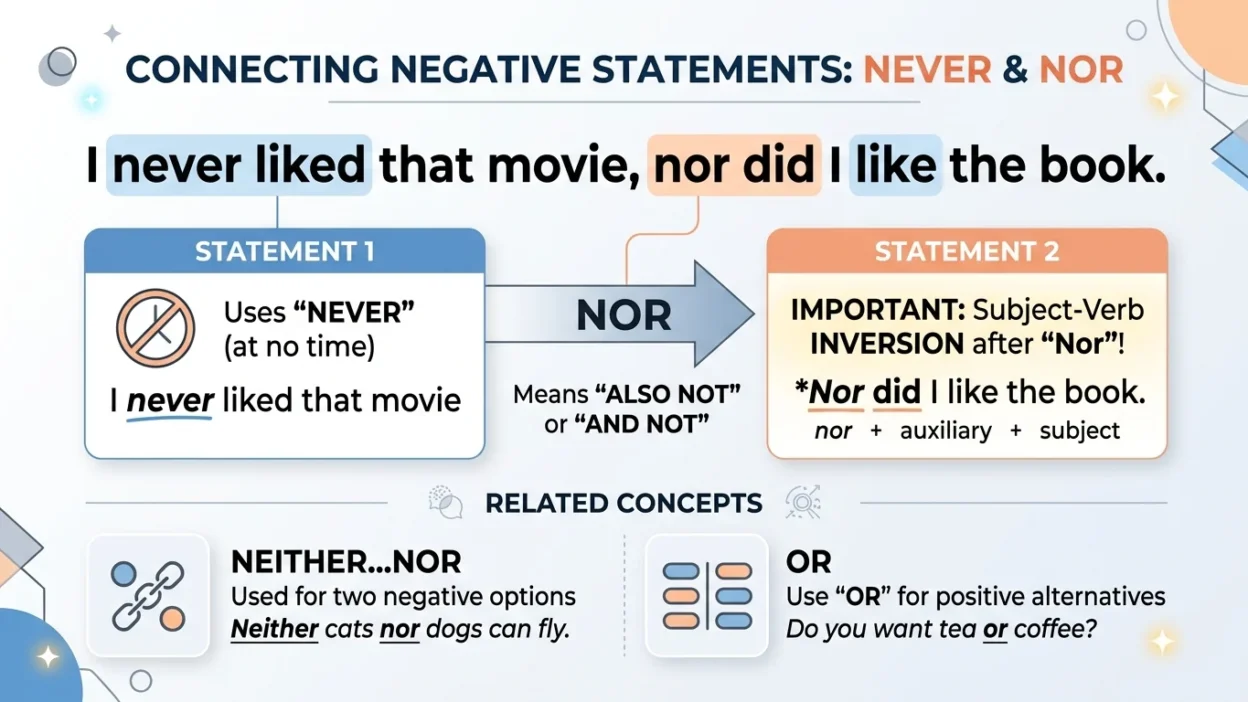
Negative statement, nor + auxiliary verb + subject
For example:
I never complained, nor did I ask for special treatment.
Notice the word order:
nor did I ask
not:
nor I did ask
This is called subject auxiliary inversion.
More examples:
She never called me, nor did she send a message.
He never apologized, nor did he explain himself.
They never visited us, nor did they invite us over.
I have never seen the movie, nor have I read the book.
This structure is common in formal and careful writing.
Why Does “Nor” Cause Inversion?
When nor introduces an additional negative clause, especially after a preceding negative statement, English commonly uses auxiliary inversion.
Compare:
I never complained, nor did I ask for help.
The second clause has:
did + subject + base verb
So:
nor did I ask
not:
nor I asked
With the present perfect:
I have never seen it, nor have I heard about it.
With the modal can:
She cannot swim, nor can she drive.
With will:
He will not apologize, nor will he admit his mistake.
Never Nor vs Neither Nor
These structures are related but not identical.
Neither … Nor
Neither … nor means that two things are both excluded.
Neither John nor Sarah attended the meeting.
The structure is:
neither + option 1 + nor + option 2
Never … Nor
Never … nor uses never to describe an action or occurrence that has not happened and nor to introduce another negative action or statement.
I have never seen nor heard anything like it.
The structure is different.
Simple Rule
Neither … nor = two nouns, choices, or alternatives
Never … nor = negative action or statement + another negative idea
Never Nor Examples
Here are more examples showing correct usage:
- I have never seen nor heard anything like this.
- She never called nor sent a message.
- He never apologized, nor did he explain himself.
- We never complained, nor did we ask for compensation.
- They never visited us, nor did they invite us to their home.
- I have never experienced nor witnessed anything so strange.
- She never smiled nor laughed during the meeting.
- He has never traveled abroad, nor has he expressed interest in doing so.
- I never promised nor suggested that I would help.
- The company never admitted responsibility, nor did it offer an explanation.
- She had never seen the ocean, nor had she ever imagined how large it was.
- He never complained about the work, nor did he ask for special treatment.
Common Mistakes With Never and Nor
1. Using “Nor” Without a Connection
Incorrect:
I never nor went there.
Correct:
I never went there.
Or:
I never went there, nor did I plan to go.
2. Using “Nor” Like “Or” Everywhere
Nor is not simply a formal replacement for or.
Incorrect:
Do you want tea nor coffee?
Correct:
Do you want tea or coffee?
Use nor in appropriate negative constructions.
3. Forgetting Inversion After “Nor”
Incorrect:
I never complained, nor I asked for help.
Correct:
I never complained, nor did I ask for help.
4. Confusing “Never Nor” With “Neither Nor”
These are different constructions.
Correct:
I never smoke or drink.
Correct:
I neither smoke nor drink.
The second uses the neither … nor construction.
5. Creating a Double Negative
Be careful with constructions such as:
I never didn’t see him.
This has a different meaning and can be confusing.
In standard English, avoid unnecessary combinations of negative words unless you deliberately intend a special meaning.
Is “I Never Did Nor” Correct?
It depends on the sentence.
For example:
I never did nor said that.
This is generally not the clearest or most natural construction.
Better:
I never did or said that.
Or:
I neither did nor said that.
However, with a complete second clause, nor can be perfectly natural:
I never did that, nor did I say it.
The second version clearly contains two negative clauses.
Is “Never Have I Ever” Related to Nor?
Not directly.
Never have I ever is a structure used to emphasize that something has not happened at any point in someone’s experience.
For example:
Never have I ever seen such a beautiful place.
It uses inversion because never appears at the beginning of the sentence.
It does not require nor.
You can, however, combine related ideas:
Never have I seen such a thing, nor have I heard of anything similar.
This is grammatical and emphatic.
American vs British English
There is no major difference between American and British English in the basic grammar of never and nor.
Both varieties use:
I never smoke or drink.
and:
I never smoke nor drink.
However, never … nor may sound more formal or literary than never … or in everyday conversation.
The structure nor did I, nor have I, and nor can I is also standard in both varieties.
Similar Negative Structures
Here are some useful structures to compare:
| Structure | Example | Meaning |
|---|---|---|
| Never | I never complain. | Not at any time |
| Never … or | I never smoke or drink. | Neither activity happens |
| Never … nor | I never smoke nor drink. | Neither activity happens, often more formal |
| Neither … nor | I neither smoke nor drink. | Both activities are excluded |
| Not … nor | I did not call, nor did I write. | Two negative actions |
| Never … nor did | I never called, nor did I write. | Two negative actions |
A Simple Rule to Remember
Think of never as the word that creates the negative meaning.
Think of nor as the word that connects another negative idea.
For example:
I never called, nor did I text.
The first negative idea is:
I never called.
The second negative idea is:
I did not text.
Nor connects them.
FAQs
Can never and nor be used together?
Yes. For example, “I have never seen nor heard anything like it.” However, “never nor” is not a fixed expression and must be used within an appropriate grammatical structure.
Is “I never smoke nor drink” correct?
Yes, it is grammatically possible, although “I never smoke or drink” is often more natural in everyday English.
What is the difference between never and nor?
Never is an adverb meaning “at no time.” Nor is a conjunction used to introduce another negative idea.
Should I use or or nor after never?
Both can occur, but or is often more natural in everyday English. Nor can sound more formal, emphatic, or literary.
Do you use inversion after nor?
When nor introduces a new negative clause, inversion is commonly required.
Correct:
I never called, nor did I text.
Incorrect:
I never called, nor I did text.
Is “never nor” a double negative?
Not necessarily. “Never” and “nor” can work together grammatically without creating a double negative, as in “I never called, nor did I text.”
Is neither nor the same as never nor?
No. Neither … nor is a paired conjunction used to exclude two things, while never … nor connects negative actions or statements.
Is “nor” formal English?
Nor is standard English, but some constructions with nor can sound more formal or literary than everyday alternatives using or.
Final Verdict
Never and nor can be used together correctly, but there is no fixed expression called “never nor.”
Use never to express that something does not happen at any time, and use nor to connect another negative action or statement.
For example:
I never called, nor did I send a message.
For everyday sentences involving two actions, or may often sound more natural:
I never called or sent a message.
The important rule is to look at the complete grammatical structure rather than assuming that “never nor” is automatically correct or incorrect.
Conclusion
The phrase “never nor” is not inherently wrong. The combination can be grammatical when never provides the negative meaning and nor introduces another related negative idea. This is especially common in structures such as “I never saw nor heard anything like it” or “I never complained, nor did I ask for help.”
However, nor should not simply replace or after every use of never. In everyday English, “I never smoke or drink” is often more natural than “I never smoke nor drink.” When nor introduces a separate negative clause, remember the common inversion pattern: nor did I, nor have I, nor can I, and so on.
Remember This
Never = not at any time.
Nor = introduces another negative idea.
For example:
I never called, nor did I text.
And remember:
Neither … nor is a separate paired structure.

Christopher Thomas is a passionate writer and dream researcher dedicated to exploring the meanings behind dreams. As an author at DrameyHut, he creates insightful and easy-to-understand interpretations that help readers connect with their subconscious mind. His work focuses on guiding individuals toward self-discovery, clarity, and a deeper understanding of their inner thoughts.