The phrase “rest assured” is common in English, especially in professional emails, reassuring messages, customer service, and formal conversations. It is used when you want to tell someone that they can feel confident because a situation is being handled or a particular outcome can be trusted.
For example, if someone says, “Rest assured, we will take care of the issue,” they are reassuring the listener that the issue will be handled. The expression can sound formal, confident, and polite, which is why it appears frequently in business communication.
However, English learners sometimes wonder whether “rest assured” is grammatically complete, if it needs a subject, and how it differs from phrases such as “be assured” or “rest easy.” This guide explains the meaning, grammar, sentence patterns, examples, common mistakes, and natural ways to use “rest assured” in everyday and professional English.
Quick Answer
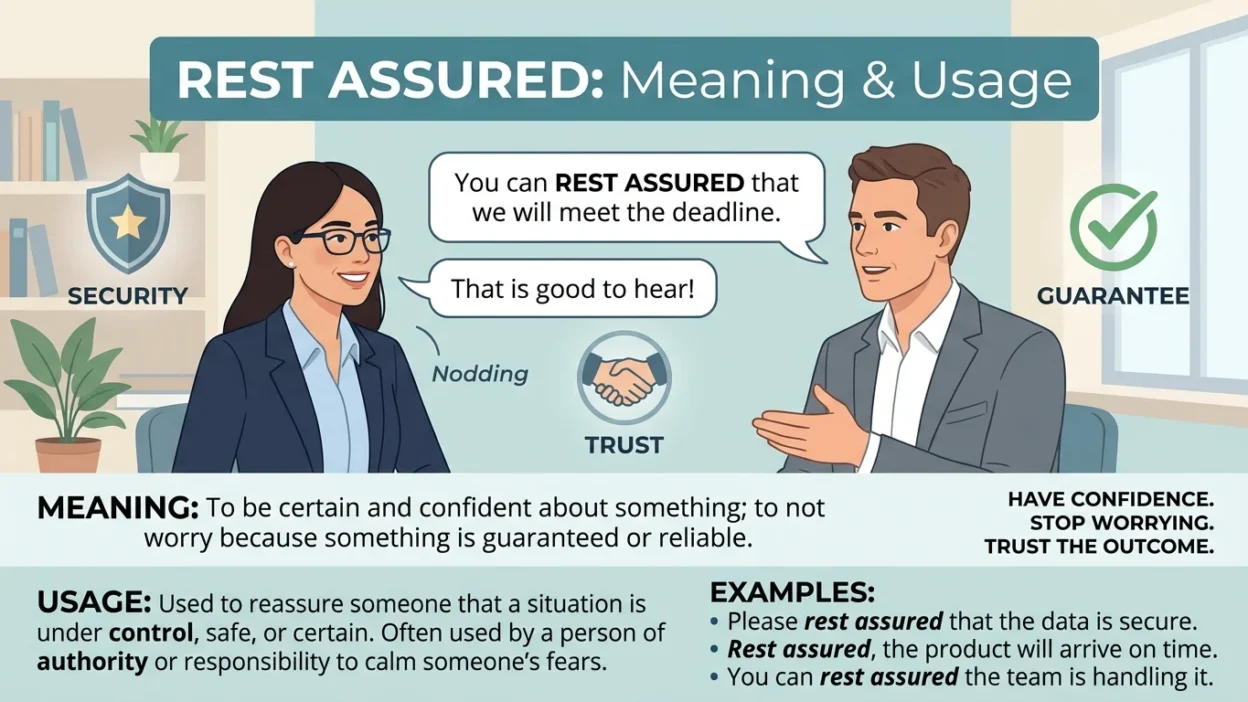
“Rest assured” means “be confident,” “do not worry,” or “you can be certain.” It is normally used to reassure someone that something is true, safe, reliable, or being handled. For example: “Rest assured, we will contact you as soon as possible.”
What Does “Rest Assured” Mean?
Rest assured is an expression used to reassure someone.
It means:
- Be confident.
- Do not worry.
- You can be certain.
- You can trust that something will happen.
- You can feel comfortable knowing that something is being handled.
For example:
Rest assured, your application is being reviewed.
This means:
You can be confident that your application is being reviewed.
The phrase usually communicates confidence and reassurance rather than simply telling someone to relax.
Why Do People Find “Rest Assured” Confusing?
The confusion often comes from the word rest.
In most situations, “rest” means to relax or stop working:
I need to rest after work.
But in “rest assured,” the expression is idiomatic. Here, “rest” has the sense of remaining or relying on a particular state of confidence.
The phrase “rest assured” is an established expression meaning that the listener can be confident or free from worry.
It does not mean that someone should physically lie down and rest.
Is “Rest Assured” Grammatically Correct?
Yes, “rest assured” is grammatically correct.
It is an imperative construction. The implied subject is you.
For example:
Rest assured, we will handle everything.
The full underlying idea is:
You can rest assured that we will handle everything.
The shorter form is more idiomatic and is very common.
Similar imperative expressions include:
Be careful.
Take care.
Rest assured.
The subject you is understood.
How to Use “Rest Assured”
There are several common ways to use “rest assured.”
1. Rest assured, + sentence
This is one of the most common patterns.
Rest assured, we are doing everything we can.
Rest assured, your information is safe.
Rest assured, I will keep you updated.
The comma after “rest assured” is appropriate when the phrase introduces the reassurance that follows.
2. Rest assured that + clause
You can also use “rest assured that” before a complete clause.
Rest assured that your concerns will be addressed.
You can rest assured that we are working on the problem.
Rest assured that your request has been received.
This structure is especially common in professional writing.
3. You can rest assured that…
This version is slightly more explicit because it includes the subject.
You can rest assured that everything is under control.
You can rest assured that we will protect your privacy.
You can rest assured that your order will arrive soon.
This construction is natural and often sounds slightly less formal or dramatic than simply starting with “Rest assured.”
“Rest Assured” vs “You Can Rest Assured”
Both are correct.
Rest assured
Rest assured, we will take care of the matter.
This is concise, confident, and somewhat formal.
You can rest assured
You can rest assured that we will take care of the matter.
This is more explicit and conversational.
Both communicate essentially the same idea.
15 Examples of “Rest Assured”
- Rest assured, we will investigate the matter carefully.
- Rest assured, your information will remain confidential.
- Rest assured, we are working to resolve the problem.
- Rest assured that your request has been received.
- You can rest assured that we will keep you informed.
- Rest assured, your payment has been processed.
- You can rest assured that your concerns are being taken seriously.
- Rest assured, I will let you know when there is an update.
- Rest assured that everything is being handled professionally.
- You can rest assured that your documents are safe.
- Rest assured, we will do everything possible to help.
- Rest assured that the team is prepared for the situation.
- You can rest assured that we have considered all the options.
- Rest assured, your complaint will be reviewed.
- Rest assured that we will contact you as soon as possible.
“Rest Assured” in Professional Emails
“Rest assured” is especially common in professional communication.
It can reassure a customer, colleague, client, or employee that an issue is being handled.
For example:
Rest assured, we are looking into the issue and will provide an update shortly.
Or:
You can rest assured that your information will be handled with care.
It works well when someone is worried, uncertain, or waiting for a resolution.
However, using it too frequently can make business writing sound formulaic. In some situations, a direct statement may be more natural.
Instead of:
Rest assured, we are working on your request.
You could simply say:
We are working on your request and will update you shortly.
Both are correct. The first emphasizes reassurance, while the second simply provides information.
Can You Say “Rest Assured That”?
Yes.
“Rest assured that” is completely correct.
For example:
Rest assured that we will address your concerns.
Rest assured that your account is secure.
Rest assured that we are taking appropriate action.
The word that introduces the clause explaining what the person can be confident about.
Can You Say “Rest Assured About”?
Usually, “rest assured that” is the more natural structure when you are introducing a complete idea.
For example:
Rest assured that everything will be fine.
Instead of:
Rest assured about everything will be fine.
However, assured about can occur with the adjective assured in other grammatical structures.
For example:
She feels assured about the decision.
That is different from the idiomatic expression rest assured.
Rest Assured vs Be Assured
These expressions are similar, but they are not always interchangeable.
Rest assured means that someone can feel confident or stop worrying.
Rest assured, we will help you.
Be assured can also mean to be confident, but it often sounds more formal and less conversational.
Be assured that your concerns will be addressed.
In many professional contexts, both are possible.
However, rest assured is a particularly established phrase for reassurance.
Rest Assured vs Rest Easy
These expressions are related but have different tones.
Rest assured is more formal and is commonly used in professional communication.
Rest assured, your complaint is being investigated.
Rest easy is more conversational and often means “do not worry.”
Rest easy. Everything is under control.
If you are writing a formal email, rest assured is generally more appropriate.
Rest Assured vs Don’t Worry
Both can reassure someone, but they have different tones.
Don’t worry. I’ll take care of it.
This is casual and direct.
Rest assured, I will take care of it.
This sounds more formal and confident.
The choice depends on the relationship and situation.
Common Mistakes With “Rest Assured”
Mistake 1: Writing “Rest assure”
Incorrect:
Rest assure, everything will be fine.
Correct:
Rest assured, everything will be fine.
The word assured is the correct form.
Mistake 2: Writing “Rest assuredly”
Incorrect:
Rest assuredly, we will help you.
Correct:
Rest assured, we will help you.
Rest assured is the established expression.
Mistake 3: Treating “rest assured” as a physical instruction
In the expression, “rest” does not literally mean “sleep” or “relax your body.”
It is an idiomatic expression of confidence and reassurance.
Mistake 4: Using “rest assured” without a reason for reassurance
The phrase works best when you actually provide something reassuring.
Rest assured, your request is being handled.
This is clearer than simply saying:
Rest assured.
The shorter form is possible, but adding the reassurance often makes the communication more useful.
Is “Rest Assured” Formal or Informal?
“Rest assured” is generally neutral to formal.
It is common in:
- Business emails
- Customer service
- Official communication
- Professional conversations
- News writing
- Formal reassurance
- Everyday speech when a confident tone is desired
In casual conversation, people may more naturally say:
Don’t worry.
You’re fine.
No need to worry.
I’ve got it.
So, “rest assured” is not overly formal, but it has a polished and somewhat formal tone.
American vs British English
“Rest assured” is standard in both American and British English.
There is no major difference in meaning or grammar between the two varieties.
For example, both American and British speakers can naturally say:
Rest assured, we will keep you informed.
You can rest assured that everything is under control.
The expression is widely understood in other varieties of English as well.
Similar Expressions
Depending on the situation, you can replace “rest assured” with:
- Be confident
- Don’t worry
- You can be sure
- You can count on it
- You can rely on that
- Rest easy
- Have no worries
- You can trust that
- Everything is under control
The best alternative depends on the level of formality.
For professional writing:
You can be confident that…
You can be assured that…
For casual conversation:
Don’t worry.
You’re fine.
I’ve got it.
A Simple Memory Trick
Think of “rest assured” as:
“Relax because you can be sure.”
When someone says:
Rest assured, we will help you.
The meaning is essentially:
You can relax because you can be confident that we will help you.
Remember:
Rest assured = Be confident = Don’t worry.
Final Verdict
“Rest assured” is a correct and common English expression used to reassure someone.
It means “be confident,” “you can be sure,” or “do not worry.”
The most common patterns are:
Rest assured, + sentence
and
Rest assured that + clause
You can also say:
You can rest assured that…
The phrase is especially useful in professional and formal communication when you want to give someone confidence that a matter is being handled.
FAQs About “Rest Assured”
What does “rest assured” mean?
“Rest assured” means be confident, do not worry, or you can be certain that something is true or will happen.
Is “rest assured” grammatically correct?
Yes. It is a standard imperative expression with an understood subject, you.
What comes after “rest assured”?
You can use a comma followed by a complete sentence:
Rest assured, we will help you.
You can also use that:
Rest assured that we will help you.
Is “rest assured” formal?
It is generally neutral to formal and is especially common in professional communication.
Is “rest assured” polite?
Yes. It is generally polite when used to reassure someone. However, its tone can sometimes sound overly formal or formulaic depending on the context.
Can I say “you can rest assured”?
Yes. “You can rest assured that…” is completely natural.
You can rest assured that your request is being handled.
What is another way to say “rest assured”?
Depending on the context, you can say “don’t worry,” “be confident,” “you can be sure,” or “you can count on it.”
Is “rest assure” correct?
No. The standard expression is “rest assured.”
Conclusion
“Rest assured” is a useful English expression for giving someone confidence and reassurance. It tells the listener that they do not need to worry because something is reliable, safe, certain, or being handled properly. The phrase is grammatically correct and works especially well in professional emails, customer service messages, and formal conversations.
The easiest way to remember it is to think “rest assured” means “you can relax because you can be confident.” Use “Rest assured, …” when you want to give direct reassurance, or “Rest assured that …” when you want to introduce a specific fact or situation. Both forms are standard and natural.
Remember This
Rest assured = be confident + do not worry.
Correct:
Rest assured, we will take care of it.
Correct:
Rest assured that your information is safe.
Correct:
You can rest assured that everything is under control.
Incorrect:
Rest assure, everything is fine.
The correct form is always rest assured.

Daniel Charles is a dedicated author and dream interpretation enthusiast at DrameyHut. He specializes in analyzing dream symbols and meanings, offering clear and insightful content for readers. His work aims to help individuals understand their subconscious thoughts, gain clarity, and explore the deeper messages hidden within their dreams.