“Cord” and “chord” sound exactly the same in most varieties of English, but they have completely different meanings. This makes them easy to confuse, especially when you hear the word rather than see it written.
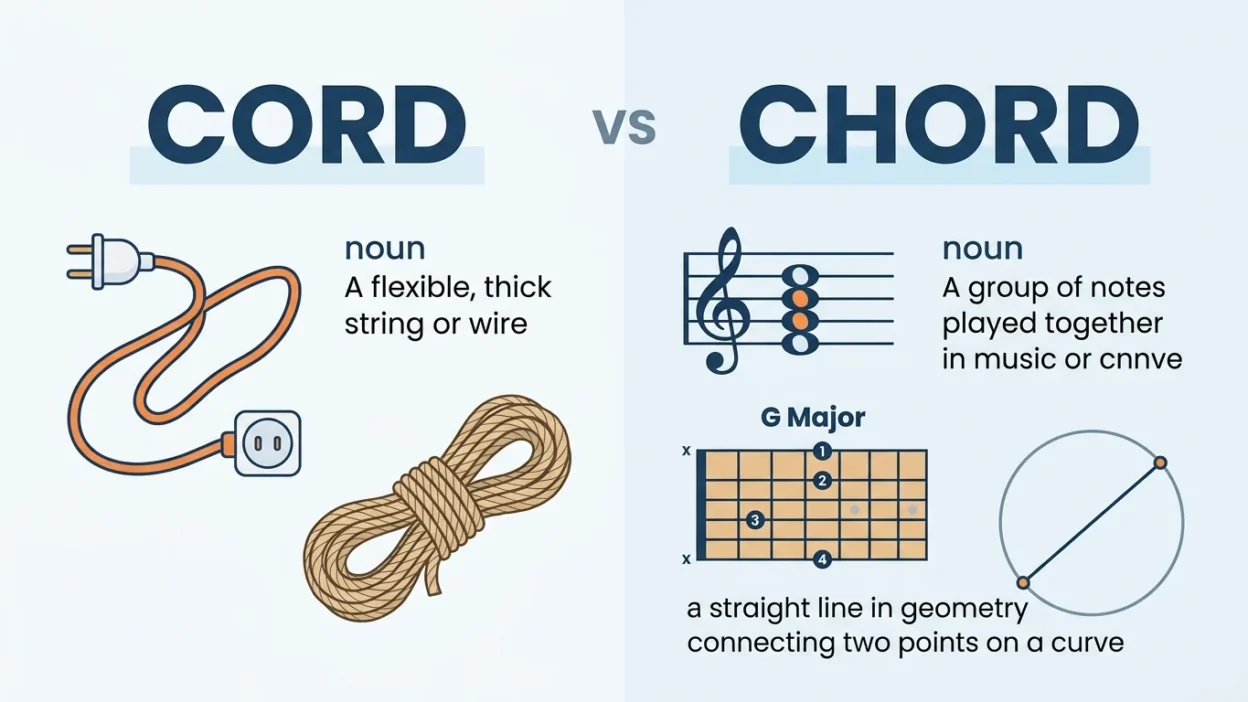
Cord usually refers to a long, flexible material made from strands or fibers, such as a rope, electrical wire, or string. It can also describe anatomical structures, such as the spinal cord or vocal cords. Chord, on the other hand, is mainly used in music and mathematics. In music, a chord is a group of notes played together. In geometry, a chord is a straight line segment connecting two points on a circle.
Understanding the difference is simple once you connect each spelling with its main meaning. This guide explains cord vs chord, shows how to use both words correctly, and gives you practical examples and memory tricks.
Quick Answer
Cord means a flexible string, rope, wire, or similar structure. Chord usually means a group of musical notes played together or a line segment connecting two points on a circle. They are homophones, so they sound alike but have different meanings and spellings.
Why Do People Confuse Cord and Chord?
The main reason is pronunciation. Cord and chord are homophones in standard English, meaning they have the same pronunciation but different spellings and meanings.
When someone says, “I learned a new chord on the guitar,” you cannot determine the spelling simply from the sound.
The context tells you which word is intended.
A useful distinction is:
Cord = something long and flexible
Chord = music or geometry
The extra h in chord can help you remember that it belongs to a specialized meaning rather than the ordinary word for a string or wire.
Cord: Meaning and Definition
Cord is a noun that generally refers to a long, flexible material made from several strands twisted or woven together.
For example:
The lamp cord is too short.
Here, cord refers to the electrical cable connecting the lamp to a power source.
The word can also refer to various anatomical structures. Common examples include spinal cord and vocal cords.
Common meanings of cord
Cord can refer to:
- A thick string or rope
- An electrical cable
- A flexible wire or cable
- An anatomical structure
- A bundle or group of long fibers
Examples of cord
- Please move the power cord away from the water.
- The extension cord is behind the sofa.
- She tied the package with a strong cord.
- The lamp cord needs to be replaced.
- The doctor examined his spinal cord.
- The singer damaged one of her vocal cords.
- The curtain cord became tangled.
- He used a piece of cord to secure the box.
Chord: Meaning and Definition
Chord has several meanings, but the two most common are related to music and geometry.
Chord in music
In music, a chord is a combination of two or more notes played or heard together, although traditional musical definitions often describe a chord as three or more notes sounding together.
For example:
She played a beautiful chord on the piano.
A guitar player might learn chords such as C, G, Am, and F.
Chord in geometry
In geometry, a chord is a straight line segment whose endpoints lie on a circle.
For example:
The diameter is the longest chord of a circle.
This is a mathematical use of the word and has nothing to do with ropes, cables, or strings.
Cord vs Chord Comparison Table
| Word | Meaning | Common Context | Example |
|---|---|---|---|
| Cord | A flexible string, rope, wire, or similar structure | Objects, electricity, anatomy | The power cord is damaged. |
| Chord | A group of musical notes | Music | He played a guitar chord. |
| Chord | A line segment joining two points on a circle | Geometry | The diameter is a chord. |
Cord vs Chord: When to Use Each
Use cord when you are talking about something such as a string, rope, cable, wire, or anatomical structure.
Examples:
- electrical cord
- extension cord
- power cord
- spinal cord
- vocal cords
- cord of rope
Use chord when you are talking about music or geometry.
Examples:
- guitar chord
- piano chord
- major chord
- minor chord
- chord progression
- chord of a circle
A simple rule is:
If it connects, carries, ties, or forms part of the body, think cord.
If it involves musical notes or a circle, think chord.
15 Examples of Cord and Chord
Examples with Cord
- I accidentally unplugged the computer cord.
- The extension cord was not long enough.
- He tied the package with a piece of cord.
- The lamp cord is damaged.
- Keep the power cord away from the heater.
- The climbing equipment included a strong cord.
- The doctor explained how the spinal cord works.
- The singer rested because her vocal cords were irritated.
Examples with Chord
- She learned a new chord on the guitar.
- The song begins with a simple piano chord.
- He played the wrong chord during the performance.
- The guitarist changed from one chord to another.
- This chord progression sounds familiar.
- In geometry, the diameter is a chord of a circle.
- The diagram shows a chord connecting two points on the circle.
Cord and Chord in Common Expressions
Certain expressions make the difference particularly easy to recognize.
Common expressions with cord
Power cord
The power cord is plugged into the wall.
Extension cord
We need an extension cord for the fan.
Spinal cord
The spinal cord is part of the central nervous system.
Vocal cords
Singers need to take care of their vocal cords.
Common expressions with chord
Guitar chord
He taught me my first guitar chord.
Major chord
The song ends with a major chord.
Minor chord
The composer used a minor chord to create a darker mood.
Chord progression
The guitarist practiced the chord progression repeatedly.
Common Mistakes
Mistake 1: Using cord for music
Incorrect:
She played a beautiful cord on the piano.
Correct:
She played a beautiful chord on the piano.
Music uses chord.
Mistake 2: Using chord for a cable
Incorrect:
My phone charging chord is broken.
Correct:
My phone charging cord is broken.
A cable or flexible wire is a cord.
Mistake 3: Confusing vocal cords with musical chords
These are completely different:
Vocal cords are anatomical structures involved in producing the voice.
Musical chords are combinations of musical notes.
For example:
The singer rested her vocal cords.
But:
The guitarist played several chords.
Mistake 4: Confusing a chord with a diameter
In geometry, a diameter is a special type of chord that passes through the center of a circle.
Therefore, every diameter is a chord, but not every chord is a diameter.
Cord vs Chord Memory Trick
Here is an easy way to remember the difference:
Cord = cable, string, or body structure.
Chord = music or circle.
For music, remember:
CHORD has an H, like the H in harmony.
You can also remember:
A cord connects things. A chord combines notes.
That simple contrast can help you choose the correct spelling quickly.
Are Cord and Chord Homophones?
Yes. Cord and chord are homophones because they are pronounced the same but have different spellings and meanings.
Other common homophones include:
- right and write
- sea and see
- flower and flour
- pair and pear
- brake and break
The spelling must therefore be determined by context.
Cord vs Chord in American and British English
The distinction between cord and chord is essentially the same in American and British English.
Both varieties use cord for things such as cables, ropes, and anatomical structures.
Both use chord for musical combinations of notes and the geometric line segment connecting two points on a circle.
There is no major American versus British spelling difference between these two words.
Similar Words
Several words are related to cord and chord, but they are not interchangeable.
Cable
A cable is a thick wire or group of wires used to carry electricity, signals, or support weight.
The technician replaced the damaged cable.
Rope
A rope is a strong, flexible length of twisted or braided material.
They used a rope to secure the boat.
String
A string is generally thinner than a rope or cord.
She tied the package with string.
Note
A note is a single musical sound or pitch.
The singer held the note for several seconds.
Harmony
Harmony refers broadly to the combination of musical notes that sound together.
The harmony gave the song a rich sound.
Segment
In geometry, a segment is a part of a line with two endpoints.
The chord is a line segment inside the circle.
Final Verdict
Cord and chord sound the same, but their meanings are different.
Use cord for a rope, string, cable, wire, or anatomical structure.
Use chord mainly for a combination of musical notes or a line segment connecting two points on a circle.
If you are talking about a guitar, piano, or music, choose chord. If you are talking about a cable, rope, electrical connection, or the body, choose cord.
FAQs About Cord vs Chord
Is it a guitar cord or guitar chord?
The correct expression is guitar chord. A chord is a combination of musical notes played together.
Is it a power cord or power chord?
The correct expression for an electrical cable is power cord.
Power chord is a musical term referring to a type of guitar chord.
Are cord and chord pronounced the same?
Yes. In standard English, cord and chord are homophones and are pronounced the same.
Is a diameter a chord?
Yes. In geometry, a diameter is a special type of chord because it connects two points on a circle and passes through its center.
Is vocal cord or vocal chord correct?
The correct anatomical term is vocal cord or, more commonly in the plural, vocal cords.
What is the easiest way to remember cord vs chord?
Remember: cord = cable or string, while chord = music or circle.
Is chord only used in music?
No. Chord is also used in geometry for a line segment whose endpoints lie on a circle.
Is cord only used for physical objects?
No. Cord can also refer to anatomical structures, such as the spinal cord and vocal cords.
Conclusion
Although cord and chord are pronounced the same, they belong to completely different areas of vocabulary. Cord is associated with strings, cables, wires, ropes, and anatomical structures, while chord is associated mainly with music and geometry. Context makes the intended word clear.
When you see or hear the word, ask yourself what the sentence is talking about. If it involves a cable, rope, string, or part of the body, use cord. If it involves musical notes or a circle, use chord. Once you connect each spelling with its main meaning, this common homophone pair becomes much easier to remember.
Remember This
Cord = cable, string, rope, or body structure.
Chord = musical notes or a line in a circle.
Think cord connects, while chord combines.

Christopher Thomas is a passionate writer and dream researcher dedicated to exploring the meanings behind dreams. As an author at DrameyHut, he creates insightful and easy-to-understand interpretations that help readers connect with their subconscious mind. His work focuses on guiding individuals toward self-discovery, clarity, and a deeper understanding of their inner thoughts.