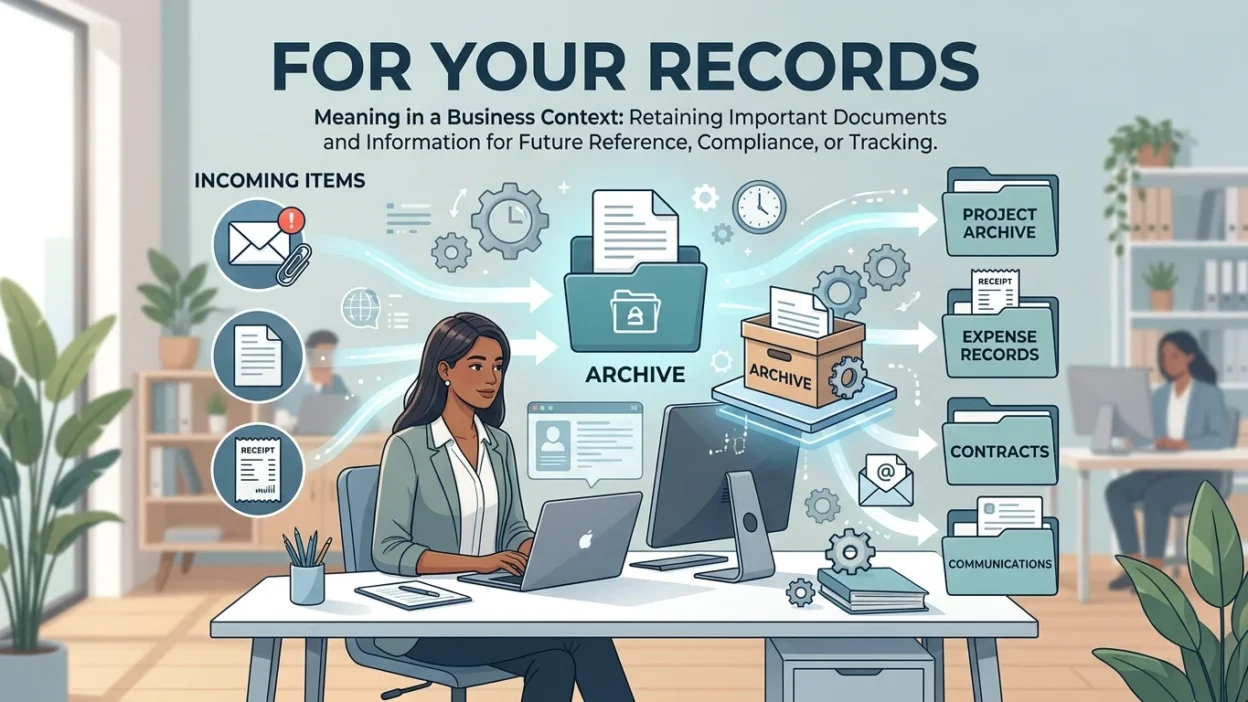
The phrase “for your records” is commonly used in emails, business communication, official notices, and everyday situations. It means that information or a document is being provided so you can keep it for future reference. When someone sends you something “for your records,” they generally want you to save or retain it in case you need to check it later.
For example, someone might write, “I have attached a copy of the receipt for your records.” This means the recipient does not necessarily need to take immediate action. The receipt is being provided so they can keep it as documentation.
The phrase is especially common in professional and administrative communication, where keeping accurate records is important. In this guide, you will learn exactly what “for your records” means, how to use it naturally, what it implies in emails, common examples, similar expressions, and common mistakes to avoid.
Quick Answer
“For your records” means “for you to keep as documentation or for future reference.” It is commonly used when sending a document, receipt, confirmation, report, or other information that the recipient may need to keep but does not necessarily need to act on immediately.
What Does “For Your Records” Mean?
For your records means that something is being given or sent to you so that you can keep it for future reference or documentation.
For example:
I have attached the receipt for your records.
This means:
I have attached the receipt so that you can keep it in your files.
The phrase does not necessarily mean that you must do anything with the document immediately.
It often simply tells the recipient:
Keep this information in case you need it later.
What Does “Records” Mean Here?
In this phrase, records means information, documents, or evidence that someone keeps for reference.
Records can include:
• receipts
• invoices
• contracts
• certificates
• reports
• payment confirmations
• correspondence
• account statements
• meeting notes
• official documents
So when someone says something is for your records, they are usually suggesting that you retain it.
For Your Records in an Email
“For your records” is extremely common in professional emails.
For example:
Please find attached a copy of the signed agreement for your records.
This tells the recipient that the agreement is being provided for documentation.
Another example:
I am sending you the payment confirmation for your records.
The recipient can save the confirmation in case they need to refer to it later.
For Your Records Examples
Here are natural examples of how to use the phrase:
- I have attached the receipt for your records.
- Please keep this confirmation for your records.
- I am sending you a copy of the agreement for your records.
- Attached is the invoice for your records.
- Please retain this letter for your records.
- I have included the payment confirmation for your records.
- Here is a copy of the report for your records.
- We are providing this notice for your records.
- Please keep the certificate for your records.
- I have forwarded the email for your records.
- The signed document is attached for your records.
- We have sent you a copy of the policy for your records.
- Please save this message for your records.
- I am attaching the updated schedule for your records.
- Here is the final version for your records.
Does “For Your Records” Mean You Need to Do Something?
Usually, no.
The phrase often indicates that the recipient should keep the information, rather than take immediate action.
For example:
Attached is your payment receipt for your records.
This usually means:
Keep the receipt.
It does not necessarily mean:
Reply to this email.
However, the surrounding message can give additional instructions.
For example:
Please review the attached contract, sign it, and return it. A copy is also included for your records.
Here, the recipient has an action to complete, while “for your records” refers to the copy they should keep.
For Your Records vs For Your Reference
These phrases are closely related.
For your records
Usually emphasizes keeping something as documentation.
I have attached the receipt for your records.
For your reference
Usually emphasizes using something as a source of information when needed.
I have attached the user guide for your reference.
The difference is subtle.
For your records = keep it.
For your reference = use it when you need information.
A document can be both.
I have attached the policy for your records and future reference.
For Your Records vs For Your Information
These expressions are also different.
For your records
Means you should keep the information or document.
Here is a copy of the invoice for your records.
For your information
Means the information is being provided so you know about something.
For your information, the meeting has been moved to Friday.
The second phrase does not necessarily suggest that you need to save anything.
For Your Records vs For Your Files
These expressions are very similar.
I am sending the invoice for your records.
I am sending the invoice for your files.
Both suggest that the recipient should keep the document.
For your records is often more broadly used and can sound slightly more polished in professional communication.
Is “For Your Records” Formal?
Yes.
For your records is appropriate in professional, business, administrative, and official communication.
It is not excessively formal, however, so it can also be used in ordinary emails.
For example:
I have attached the receipt for your records.
This sounds professional and natural.
Common Situations Where You Can Use “For Your Records”
Receipts
Please keep the receipt for your records.
Invoices
A copy of the invoice is attached for your records.
Contracts
Please find a signed copy of the agreement for your records.
Payments
The payment confirmation is attached for your records.
Official Notices
Please retain this notice for your records.
Reports
I have attached the final report for your records.
Certificates
A copy of your certificate is included for your records.
Common Mistakes
1. Thinking It Means “Remember This”
“For your records” does not simply mean “remember this.”
It specifically suggests keeping information or documentation.
2. Assuming It Always Requires a Reply
Usually, the phrase does not require a response.
The recipient may simply need to save the document.
3. Confusing Records With Memories
Here, “records” means documents or stored information, not personal memories.
4. Using “For Your Record”
The standard phrase is:
for your records
The plural records is normally used.
5. Thinking It Is Only Used for Physical Documents
It can refer to digital documents, emails, electronic receipts, PDFs, screenshots, or other stored information.
Grammar of “For Your Records”
The phrase is a prepositional phrase.
For is the preposition.
Your is the possessive determiner.
Records is the plural noun.
The phrase can appear at the end or beginning of a sentence.
I have attached the document for your records.
Or:
For your records, I have attached a copy of the document.
The first position is generally more natural in ordinary professional emails.
“For Your Records” in Professional Emails
Here are some polished email style examples:
Please find attached a copy of the signed agreement for your records.
I have attached the payment receipt for your records.
A copy of the completed form is included for your records.
Please retain the attached document for your records.
I am forwarding the confirmation email for your records.
The phrase is especially useful when you want to make it clear that the attachment is primarily being provided for documentation.
Is “For Your Records” Polite?
Yes.
The phrase is neutral and professional.
It does not normally sound demanding or rude.
For example:
Please keep the attached receipt for your records.
This is a polite way to tell someone to retain the document.
American vs British English
For your records is standard in both American and British English.
There is no significant difference in meaning or usage.
It is common in professional communication in both varieties.
Similar Expressions
Depending on the context, you can use:
For your reference: So you can consult it later.
For your files: So you can keep it with your documents.
For documentation: To serve as documentation.
For future reference: So you can use it later.
Please retain this: Please keep this document.
Please keep a copy: Save or retain a copy.
For your information: So you are aware of the information.
These expressions are related but not always interchangeable.
Memory Trick
Think of records as your personal or professional filing system.
If someone sends you a document for your records, imagine them saying:
“Keep this in your files.”
So:
For your records = keep it for later.
FAQs
What does “for your records” mean?
It means something is being provided for you to keep as documentation or for future reference.
What does “for your records” mean in an email?
It usually means the sender has included information or an attachment that you should save in case you need it later.
Does “for your records” mean I need to respond?
Usually not. It generally means that you should keep the information rather than take immediate action.
Is “for your records” formal?
Yes. It is professional and appropriate for business, administrative, and official communication.
What is another way to say “for your records”?
You can say for your reference, for your files, for future reference, or for documentation, depending on the context.
Is “for your record” correct?
The standard expression is for your records, with the plural noun.
What is the difference between “for your records” and “for your reference”?
“For your records” emphasizes keeping something as documentation, while “for your reference” emphasizes consulting something for information later.
Can “for your records” refer to digital files?
Yes. It can refer to PDFs, emails, electronic receipts, digital contracts, and other electronic documents.
Final Verdict
“For your records” means “for you to keep as documentation or for future reference.”
It is especially common when sending receipts, invoices, contracts, reports, confirmations, certificates, and other important documents.
The phrase is professional, polite, and standard in both American and British English. It usually does not require the recipient to take immediate action.
Conclusion
The phrase “for your records” is a useful expression in professional and everyday communication. When someone gives you a document “for your records,” they are generally asking you to keep it so you can refer to it later if necessary.
It is especially common in emails and administrative communication because it clearly explains why a document is being sent. Remember that for your records focuses on keeping documentation, while for your reference focuses more on using information later. Once you understand this distinction, the phrase becomes easy to use naturally.
Remember This
For your records = keep it for future reference or documentation.
Think:
“For your records” = “Keep this in your files.”

Daniel Charles is a dedicated author and dream interpretation enthusiast at DrameyHut. He specializes in analyzing dream symbols and meanings, offering clear and insightful content for readers. His work aims to help individuals understand their subconscious thoughts, gain clarity, and explore the deeper messages hidden within their dreams.