English learners often come across the phrase “much better” in everyday conversations, emails, reviews, and professional writing. It is a simple expression, but understanding exactly how much works with better can make your English sound more natural and precise.
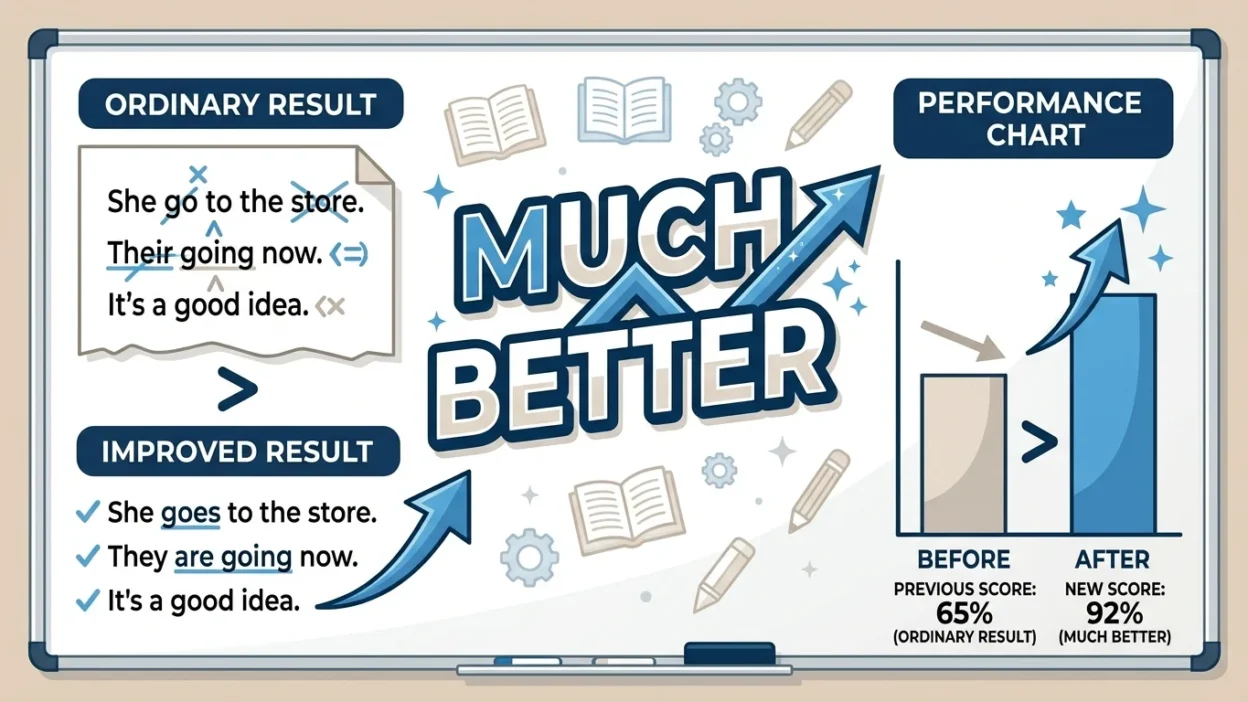
“Much better” means considerably better, noticeably improved, or better by a significant degree. It is commonly used when comparing two situations, things, experiences, or conditions.
For example, if someone asks, “How are you feeling today?” you might say, “Much better, thank you.” Here, you are saying that your condition has improved significantly compared with before. You can also use the phrase in comparisons, such as “This version is much better than the original.”
In this article, we will explore the meaning, grammar, correct usage, examples, common mistakes, similar expressions, and differences between “much better” and related phrases.
Quick Answer
“Much better” is correct standard English. It means significantly or noticeably better than something previously mentioned or compared. “Much” strengthens the comparative adjective “better.” For example, “This solution is much better than the first one.”
Why People Confuse “Much Better”
The phrase can sometimes confuse English learners because much is often associated with uncountable nouns, as in “much water” or “much time.”
However, much can also modify comparative adjectives and adverbs.
For example:
- much better
- much bigger
- much faster
- much easier
- much more useful
- much less expensive
In “much better,” the word much does not describe an amount of something. Instead, it emphasizes the degree of comparison.
Compare these sentences:
This book is better.
This tells us that the book is superior to another book.
This book is much better.
This tells us that the difference is significant.
So, “much” makes the comparison stronger.
What Does “Much Better” Mean?
Much better means considerably better, significantly improved, or noticeably better.
The exact meaning depends on context.
1. Significantly better
This restaurant is much better than the one we visited yesterday.
The speaker thinks there is a clear difference in quality.
2. Significantly improved
I feel much better today.
The person’s condition has improved noticeably compared with before.
3. A stronger comparison
Your second draft is much better.
The second draft is substantially better than the first.
4. A polite response
“How are you feeling?”
“Much better, thanks.”
Here, “much better” can stand alone because the comparison is understood from the context.
The Grammar of “Much Better”
“Better” is the comparative form of good and well.
The basic pattern is:
much + comparative adjective/adverb
Examples include:
- much better
- much worse
- much larger
- much smaller
- much faster
- much slower
- much easier
- much harder
So:
This method is much better.
Here, better is the comparative adjective, while much intensifies it.
You can also use “much better” before a noun when the grammar requires an adjective:
We need a much better solution.
The phrase “much better” describes the noun solution.
“Much Better” vs “Better”
Both expressions are correct, but they communicate different degrees of difference.
| Expression | Meaning | Example |
|---|---|---|
| better | improved or superior | This option is better. |
| much better | significantly improved or superior | This option is much better. |
| slightly better | only a little better | This option is slightly better. |
| far better | considerably better | This option is far better. |
| a lot better | considerably better, informal | This option is a lot better. |
The important difference is strength.
“Better” simply establishes a comparison.
“Much better” emphasizes that the difference is substantial.
When to Use “Much Better”
When comparing two things
This phone is much better than my old one.
When describing improvement
She is feeling much better now.
When evaluating a revised version
The new design looks much better.
When responding to a question
“Is your headache better?”
“Yes, much better.”
When making a recommendation
The second option is much better for beginners.
When comparing performance
The team played much better in the second half.
“Much Better Than” in Comparisons
One of the most common structures is:
much better than + noun/pronoun
Examples:
This plan is much better than the previous one.
He is much better at mathematics than I am.
The new system works much better than the old system.
This explanation is much better than the first one.
The phrase “much better than” makes the comparison explicit.
You can also use “much better” without “than” when the comparison is already understood.
I tried the new version, and it is much better.
The listener can infer that the new version is being compared with the old one.
Examples of “Much Better”
Here are more than ten natural examples showing how the phrase works in different contexts.
- I feel much better today.
- This restaurant is much better than I expected.
- Your second answer is much better.
- The weather is much better now.
- She speaks English much better than she did last year.
- This computer runs much better after the update.
- The new design looks much better than the old one.
- I slept well last night, so I feel much better this morning.
- This explanation is much better for beginners.
- He is doing much better in school this semester.
- The revised version is much better than the original.
- This solution seems much better to me.
- You look much better in this color.
- The second half of the game was much better.
- I understand the topic much better now.
“Much Better” as a Standalone Response
A particularly common use of “much better” occurs when it appears by itself.
For example:
“How are you feeling?”
“Much better.”
This is completely natural.
The full meaning is usually something like:
“I am feeling much better than I was before.”
English speakers often omit the rest because the comparison is obvious from the context.
Other examples include:
“Is your car running better?”
“Much better.”
Or:
“Do you understand the lesson now?”
“Much better.”
This makes “much better” especially useful in everyday conversation.
Common Mistakes
Mistake 1: Using “very better”
A common learner error is:
❌ This is very better.
The standard form is:
✅ This is much better.
“Very” normally modifies the base adjective, while “much” commonly modifies a comparative form.
Compare:
very good
much better
very fast
much faster
Mistake 2: Saying “more better”
“Better” is already a comparative form.
❌ This option is more better.
✅ This option is much better.
Do not normally combine more with better.
Mistake 3: Using “much good”
When you mean “significantly better,” do not say:
❌ This is much good.
Say:
✅ This is much better.
Mistake 4: Confusing “much better” with “much best”
“Best” is the superlative form of “good.”
❌ This is much best.
✅ This is much better.
✅ This is the best.
Mistake 5: Assuming “much better” always needs “than”
It does not.
You can say:
I feel much better.
You can also say:
I feel much better than yesterday.
Both are correct. The second sentence simply makes the comparison explicit.
Much Better vs A Lot Better
Both expressions mean that something is significantly better.
Much better is neutral and widely appropriate in both conversation and writing.
A lot better is more conversational.
Compare:
This version is much better.
This version is a lot better.
Both are natural, but “much better” may sound slightly more polished in formal or professional contexts.
Much Better vs Far Better
Much better and far better can both indicate a substantial difference.
“Far better” often sounds stronger and can emphasize a very clear advantage.
This approach is much better than the old one.
This approach is far better than the old one.
The second sentence can suggest an even stronger contrast, depending on context.
Much Better vs Way Better
Way better is informal and common in casual American English.
This movie is way better than the first one.
“Much better” is more neutral:
This movie is much better than the first one.
For professional writing, academic writing, and formal communication, much better is usually the safer choice.
Memory Trick
Remember this simple rule:
Better = more good.
Much better = significantly more good.
You can also remember:
Much + comparative = stronger comparison.
Examples:
- much better
- much bigger
- much faster
- much easier
- much cheaper
- much stronger
So when you want to emphasize a comparative adjective, much is often the right word.
American vs British English
There is no important difference between American and British English when it comes to “much better.”
Both varieties commonly use the expression.
American English:
This version is much better.
British English:
This version is much better.
The phrase is natural in conversation, professional communication, education, journalism, and general writing in both varieties.
Informal alternatives such as “way better” may be particularly common in casual American conversation, but British speakers also understand and use informal comparative expressions.
Similar Words and Expressions
Several expressions can replace “much better,” depending on the context.
Significantly better
More formal and precise.
The revised model is significantly better.
Considerably better
Emphasizes a noticeable difference.
The new method is considerably better.
Far better
Strongly emphasizes superiority.
This approach is far better.
A lot better
Natural and conversational.
I feel a lot better now.
Way better
Very informal.
This version is way better.
Much improved
Useful when talking about a condition, situation, or performance.
Her performance is much improved.
Improved considerably
A more formal construction.
The system has improved considerably.
Is “Much Better” Correct English?
Yes. “Much better” is completely correct and very common English.
It can be used before a noun:
We need a much better plan.
After a linking verb:
This plan is much better.
As part of a comparison:
This plan is much better than the previous one.
Or as a short response:
“How do you feel?”
“Much better.”
Its meaning is generally that something is noticeably or significantly better than before or than another thing.
FAQs
Is “much better” grammatically correct?
Yes. “Much better” is grammatically correct. “Better” is the comparative form, and “much” intensifies the degree of comparison.
What does “much better” mean?
“Much better” means significantly, considerably, or noticeably better than something else or than a previous condition.
Is it correct to say “very better”?
No, “very better” is not standard English. Use “much better” when you want to emphasize a comparative improvement.
Is “much better than” correct?
Yes. “Much better than” is a very common comparative structure.
This method is much better than the old one.
Can “much better” stand alone?
Yes. For example:
“How are you feeling?”
“Much better.”
The rest of the comparison is understood from context.
Is “much better” formal or informal?
“Much better” is neutral. It works in casual conversation as well as professional and formal writing.
What is another way to say “much better”?
Depending on the context, you can say significantly better, considerably better, far better, a lot better, way better, or much improved.
Final Verdict
“Much better” is the correct and natural expression when you want to say that something is significantly or noticeably better.
The word better already expresses comparison, while much strengthens that comparison. You can use the phrase with or without than, depending on whether the comparison needs to be stated explicitly.
Remember that “very better” and “more better” are not standard forms. In most situations, “much better” is the natural choice.
Whether you are describing an improvement, comparing two products, discussing performance, or simply answering “How are you feeling?”, “much better” is a versatile expression that belongs in everyday English.
Conclusion
“Much better” is a simple but highly useful English expression. It tells the listener that the improvement or difference is not merely small but noticeable or significant. You can use it to compare people, things, situations, performance, health, quality, or experiences.
The easiest rule is to remember that much can strengthen a comparative adjective such as better. So say “much better,” “much faster,” “much easier,” and “much stronger.” Once you understand this pattern, using “much better” naturally becomes straightforward.
Remember This
Much better = significantly or noticeably better.
Use:
much better
Not:
❌ very better
❌ more better
❌ much good
Example:
“How are you feeling now?”
“Much better, thanks.”

Christopher Thomas is a passionate writer and dream researcher dedicated to exploring the meanings behind dreams. As an author at DrameyHut, he creates insightful and easy-to-understand interpretations that help readers connect with their subconscious mind. His work focuses on guiding individuals toward self-discovery, clarity, and a deeper understanding of their inner thoughts.