Opposed and apposed look and sound similar, but they have very different meanings and grammatical uses. This makes them easy to confuse, especially because both words can appear in formal or academic writing.
Opposed is the much more common word. It usually means being against something, or being placed in contrast to something. For example, “She is opposed to the new policy” means that she disagrees with or does not support it.
Apposed, on the other hand, is a specialized word. It means placed next to or alongside something else. In grammar, it can describe words or phrases placed beside another element to explain or identify it.
Because “apposed” is uncommon in everyday English, many writers accidentally use “opposed” when they mean something else, or assume the two words are interchangeable. They are not.
Quick Answer
Opposed means against, in contrast to, or positioned opposite something. Apposed means placed next to or alongside something. “Opposed” is common in everyday and formal English, while “apposed” is relatively uncommon and is mainly used in technical, grammatical, or formal contexts.
Why People Confuse It
The confusion comes from the similar spelling and pronunciation of opposed and apposed.
Both words contain the ending posed, which comes from a Latin root related to placing or putting. However, their prefixes give them different meanings.
Opposed is associated with being against or in contrast.
Apposed is associated with being placed beside or next to something.
A useful distinction is:
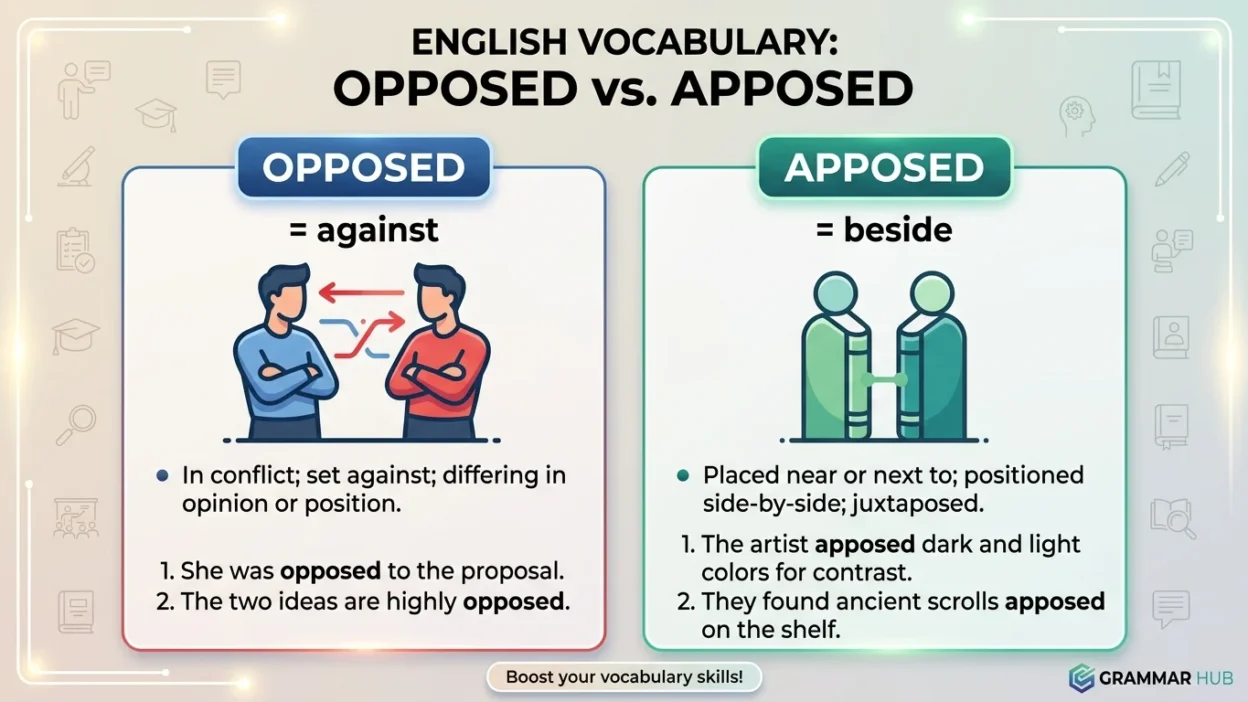
Opposed = against
Apposed = beside
Opposed
Opposed is the past tense and past participle of oppose.
It commonly means to disagree with, resist, or be against something.
Many residents are opposed to the proposal.
It can also mean positioned in contrast or facing something.
The two teams stood opposed to each other.
Common Pattern: Opposed to
One of the most common structures is:
be opposed to + noun
I am opposed to the plan.
be opposed to + gerund
I am opposed to raising taxes.
Remember that to in “opposed to” is a preposition, so it can be followed by a noun or a gerund.
Apposed
Apposed means placed next to, beside, or alongside something.
It is related to the verb appose, which is much less common than “oppose.”
For example:
The two objects were apposed to one another.
In grammar, apposition refers to a construction in which one noun or noun phrase is placed beside another to identify or explain it.
For example:
My brother, James, lives in Canada.
Here, James is in apposition to my brother because it identifies the person being discussed.
The word apposed is therefore most likely to appear in specialized discussions of grammar, linguistics, anatomy, or other technical subjects.
Comparison Table
| Word | Meaning | Commonness | Example |
|---|---|---|---|
| Opposed | Against, resisting, or in contrast | Very common | She is opposed to the proposal. |
| Apposed | Placed next to or alongside | Uncommon | The structures were apposed to each other. |
| Oppose | To resist or disagree with | Common | They oppose the new law. |
| Appose | To place beside or alongside | Rare | The parts were apposed carefully. |
| Apposition | Placement of one element beside another for explanation or identification | Technical | James is in apposition to my brother. |
When to Use Each
Use opposed when you mean “against”
They are opposed to the new regulations.
She strongly opposed the decision.
The senator is opposed to the proposal.
This is by far the more common use.
Use apposed when you mean “placed beside”
The two surfaces were apposed during the procedure.
This is a specialized use and is not normally needed in everyday conversation.
Use apposition in grammar
When discussing grammar, apposition is usually the more useful term.
In “Sarah, my sister, called me,” the phrase “my sister” is in apposition to “Sarah.”
Examples of Opposed
- I am opposed to the new policy.
- They were strongly opposed to the decision.
- Many citizens opposed the proposal.
- She is opposed to changing the schedule.
- The workers opposed the new rules.
- He has always been opposed to violence.
- The two groups were politically opposed.
- We are not opposed to the idea.
- The committee opposed the recommendation.
- She opposed the plan because it was too expensive.
Examples of Apposed
- The two surfaces were apposed during the procedure.
- The structures were carefully apposed.
- The edges were apposed to create a continuous surface.
- The two parts were placed in an apposed position.
- The tissues were apposed with care.
- The grammatical elements are apposed to one another.
- The two structures remained closely apposed.
- The researchers examined two apposed surfaces.
- The components were apposed along their edges.
- The noun phrase is apposed to the preceding noun.
These examples reflect the specialized nature of apposed. In ordinary situations, a simpler expression such as placed next to, beside, or alongside is usually more natural.
Common Mistakes
1. Using apposed when you mean against
Incorrect:
I am apposed to the proposal.
Correct:
I am opposed to the proposal.
If you mean that you disagree with something, use opposed.
2. Assuming apposed is a spelling variant of opposed
It is not.
The two words have different meanings.
3. Using opposed when you mean placed beside
If you are describing two things physically positioned next to each other, apposed may be appropriate in technical writing.
For everyday writing, however, “placed next to” is usually clearer.
4. Confusing opposed to with opposite
These expressions are related but not identical.
I am opposed to the plan.
means:
I am against the plan.
But:
The store is opposite the bank.
means:
The store is across from the bank.
5. Forgetting the common “opposed to” structure
A frequent mistake is leaving out to.
Standard:
She is opposed to the proposal.
Not:
She is opposed the proposal.
However, the verb oppose does not take “to” in this construction:
She opposed the proposal.
Memory Trick
Think of the prefixes:
OPPOSED = against
APPOSED = alongside
You can remember apposed by connecting it with apposition, where one element is placed beside another.
So:
Opposed = against
Apposed = beside
That simple distinction will prevent most mistakes.
American vs British English
There is no major American versus British spelling difference between these words.
Both American and British English use:
opposed
and
apposed
The important difference is frequency and context. “Opposed” is common in both varieties, while “apposed” is relatively specialized in both.
Similar Words
Similar to opposed
Against: The simplest everyday alternative.
Resistant to: Showing resistance to something.
Opposing: Actively disagreeing with or resisting something.
Contrary to: In disagreement or conflict with something.
Hostile to: Strongly against something.
Similar to apposed
Adjacent: Next to something.
Beside: At the side of something.
Alongside: Next to or together with something.
Abutting: Directly touching or bordering something.
Apposition: The grammatical or structural relationship involving placement beside another element.
Final Verdict
Opposed and apposed are not interchangeable.
Use opposed when you mean against, resisting, or disagreeing with something.
Use apposed when you mean placed next to or alongside something, especially in specialized or technical writing.
For everyday English, you will almost always need opposed, particularly in the common expression “opposed to.”
FAQs
Is it opposed or apposed?
It depends on the meaning. Use opposed for “against” and apposed for “placed next to or alongside.”
Is “I am apposed to it” correct?
No, not if you mean that you are against it. The correct sentence is:
I am opposed to it.
What does apposed mean?
“Apposed” means placed next to, beside, or alongside something. It is an uncommon and specialized word.
What does opposed mean?
“Opposed” means against, resisting, disagreeing with, or sometimes positioned in contrast to something.
Is apposed a real word?
Yes. “Apposed” is a legitimate word, but it is much less common than “opposed” and is mainly used in specialized contexts.
What is apposition in grammar?
Apposition occurs when one noun or noun phrase is placed beside another to identify or explain it.
For example:
My friend, David, called me.
“David” is in apposition to “my friend.”
What is the difference between opposed and opposite?
“Opposed” commonly means against or in disagreement with something. “Opposite” usually refers to something facing or contrasting with another thing.
Conclusion
The difference between opposed and apposed becomes easy once you focus on their meanings. Opposed means against, resisting, or disagreeing with something, while apposed means placed beside or alongside something.
In normal conversation and general writing, opposed is the word you are much more likely to need. If you are writing about grammar, anatomy, or another specialized subject, you may encounter apposed. When in doubt, ask yourself whether you mean against or beside.
Remember This
Opposed = against
Apposed = beside or alongside
If you mean “against,” choose opposed.
If you mean “placed next to,” choose apposed.

Daniel Charles is a dedicated author and dream interpretation enthusiast at DrameyHut. He specializes in analyzing dream symbols and meanings, offering clear and insightful content for readers. His work aims to help individuals understand their subconscious thoughts, gain clarity, and explore the deeper messages hidden within their dreams.