Dammit and damnit are informal exclamations used to express anger, frustration, annoyance, or disappointment. They are often treated as alternative spellings of the same expression, but dammit is generally the more established and widely recognized spelling.
The word comes from “damn it,” an expression in which “damn” is followed by the pronoun “it.” Over time, the phrase developed into informal written forms such as “dammit” and “damnit.
” While both spellings can be found in casual writing, dialogue, and online communication, “dammit” is usually the safer choice when you want the conventional spelling. Because the expression is considered mildly vulgar or profane, it is best suited to informal contexts.
Quick Answer
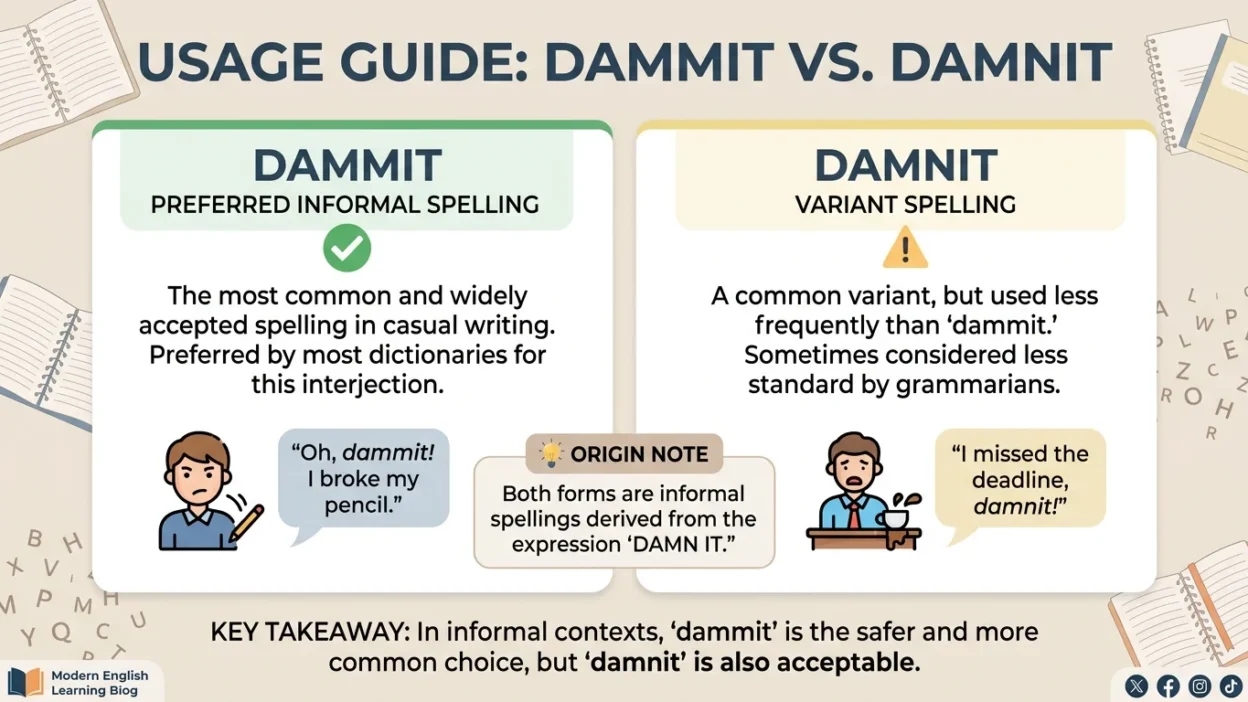
Dammit is the more standard and widely accepted spelling. Damnit is a common informal variant that reflects the way the expression may sound when spoken quickly. Both are used to express frustration or anger, but “dammit” is generally the better choice in writing.
Why People Confuse It
The confusion comes from the pronunciation of “damn it.”
When people say the expression quickly, the sounds can run together. This has led to different informal spellings, including dammit and damnit.
The original expression is:
Damn it!
The common informal spelling is:
Dammit!
You may also encounter:
Damnit!
However, “damnit” is generally considered a less conventional variant.
Dammit
Dammit is an informal interjection used to express frustration, anger, annoyance, or disappointment.
Examples:
Dammit! I forgot my keys.
Dammit, we missed the train.
Oh, dammit, I made the same mistake again.
It is essentially a written form that developed from “damn it.”
“Dammit” is common in informal dialogue, fiction, text messages, and casual online communication.
Damnit
Damnit is an informal variant spelling of “dammit.”
It is used with the same basic meaning.
For example:
Damnit! I broke the handle.
The spelling is understandable, but dammit is generally more established in standard dictionaries and general written usage.
If you are unsure which form to use, choose dammit.
Comparison Table
| Word or expression | Status | Meaning | Example |
|---|---|---|---|
| Dammit | Common informal spelling | Expresses frustration or anger | Dammit! I forgot again. |
| Damnit | Informal variant | Same meaning as dammit | Damnit! We are late. |
| Damn it | Original phrase | Expresses frustration or anger | Damn it! I lost my phone. |
| Damn | Interjection or verb | Expresses anger or disapproval, among other meanings | Damn, that was close. |
When to Use Each
Use “dammit” for the conventional informal spelling
Dammit, I left my wallet at home.
This is generally the best choice when you want to write the expression as one word.
Use “damnit” only when the informal variant fits your purpose
Damnit, I should have checked first.
It is understandable, but it is less conventional than “dammit.”
Use “damn it” when keeping the original two word form
Damn it, this is frustrating.
This form makes the origin of the expression especially clear.
Examples of Dammit and Damnit
- Dammit! I forgot my password again.
- Dammit, that was the wrong answer.
- Oh, dammit! We are already late.
- Dammit, I thought I had more time.
- She whispered, “Dammit,” under her breath.
- Damnit! The door is locked.
- He said, “Damnit, I should have known.”
- Dammit, why did I do that?
- I dropped the glass. Dammit!
- Damnit, we missed the last bus.
- Damn it, I forgot to send the email.
- Damn it! That really hurt.
Common Mistakes
1. Assuming “damnit” is the standard spelling
“Damnit” is widely recognizable, but dammit is generally the more established spelling.
2. Thinking “dammit” is a completely different word
It is essentially an informal written form that developed from “damn it.”
3. Using it in formal writing
“Dammit” is an informal and mildly profane expression. Avoid it in formal reports, academic writing, professional correspondence, and other situations where restrained language is expected.
4. Assuming it has only one emotional meaning
“Dammit” can express frustration, anger, annoyance, disappointment, or even strong emphasis.
For example:
Dammit, you were right!
The speaker may be frustrated about admitting that another person was correct.
5. Confusing “dammit” with “dammed”
These words are unrelated in usage.
Dammit is an exclamation.
Dammed is the past tense or past participle of “dam,” as in:
The river was dammed to control the water.
Memory Trick
Remember the original phrase:
DAMN IT → DAMMIT
The conventional informal spelling keeps the mm sound and letters from “damn” and “it” together.
So if you are unsure, remember:
Dammit = the safer informal spelling
Damnit = an informal variant
American vs British English
“Dammit” and “damnit” can both be encountered in American and British English. The main distinction is not a straightforward American versus British spelling difference.
Unlike pairs such as color / colour or center / centre, “dammit” and “damnit” are informal variants rather than established regional spellings.
Dammit is generally the more common conventional form.
Because the expression is informal and mildly profane, usage can also depend on the writer’s style and context.
Similar Words
If you want to express frustration without using profanity, several alternatives are available.
Darn it: A milder expression of frustration.
Shoot: A very mild expression of annoyance or disappointment.
Oh no: Expresses disappointment or concern.
Ugh: Expresses annoyance, frustration, or disgust.
Good grief: Expresses surprise, frustration, or disbelief.
Drat: An old fashioned but mild expression of annoyance.
For example:
Dammit, I forgot my wallet.
can become:
Darn it, I forgot my wallet.
The second sentence is much milder.
Final Verdict
Dammit is generally the preferred and more established informal spelling of the expression derived from “damn it.”
Damnit is also used, especially in casual writing and online communication, but it is better understood as an informal variant.
If you need to choose just one spelling, use dammit. If you need a more formal or polite expression, consider “darn it,” “oh no,” or another milder alternative.
FAQs
Is dammit or damnit correct?
Dammit is generally the more established spelling. “Damnit” is a common informal variant, but it is less conventional.
Is dammit one word?
Yes. Dammit is commonly written as one word in informal English. It developed from the expression “damn it.”
Is “damn it” also correct?
Yes. Damn it is the original two word expression and remains perfectly valid.
Is damnit a misspelling?
It can be considered a nonstandard or variant spelling rather than the conventional form. It is widely understandable and used in informal writing.
What does dammit mean?
“Dammit” is an exclamation used to express frustration, anger, annoyance, or disappointment.
Is dammit a bad word?
It is a mild profanity or swear expression. It is generally acceptable in some informal contexts but may be inappropriate in formal or professional situations.
Can I use dammit in academic writing?
It is generally best to avoid “dammit” in academic writing unless you are directly quoting someone or discussing the word itself.
Conclusion
The difference between dammit and damnit is mainly a matter of conventional spelling. Both forms are used as informal expressions of frustration, but dammit is the more established spelling and is usually the better choice.
Both forms developed from the phrase “damn it,” which remains another correct way to write the expression. Because the word is informal and mildly profane, consider your audience and situation before using it.
Remember This
Dammit is the preferred informal spelling.
Damnit is a common informal variant.
Damn it is the original two word expression.
When in doubt, choose dammit.

Nancy Lisa is a passionate writer and contributor at DrameyHut, focused on uncovering the deeper meanings behind dreams. She creates engaging and insightful content that helps readers interpret their dreams and understand their subconscious thoughts. Her work inspires self-reflection, clarity, and a stronger connection to inner emotions.