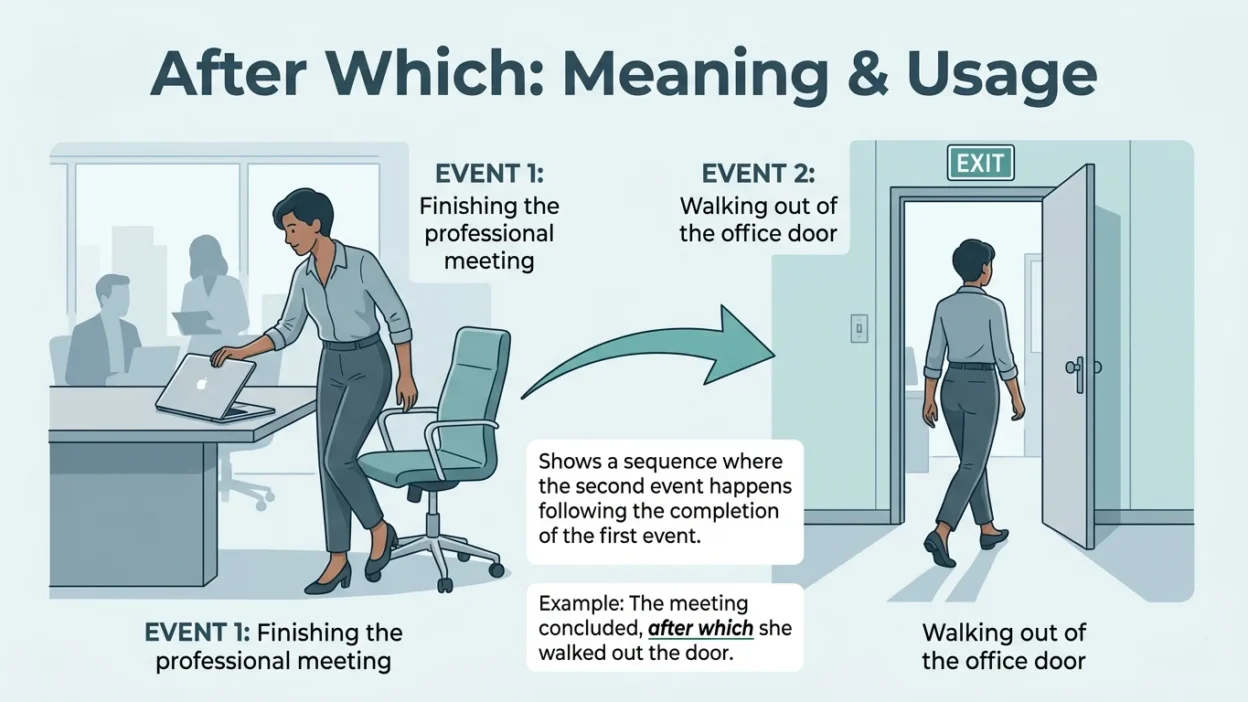
The phrase “after which” is a common relative structure in English, especially in formal, academic, professional, and written communication. It connects one event or action to another and means “after that” or “following which.” For example, “She completed the interview, after which she went home” means that she went home after completing the interview.
Although “after which” is grammatically correct, English learners sometimes wonder when to use it, whether a comma is necessary, and how it differs from simply saying “after that” or using “then.”
The answer depends mainly on sentence structure and the relationship between the two events. This guide explains after which usage, shows the most common sentence patterns, covers punctuation, and provides plenty of examples so you can use the expression naturally and correctly.
Quick Answer
“After which” means “after that” or “following which.” It refers back to a previously mentioned event, action, or situation and introduces what happened next. For example: “He finished the meeting, after which he returned to his office.” It is correct and often sounds more formal than “after that.”
What Does “After Which” Mean?
After which means after that event, action, or situation.
It connects two related events.
For example:
She finished her work, after which she went home.
This means:
She finished her work, and after that, she went home.
The word which refers back to the event or situation mentioned before it.
In the example above, which refers to the fact that she finished her work.
How “After Which” Works
The basic structure is:
First event + , after which + second event
For example:
The meeting ended, after which everyone left the building.
The first event is:
The meeting ended.
The second event is:
Everyone left the building.
After which connects the two events and shows that the second happened after the first.
Another example:
He submitted the application, after which he received a confirmation email.
The confirmation email came after the application was submitted.
Is “After Which” Grammatically Correct?
Yes, “after which” is completely grammatically correct.
It is a combination of the preposition after and the relative pronoun which.
It is particularly useful when you want to refer back to an entire preceding event or situation.
For example:
They discussed the proposal, after which they voted on it.
Here, which refers to the preceding event of discussing the proposal.
“After Which” Sentence Structure
One common structure is:
Main clause, after which + subject + verb.
Examples:
The class ended, after which the students went home.
She completed the report, after which her manager reviewed it.
We had dinner, after which we watched a movie.
The company announced the changes, after which employees received further instructions.
Notice that the clause after which normally contains its own subject and verb.
Why Is There Usually a Comma Before “After Which”?
When after which follows a complete independent clause, a comma is normally used before it.
For example:
He finished the presentation, after which the audience asked questions.
The comma separates the first complete clause from the following relative clause.
Without the comma:
He finished the presentation after which the audience asked questions.
This can be harder to read and may create ambiguity.
For clear formal writing, use:
He finished the presentation, after which the audience asked questions.
After Which vs After That
After which and after that can have very similar meanings, but they are used differently grammatically.
After which
She finished the meeting, after which she called her manager.
After which connects grammatically to the preceding clause.
After that
She finished the meeting. After that, she called her manager.
After that normally works as an independent adverbial phrase.
You can also say:
She finished the meeting, and after that, she called her manager.
The main difference is sentence structure and style.
After which often sounds more formal and compact.
After that is more conversational and direct.
After Which vs Then
Then simply shows sequence.
She finished the report and then went home.
After which emphasizes the relationship between the preceding event and what happened afterward.
She finished the report, after which she went home.
Both are correct.
In everyday conversation, then is often simpler.
In formal or academic writing, after which can provide a smoother connection between events.
After Which vs Following Which
Following which has a very similar meaning to after which.
For example:
The committee approved the proposal, after which construction began.
and:
The committee approved the proposal, following which construction began.
Both mean that construction began after the proposal was approved.
Following which can sound slightly more formal.
When to Use “After Which”
Use after which when:
- You are describing two events in sequence.
- The second event happens after the first.
- You want to refer back to a previously mentioned event or situation.
- You want a formal or concise written structure.
Examples:
The patient was examined, after which the doctor prescribed medication.
The contract was signed, after which the project officially began.
The guests arrived, after which dinner was served.
15 Examples of “After Which”
- She finished her homework, after which she watched television.
- The meeting ended, after which everyone returned to work.
- He completed the training, after which he received his certificate.
- We had dinner, after which we went for a walk.
- The doctor examined the patient, after which she explained the treatment.
- The company announced the decision, after which several employees asked questions.
- They signed the agreement, after which construction began.
- The students completed the test, after which they left the classroom.
- He submitted the application, after which he received a confirmation email.
- The police interviewed the witness, after which they released a statement.
- She gave her presentation, after which the audience asked questions.
- The guests arrived, after which the ceremony began.
- We discussed the problem, after which we agreed on a solution.
- The machine was repaired, after which production resumed.
- He completed the final interview, after which the company made its decision.
Can “After Which” Refer to a Person?
Usually, after which refers to a thing, event, action, or situation rather than directly referring to a person.
For people, after whom is normally used when the person is the object of the preposition.
For example:
She met the professor, after whom the award was named.
Here, whom refers to the professor.
However, if the phrase refers to an event involving a person, after which can still be correct:
She met the professor, after which she went home.
Here, which refers to the event of meeting the professor, not directly to the professor.
This distinction is important.
“After Which” at the Beginning of a Sentence
After which can appear at the beginning of a sentence when the context is already clear, although this is less common than placing it after the first clause.
For example:
The meeting ended at noon. After which, everyone returned to work.
In careful standard writing, it is generally better to make the structure complete:
The meeting ended at noon, after which everyone returned to work.
Or:
The meeting ended at noon. After that, everyone returned to work.
The second version is especially natural in everyday English.
Can You Use “After Which” in Formal Writing?
Yes. After which is particularly useful in formal writing.
It appears frequently in:
- Academic writing
- Business reports
- Legal writing
- Professional communication
- Historical writing
- Formal narratives
- News writing
For example:
The committee reviewed the evidence, after which it issued its recommendation.
This sounds concise and formal.
In casual conversation, a speaker might simply say:
The committee reviewed everything, and then they made a recommendation.
Both are correct.
Common Mistakes With “After Which”
Mistake 1: Using “after which” without a clear reference
The reader should be able to understand what which refers to.
Unclear:
He went there after which he called me.
Better:
He went to the office, after which he called me.
The first event should be clearly established.
Mistake 2: Forgetting the comma
In the common structure, use a comma before after which:
She finished the meeting, after which she left.
This makes the sentence easier to understand.
Mistake 3: Confusing “after which” with “after that”
These expressions are related but grammatically different.
Correct:
He finished the work, after which he went home.
Correct:
He finished the work. After that, he went home.
Mistake 4: Using “after which” when “then” is much simpler
There is nothing wrong with:
She ate dinner, after which she watched TV.
But in casual conversation, this may sound unnecessarily formal.
A more natural conversational version is:
She ate dinner and then watched TV.
Choose the structure according to the context.
Mistake 5: Using “after whom” and “after which” interchangeably
Use after whom when referring directly to a person.
The woman after whom the street was named was a famous writer.
Use after which when referring to a thing, event, action, or situation.
The ceremony ended, after which everyone went home.
After Which vs After Whom
This distinction is particularly useful.
After which
Used for things, events, actions, or situations.
The meeting ended, after which we went home.
After whom
Used for people.
The professor after whom the building was named was highly respected.
Remember:
which = thing or event
whom = person
After Which vs In Which
These expressions have different meanings.
After which means after that event or situation.
The meeting ended, after which everyone left.
In which means in that situation, place, period, or context.
The meeting was held in a room in which everyone could sit comfortably.
Do not use them interchangeably.
American vs British English
“After which” is standard in both American and British English.
There is no important difference in grammar or meaning between the two varieties.
For example:
The meeting ended, after which everyone left.
is correct in both American and British English.
The phrase may be more noticeable in formal writing than in casual conversation, but this applies to both varieties.
Similar Expressions
Depending on the context, you can use:
- After that
- Then
- Following that
- Following which
- Subsequently
- Later
- Afterwards
- Afterward
- Once that happened
Examples:
The meeting ended, after which everyone left.
The meeting ended. After that, everyone left.
The meeting ended, following which everyone left.
The meeting ended, and then everyone left.
The best choice depends on the formality and sentence structure.
A Simple Memory Trick
Remember:
After which = after that event.
If you can replace which with that event, the structure will often make sense.
For example:
She finished the exam, after which she went home.
Think:
She finished the exam. After that event, she went home.
This makes the meaning easy to understand.
Final Verdict
“After which” is a correct English expression meaning “after that” or “following which.”
It is commonly used to connect two events, especially in formal or written English.
The most common pattern is:
First event, after which + second event.
For example:
The meeting ended, after which everyone went home.
Use after which when you want a concise and formal connection between events. Use after that or then when you want a simpler, more conversational style.
FAQs About “After Which”
What does “after which” mean?
“After which” means after that event, action, or situation. It connects something that happened first with something that happened afterward.
Is “after which” grammatically correct?
Yes. After which is a standard and grammatically correct relative structure.
Do I need a comma before “after which”?
When it follows a complete clause, a comma is normally used:
She finished the meeting, after which she went home.
Is “after which” formal?
It is generally more formal or written than after that or then, so it is especially common in professional and academic writing.
Can I use “after which” in everyday conversation?
Yes, but it can sound somewhat formal. In casual conversation, after that or then may sound more natural.
What is the difference between “after which” and “after that”?
Both can mean the same thing, but after which connects grammatically to the preceding clause, while after that usually functions as a separate adverbial phrase.
Can “after which” refer to a person?
Usually, after which refers to a thing, event, action, or situation. When directly referring to a person, after whom may be appropriate.
What is another word for “after which”?
Depending on the context, alternatives include after that, following which, subsequently, afterward, and then.
Conclusion
After which is a useful English structure for showing that one event happened after another. It means “after that” or “following which” and is especially common in formal, academic, professional, and written English. The phrase normally follows a complete clause and is commonly separated from it by a comma.
The easiest way to understand it is to replace “after which” with “after that event.” If the meaning remains clear, the structure is probably appropriate. For casual speech, then or after that may sound simpler, while after which gives your writing a more concise and polished style.
Remember This
After which = after that event or situation.
Correct:
She finished the report, after which she went home.
Also correct:
She finished the report. After that, she went home.
For casual speech:
She finished the report and then went home.
Remember the key distinction:
After which = formal connection between events
After that = simpler, more conversational
Then = simple sequence

Daniel Charles is a dedicated author and dream interpretation enthusiast at DrameyHut. He specializes in analyzing dream symbols and meanings, offering clear and insightful content for readers. His work aims to help individuals understand their subconscious thoughts, gain clarity, and explore the deeper messages hidden within their dreams.