
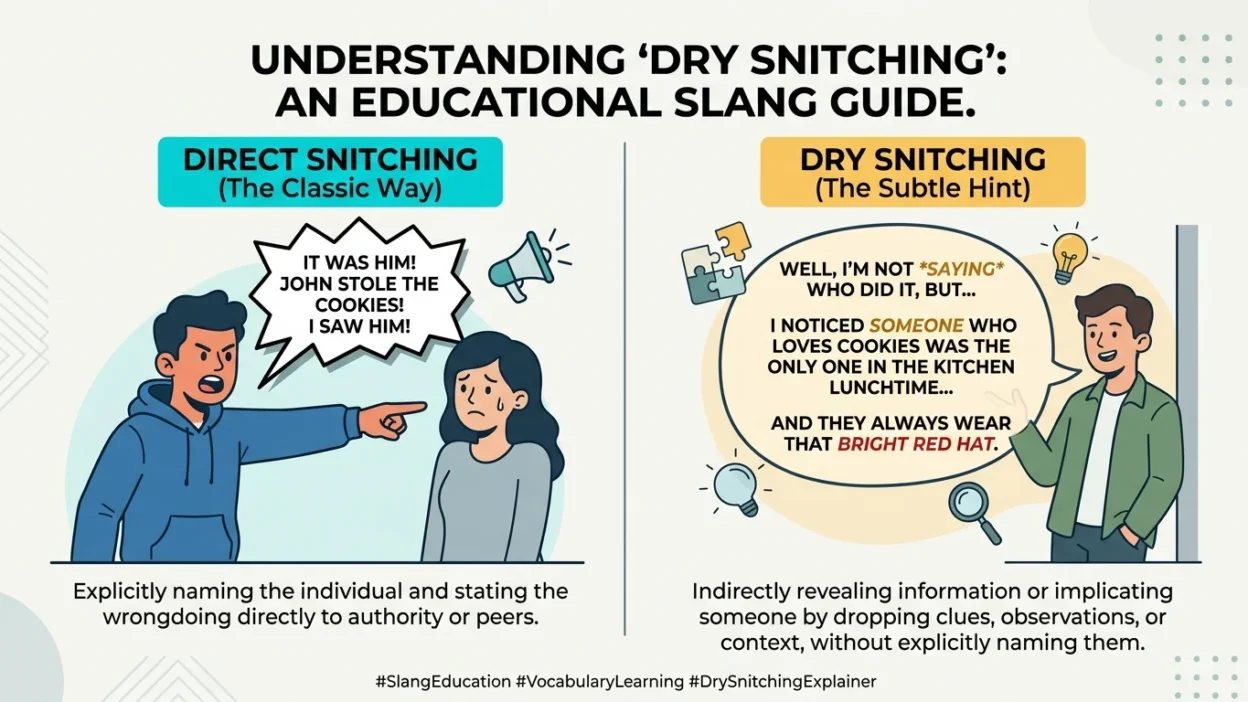
If you have heard someone say “Stop dry snitching”, you may have wondered what the phrase means. Dry snitching is informal slang, and it describes a particular way of revealing information about another person without directly saying that you are reporting them.
In general, dry snitching means indirectly revealing someone’s wrongdoing, rule breaking, or private behavior in a way that may expose them or get them into trouble. Instead of directly saying who did something, a person may give hints, mention specific details, or make a comment that allows others to identify the person involved.
The expression is usually negative because it suggests that someone is exposing another person while avoiding openly taking responsibility for reporting them. However, context matters. Reporting serious wrongdoing or dangerous behavior is not automatically “dry snitching” simply because information is being revealed.
Quick Answer
Dry snitching means indirectly revealing information about someone, especially information that could expose them or get them into trouble. It is informal slang and is usually used negatively. A person may dry snitch by giving hints, clues, or details instead of directly naming the person involved.
What Does Dry Snitching Mean?
Dry snitching refers to the act of indirectly exposing another person.
The person doing it may not directly say:
“John did it.”
Instead, they might say something like:
“Someone wearing a red jacket was the one who broke the rule.”
If everyone knows John was wearing a red jacket, the statement effectively identifies him without directly naming him.
That is the basic idea behind dry snitching.
Simple definition
Dry snitching = indirectly revealing information that exposes someone or may get them into trouble.
The phrase is most often used when the speaker believes the information was revealed unnecessarily or deliberately.
Why Is It Called Dry Snitching?
The word snitching generally means informing on someone or giving information about another person’s wrongdoing.
The word dry suggests that the person is not openly reporting or directly naming the other person. Instead, they are giving information indirectly.
For example:
“I didn’t say who was using the phone during the test. I just said someone in the back row was texting.”
If the comment was intended to identify the person, someone might call this dry snitching.
The person technically did not name anyone, but they gave enough information for others to figure out who was involved.
Dry Snitching vs Snitching
Dry snitching and snitching are closely related, but there is an important difference in how the information is revealed.
| Expression | Meaning | Example |
|---|---|---|
| Snitching | Directly reporting or informing on someone | “He told the teacher that Sam cheated.” |
| Dry snitching | Indirectly revealing information that exposes someone | “He said the person who cheated was sitting in the back.” |
| Gossiping | Sharing personal information or rumors | “She told everyone about her friend’s private problems.” |
| Telling on someone | Informally reporting someone’s behavior | “He told on his brother.” |
| Reporting | Giving information about a problem or violation | “She reported the safety issue to her manager.” |
The central idea behind dry snitching is indirect exposure.
Examples of Dry Snitching
1. At school
“He didn’t say my name, but he described exactly what I did. That’s dry snitching.”
2. At work
“Why did you mention that I left early yesterday? You’re dry snitching.”
3. Among friends
“You didn’t have to tell everyone where I was. That’s dry snitching.”
4. Breaking a rule
“She said someone had been using their phone during the meeting, and everyone knew who she meant.”
Someone might describe this as dry snitching if they believe she intentionally exposed the person.
5. In a family
“Mom, somebody ate the last piece of cake.”
If the speaker knows exactly who ate it and is trying to get that person into trouble without naming them, someone might jokingly call it dry snitching.
6. With roommates
“You told the landlord that someone had been having people over. That’s dry snitching.”
7. In a group
“Don’t give hints about who broke the rule. You’re dry snitching.”
8. On social media
“Posting all those details without naming him is still dry snitching.”
9. During a disagreement
“She didn’t accuse him directly, but her comments made it obvious what he had done.”
That could be described as dry snitching.
10. At work
“He kept mentioning who had arrived late. Everyone thought he was dry snitching.”
11. Among classmates
“She never said my name, but she told the teacher enough information to figure it out.”
“That’s dry snitching.”
12. In casual conversation
“If you’re going to tell them what happened, just say it directly. Don’t dry snitch.”
How to Use “Dry Snitching” in a Sentence
Dry snitching is usually used as an informal noun phrase or gerund phrase.
Common examples include:
“That’s dry snitching.”
“He is dry snitching.”
“Why are you dry snitching?”
“Stop dry snitching.”
“She was accused of dry snitching.”
You may also hear the verb form:
“He dry snitched on his friend.”
The expression is strongly informal, so it is more suitable for casual conversations, social media, and informal writing than for academic or professional communication.
What Does “Dry Snitch” Mean?
A dry snitch is a person who indirectly reveals information about another person, especially information that could expose them or cause trouble.
For example:
“He’s a dry snitch.”
This means the speaker believes that the person exposes others indirectly.
The phrase can also be used as a verb:
“Why are you dry snitching on him?”
Here, dry snitching means indirectly giving away information about him.
Dry Snitching vs Gossiping
Dry snitching and gossiping can overlap, but they are not exactly the same.
Gossiping involves talking about other people’s personal affairs, often when they are not present.
Dry snitching focuses more specifically on revealing information that exposes another person or may cause consequences for them.
For example:
“Did you hear that Sarah is moving to another city?”
This could be gossip if the information is private.
But:
“Sarah was the person who took the money.”
is direct disclosure.
If someone instead says:
“The person who took the money works in the front office.”
while deliberately giving enough information for people to identify Sarah, that could be called dry snitching.
Is Dry Snitching Always Bad?
The expression dry snitching is normally negative, but whether revealing information is actually wrong depends on the circumstances.
For example, reporting abuse, serious misconduct, fraud, threats, or dangerous behavior can be responsible. The fact that someone reveals information does not automatically make them a “snitch.”
The term mainly describes the speaker’s view of how the information was revealed and why it was revealed.
For example:
“She reported a dangerous situation to her supervisor.”
That is not necessarily dry snitching.
The phrase is more likely to be used when someone believes another person unnecessarily exposed someone through indirect comments or clues.
Common Mistakes
Mistake 1: Thinking dry snitching simply means gossiping
Not necessarily.
Gossip is generally about spreading personal information or rumors. Dry snitching specifically involves indirectly exposing another person’s actions or identity.
Mistake 2: Thinking dry snitching only involves crimes
It does not.
The expression can be used for relatively minor rule breaking.
For example:
“He told the teacher someone was texting during class.”
If he deliberately provided clues to identify the student, someone might call that dry snitching.
Mistake 3: Assuming every indirect statement is dry snitching
Context matters.
A person may accidentally reveal information without intending to expose anyone. The phrase usually carries an implication that the disclosure was deliberate or had an exposing effect.
Mistake 4: Using dry snitching in formal writing
Dry snitching is informal slang.
In formal contexts, you could use expressions such as:
indirectly reporting someone
revealing information about someone’s misconduct
indirectly exposing someone’s actions
Mistake 5: Thinking dry snitching and direct snitching are identical
They are related, but dry snitching emphasizes indirectness.
Direct snitching openly reports someone, while dry snitching gives away information through hints, comments, or clues.
Memory Trick
Remember:
Snitching tells. Dry snitching hints.
If someone directly says:
“John broke the rule.”
that is direct reporting or snitching.
If someone says:
“Someone wearing a red shirt broke the rule.”
while clearly trying to make John identifiable, that may be described as dry snitching.
So remember:
Direct = tells.
Dry = hints.
American vs British English
Dry snitching is primarily associated with informal American English slang.
The expression may be understood by English speakers in other countries, especially through American movies, television, music, and social media, but its everyday use is not necessarily the same everywhere.
In formal American or British English, clearer expressions such as indirectly reporting someone or revealing information about someone’s behavior may be more appropriate.
Similar Words and Expressions
Snitch
An informal word for someone who informs on another person.
“Nobody likes a snitch.”
Informant
A person who provides information, especially to authorities. This is more neutral and formal than snitch.
Tell on someone
An informal expression meaning to report someone’s behavior.
“Don’t tell on me.”
Rat someone out
An informal expression meaning to reveal information about someone, especially information that may get them into trouble.
Give someone away
To reveal information that exposes someone’s identity, location, or actions.
Report someone
A more neutral expression meaning to provide information about someone’s behavior.
Expose someone
To reveal information about someone’s actions, identity, or behavior.
Final Verdict
Dry snitching means indirectly revealing information about another person, especially information that could expose them or get them into trouble.
The main difference between dry snitching and ordinary snitching is the method. Direct snitching openly reports someone, while dry snitching gives away information through hints, clues, comments, or details.
The phrase is informal slang and usually has a negative tone. However, context matters. Reporting serious wrongdoing, danger, abuse, or misconduct can be responsible and should not automatically be described as dry snitching.
Frequently Asked Questions
What does dry snitching mean in slang?
Dry snitching means indirectly revealing information about someone, especially information that could expose them or get them into trouble.
What is an example of dry snitching?
If someone says, “I won’t say who broke the rule, but it was the person sitting next to you,” they may be indirectly identifying the person. This could be described as dry snitching.
Is dry snitching the same as snitching?
They are related but not identical. Snitching can involve directly reporting someone, while dry snitching emphasizes indirectly revealing information.
Is dry snitching always bad?
The phrase is normally used negatively, but reporting dangerous or seriously harmful behavior can be responsible. Context is important.
Is dry snitching slang?
Yes. Dry snitching is an informal slang expression, particularly associated with American English.
What is a dry snitch?
A dry snitch is someone who indirectly reveals information about another person, especially information that may expose them or cause consequences.
Can dry snitching happen accidentally?
The phrase usually suggests intentional or consequential disclosure, but people can use it loosely for comments that unintentionally reveal someone else’s actions.
What is another word for dry snitching?
Depending on the context, alternatives include indirectly reporting, indirectly exposing someone, giving someone away, or revealing information about someone’s actions.
Conclusion
Dry snitching is informal slang for indirectly exposing someone by revealing information that can identify them or potentially get them into trouble. Unlike direct snitching, the person does not necessarily name the other person or openly report them. Instead, they may use hints, clues, comments, or specific details.
The expression is usually negative because it suggests that someone is revealing information while avoiding directly admitting that they are reporting another person. However, the phrase should always be understood in context. Reporting genuine danger, serious wrongdoing, or harmful behavior can be responsible rather than improper.
Remember This
Dry snitching means indirectly exposing someone by giving away information that can identify them or get them into trouble.
Snitching = directly tells.
Dry snitching = indirectly hints or reveals.
Because it is slang, use dry snitching mainly in casual conversation and informal contexts.

Nancy Lisa is a passionate writer and contributor at DrameyHut, focused on uncovering the deeper meanings behind dreams. She creates engaging and insightful content that helps readers interpret their dreams and understand their subconscious thoughts. Her work inspires self-reflection, clarity, and a stronger connection to inner emotions.