“Which one is you?” and “Which one are you?” may look almost identical, but they do not sound equally natural in standard English. The confusion usually comes from the verb is versus are and the way the pronoun you works in a question.
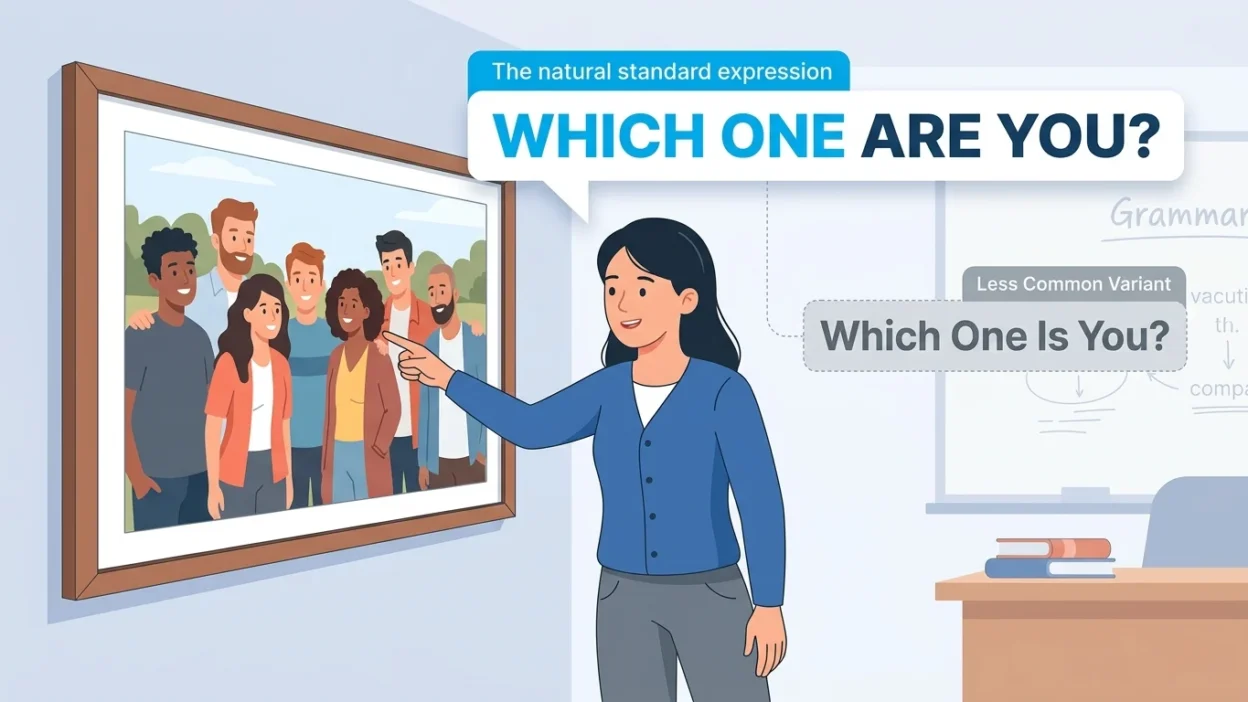
If you are looking at a photograph, a group of people, a list of names, or several characters and want someone to identify themselves, the natural question is “Which one are you?” This is the standard expression used in everyday English.
You may occasionally hear “Which one is you?”, especially in very informal speech or when someone is thinking of “you” as a particular identity or representation. However, it is generally less natural and is not the preferred form for standard English. Understanding why are is used makes this difference easy to remember.
Quick Answer
“Which one are you?” is the standard and natural expression when asking someone to identify themselves from several people or choices. “Which one is you?” can occur in informal speech, but it often sounds unnatural. In most situations, use “Which one are you?”
Why People Confuse “Which One Is You” and “Which One Are You”
The confusion often happens because which one is singular.
Learners may think:
one = singular = is
That leads them to:
Which one is you?
However, the question is not simply about the word one. The pronoun you is also part of the subject and complement relationship, and you takes are in standard English.
We say:
You are the person in the picture.
When we turn that idea into a question, we get:
Which one are you?
The word order changes, but are remains associated with you.
Which One Are You?
“Which one are you?” is the standard and most natural way to ask someone to identify themselves from a group or selection.
For example, imagine that you are looking at a photograph containing six people. You can ask:
Which one are you?
The question means:
Which person in this picture is you?
However, English naturally uses:
Which one are you?
rather than:
Which person is you?
Common situations
You can use “Which one are you?” when identifying someone in:
- A photograph
- A family picture
- A group of students
- A video
- A drawing
- A team
- A list of people
- A group of characters
Examples
Which one are you in this picture?
Which one are you in the family photo?
There are five people here. Which one are you?
Which one are you in the video?
I cannot recognize you. Which one are you?
Which one are you on the team?
Which One Is You?
“Which one is you?” can be understood, and you may hear it in informal speech, but it is not normally the preferred standard construction.
The main problem is that you normally takes are.
We say:
You are here.
You are the person in the photograph.
You are the winner.
We do not normally say:
You is here.
So when asking someone directly which person they are, standard English naturally gives us:
Which one are you?
rather than:
Which one is you?
Why might people say “Which one is you?”
In casual speech, people sometimes treat you as though it refers to a particular representation, character, image, or identity.
For example:
Which character is you?
The intended meaning might be:
Which character represents you?
However, even in this context, many speakers would choose a more natural construction:
Which character are you?
or:
Which character represents you?
Therefore, “Which one is you?” is understandable but generally less natural than “Which one are you?”
Which One Is You vs Which One Are You
| Expression | Standard English | Naturalness | Meaning |
|---|---|---|---|
| Which one are you? | Yes | Very natural | Asking someone to identify themselves |
| Which one is you? | Less standard | Often awkward | Asking which option represents or corresponds to someone |
| Which one is yours? | Yes | Very natural | Asking which item belongs to someone |
| Which one represents you? | Yes | Natural | Asking which option symbolizes someone |
| Who are you? | Yes | Very natural | Asking about someone’s identity generally |
The easiest choice is “Which one are you?” when you are directly asking a person to identify themselves.
When to Use “Which One Are You?”
Use “Which one are you?” when there are several possible people or identities and you want someone to tell you which one is them.
In a photograph
Which one are you in this photograph?
In a group
There are six people here. Which one are you?
In a family picture
Which one are you in the family picture?
In a video
Which one are you in the video?
Among several characters
Which one are you?
On a team
Which one are you on the team?
The expression is flexible and works in many everyday situations.
When Can “Which One Is You?” Be Used?
Although “Which one is you?” is less standard, there are contexts where speakers may use it informally.
For example:
There are four cartoon characters here. Which one is you?
The speaker may mean:
Which character represents you?
Another possibility is:
Which one is you in this picture?
The intended meaning is clear, but many speakers would still prefer:
Which one are you in this picture?
The important point is that being understandable does not necessarily make an expression the most natural choice in standard English.
If you are writing an article, email, school assignment, professional message, or other careful English, “Which one are you?” is the better choice.
12 Examples of “Which One Are You?”
Here are natural examples:
- Which one are you in this picture?
- Which one are you in the family photo?
- Which one are you among these students?
- Which one are you in the video?
- Which one are you on the team?
- Which one are you supposed to be?
- Which one are you in this drawing?
- Which one are you in the old photograph?
- Which one are you among these people?
- Which one are you, the person in the blue shirt?
- I cannot recognize you. Which one are you?
- There are several characters here. Which one are you?
These examples all use are because the question directly addresses you.
Common Mistakes
Mistake 1: Thinking “one” must always be followed by “is”
It is true that one is singular, but that does not mean every question containing which one must use is.
Compare:
Which one are you?
Here, the verb agrees with you.
Compare it with:
Which one is yours?
Here, is is correct because the structure is different.
Mistake 2: Saying “Which one is you?” in standard situations
Although people may understand it, it can sound unnatural.
For standard English, use:
Which one are you?
Mistake 3: Confusing “you” with “yours”
These questions have different meanings:
Which one are you?
This asks which person you are.
Which one is yours?
This asks which object belongs to you.
For example:
Which bag is yours?
Here, you are identifying possession, not identity.
Mistake 4: Assuming “Which one are you?” is informal
It is perfectly standard English and can be used in both everyday and professional contexts when the situation calls for it.
Mistake 5: Using “Which one is you?” when “Which one represents you?” is intended
If you are talking about a personality type, symbol, character, or representation, “Which one represents you?” may communicate the intended meaning more clearly.
Memory Trick
Remember one simple rule:
You goes with are.
So:
You are.
becomes:
Which one are you?
Another useful memory trick is:
Identity = Which one are you?
Possession = Which one is yours?
For example:
Which one are you?
asks about a person’s identity.
Which one is yours?
asks about something belonging to that person.
American vs British English
There is no major difference between American and British English here.
Both varieties normally use:
Which one are you?
The expression “Which one is you?” may occur in informal speech, but it is not a standard American versus British distinction.
The basic grammar remains the same:
You are.
Therefore:
Which one are you?
is the broadly natural form in both American and British English.
Similar Expressions
Which one are you?
Used when identifying a person from several possibilities.
Which one are you in the picture?
Who are you?
A more general question about identity.
Who are you?
It does not necessarily involve several choices.
Which one is yours?
Used to ask which object belongs to someone.
Which one is yours, the red bag or the black one?
Which one belongs to you?
A more explicit question about ownership.
Which one belongs to you?
Which one represents you?
Useful when discussing characters, symbols, personality types, or other representations.
Which character represents you?
Which person are you?
Grammatically possible, but usually less natural than:
Which one are you?
Final Verdict
“Which one are you?” is the standard and natural expression when asking someone to identify themselves from a group, photograph, video, or set of choices.
“Which one is you?” can be understood and may appear in informal speech, but it is generally less natural in standard English. It can sometimes be used when “you” is being treated as an identity or representation, but clearer alternatives are usually available.
If you want the safest and most natural form, remember:
Which one are you?
The key grammar rule is simple: you takes are.
Frequently Asked Questions
Is “Which one are you?” correct?
Yes. “Which one are you?” is grammatically correct and natural English.
Is “Which one is you?” correct?
It can be understood and is sometimes used informally, but it is generally less natural than “Which one are you?”
Why do we use “are” in “Which one are you?”
Because the pronoun you takes are.
You are.
Therefore:
Which one are you?
Which is better, “Which one is you” or “Which one are you”?
“Which one are you?” is the standard and more natural choice when asking someone to identify themselves.
Can I say “Which one is yours?”
Yes. “Which one is yours?” is completely correct, but it asks which object belongs to someone.
What is the difference between “Which one are you?” and “Who are you?”
“Which one are you?” asks someone to identify themselves from several choices. “Who are you?” is a broader question about identity.
Can “Which one is you?” be used in casual English?
Yes, it may occur in casual speech, especially when discussing characters, pictures, or representations. However, “Which one are you?” is generally more natural.
What is the easiest way to remember the correct form?
Remember:
You = are
So when asking someone to identify themselves, say:
Which one are you?
Conclusion
The difference between “Which one is you?” and “Which one are you?” becomes much easier once you remember that you takes are in standard English. When you are looking at a group of people or several choices and asking someone to identify themselves, “Which one are you?” is the natural question.
Although “Which one is you?” may appear in informal speech, it can sound awkward and is not normally the preferred standard form. Use “Which one are you?” for clear, natural English, and use “Which one is yours?” when you are asking about possession instead of identity.
Remember This
You goes with are.
So:
Which one are you? = asking about identity.
Which one is yours? = asking about possession.
Which one represents you? = asking about representation.
For standard English, choose “Which one are you?”

Christopher Thomas is a passionate writer and dream researcher dedicated to exploring the meanings behind dreams. As an author at DrameyHut, he creates insightful and easy-to-understand interpretations that help readers connect with their subconscious mind. His work focuses on guiding individuals toward self-discovery, clarity, and a deeper understanding of their inner thoughts.