
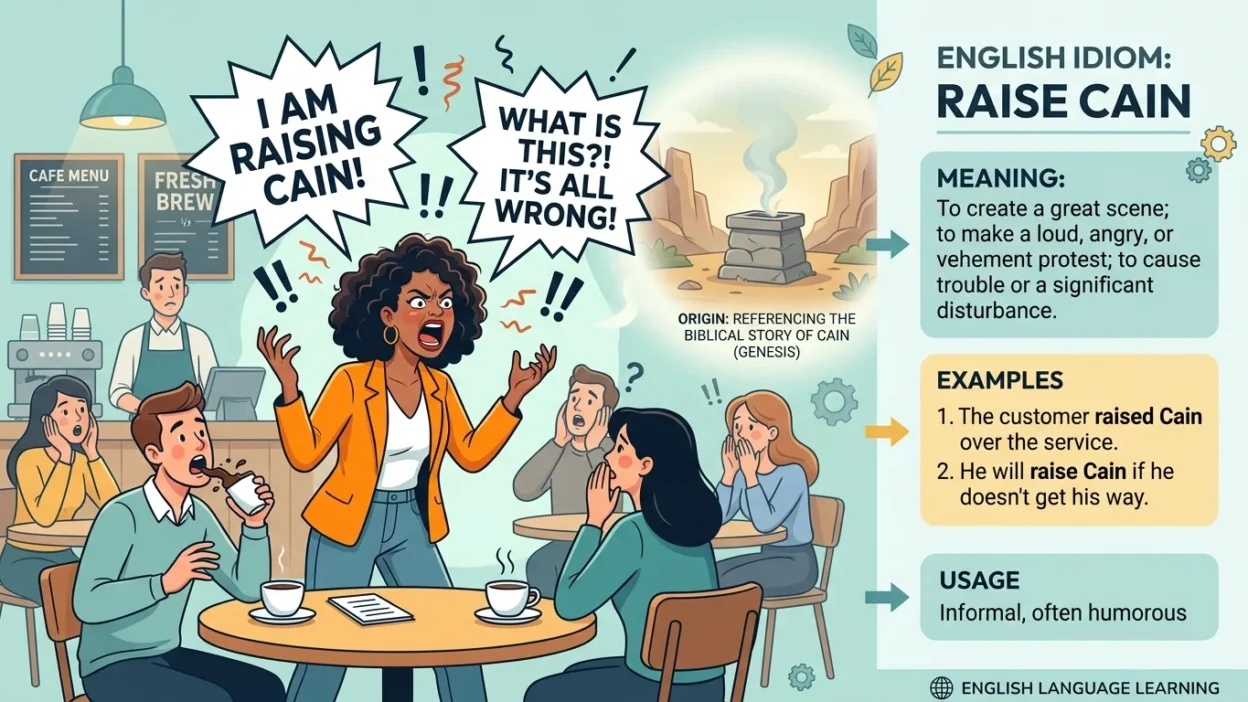
If you hear someone say that they are going to “raise Cain,” they are not talking about literally raising a person named Cain. This colorful English idiom means to cause a lot of trouble, make a loud disturbance, create an angry scene, or strongly protest against something.
The expression is informal and is often used when someone becomes angry and makes their feelings impossible to ignore. For example, if a customer receives terrible service and loudly demands to speak to the manager, someone might say, “He raised Cain at the restaurant.”
Depending on the situation, raising Cain can involve anger, shouting, complaining, protesting, or creating general chaos. In this guide, you will learn the exact meaning of “raise Cain,” where the expression comes from, how to use it naturally, common mistakes, and easy ways to remember it.
Quick Answer
Raise Cain means to make a loud disturbance, cause trouble, protest angrily, or create a scene. It is an informal idiom, often used when someone becomes angry and makes their displeasure very obvious. “Raise Cain” can also be spelled raise hell, depending on the context.
What Does “Raise Cain” Mean?
Raise Cain means to cause trouble, make a disturbance, or become very angry and vocal about something.
It is usually used when someone’s behavior becomes loud, forceful, disruptive, or difficult to ignore.
For example:
The customer raised Cain when the store refused to give him a refund.
This means the customer became very angry and made a strong complaint or disturbance.
The expression can also mean to protest strongly:
The residents raised Cain about the sudden increase in parking fees.
Here, the residents strongly objected to the change.
What Does Cain Mean in the Expression?
Cain refers to the biblical figure Cain, who appears in the Book of Genesis.
According to the biblical account, Cain killed his brother Abel. The name therefore became associated in English with wrongdoing, conflict, and trouble.
In the idiom raise Cain, however, the expression is not meant literally. It is a colorful way of describing someone causing trouble or making a major disturbance.
Why Is It Called “Raise Cain”?
The exact development of the expression is not completely certain, but it is generally connected with the biblical story of Cain.
The phrase is an American English idiom that became established in the nineteenth century.
It is often explained as a figurative reference to bringing Cain into the situation, although the precise historical pathway from the biblical name to the idiom is not completely settled.
The expression has survived because it provides a vivid way to describe someone making a serious fuss or causing trouble.
Raise Cain Examples
Here are some natural examples of how to use the expression:
- The customer raised Cain when the restaurant charged him twice.
- My father will raise Cain if he finds out what happened.
- The residents raised Cain about the sudden rent increase.
- She raised Cain when her flight was canceled.
- The manager raised Cain after discovering the mistake.
- The parents raised Cain about the school’s new policy.
- He raised Cain when the mechanic returned his car late.
- The passengers raised Cain after waiting for hours.
- Don’t make me raise Cain over something so small.
- The workers raised Cain about the unsafe conditions.
- She threatened to raise Cain if the company did not respond.
- The fans raised Cain after the controversial decision.
- He raised Cain at the meeting when his proposal was rejected.
- The neighbors raised Cain about the loud construction work.
- The customer was furious and started raising Cain at the counter.
Is “Raise Cain” a Negative Expression?
Usually, yes.
Raise Cain generally describes disruptive, angry, or troublesome behavior.
However, the phrase does not always imply that the person’s complaint is unreasonable.
For example:
The workers raised Cain about unsafe working conditions.
The expression describes their strong and possibly noisy protest. It does not necessarily mean that their complaint was wrong.
The meaning focuses more on how strongly they reacted than on whether their underlying complaint was justified.
Raise Cain vs Raise Hell
Raise hell is a closely related expression.
Both can mean to cause trouble, make a disturbance, or protest angrily.
For example:
She raised Cain when she discovered the mistake.
She raised hell when she discovered the mistake.
Both sentences suggest a strong reaction.
However, raise hell is generally more forceful and can sound more vulgar because of the word “hell.”
Raise Cain can sometimes sound more old fashioned or folksy.
Raise Cain vs Make a Scene
These expressions are similar but not identical.
Make a scene means to behave loudly or dramatically in a public place, especially in a way that attracts attention.
Raise Cain is broader. It can describe making a scene, causing trouble, protesting angrily, or creating a disturbance.
Compare:
She made a scene at the restaurant.
This emphasizes embarrassing or disruptive public behavior.
She raised Cain about the poor service.
This emphasizes her angry protest or complaint.
Raise Cain vs Raise a Fuss
Raise a fuss means to complain or make a big issue out of something.
Raise Cain usually suggests a stronger, angrier, or more disruptive reaction.
For example:
He raised a fuss about the delay.
This suggests a complaint.
He raised Cain about the delay.
This suggests a much more forceful reaction.
The exact strength depends on context.
Can “Raise Cain” Mean to Cause Trouble?
Yes.
One of the main meanings of the expression is to cause trouble or create a disturbance.
For example:
The kids raised Cain while their parents were away.
This means the children caused a lot of trouble or made a great disturbance.
It does not necessarily mean that they were angry. The expression can focus on noisy or disruptive behavior.
Can “Raise Cain” Mean to Complain?
Yes.
The expression is frequently used when someone complains loudly or angrily.
For example:
The passengers raised Cain about the canceled flight.
This means they complained strongly and made their dissatisfaction known.
The complaint can be directed toward a person, company, organization, or situation.
Common Mistakes
1. Taking “Raise Cain” Literally
The expression is idiomatic.
It does not mean physically raising someone named Cain.
2. Assuming It Always Means Violence
Raising Cain does not necessarily mean becoming physically violent.
It can simply mean complaining loudly, protesting, making a scene, or causing trouble.
3. Thinking the Complaint Must Be Unreasonable
The idiom describes the intensity or disruptive nature of the reaction. It does not automatically tell us whether the complaint itself is justified.
4. Using It in Very Formal Writing
“Raise Cain” is informal and somewhat colorful.
In formal writing, alternatives such as protest strongly, complain forcefully, create a disturbance, or object strongly may be more appropriate.
5. Confusing Cain With Cane
Cain is the name in the idiom.
Cane is a completely different word, referring to a stick or walking aid, among other meanings.
The correct expression is:
raise Cain
Not:
raise cane
Raise Cain in a Sentence
The most common grammatical pattern is:
raise Cain about + something
Examples:
They raised Cain about the new rules.
You can also use:
raise Cain when + situation
She raised Cain when she saw the bill.
Or:
raise Cain over + something
The customers raised Cain over the price increase.
You can use the expression in different tenses:
Present: He raises Cain whenever something goes wrong.
Past: He raised Cain yesterday.
Future: He will raise Cain if he finds out.
Continuous: She is raising Cain about the decision.
American vs British English
Raise Cain is strongly associated with American English and has a distinctly informal, sometimes old fashioned American flavor.
British English speakers can understand the expression, but other expressions such as make a fuss, make a scene, or kick up a fuss may be more natural depending on the context.
The expression is still understandable to many English speakers because of its appearance in American literature, films, television, and popular culture.
Is “Raise Cain” Still Used?
Yes, but it is less common than many everyday alternatives.
You may still encounter it in informal American speech, books, newspapers, movies, and humorous writing.
It can sometimes sound colorful, folksy, old fashioned, or deliberately expressive.
More common modern alternatives include:
make a scene
raise hell
make a fuss
cause trouble
complain loudly
protest strongly
Similar Expressions
Here are some expressions with related meanings:
Raise hell: Cause trouble or protest angrily.
Make a scene: Behave loudly or dramatically, especially in public.
Raise a fuss: Complain or object strongly.
Kick up a fuss: Make a noticeable complaint or protest.
Cause trouble: Create problems or difficulties.
Make a stink: Complain strongly about something.
Kick up a storm: Cause a lot of trouble or protest strongly.
Make a big deal: Treat something as more important or serious than it may be.
Memory Trick
Think of Cain as a name associated with trouble.
So:
Raise Cain = raise trouble.
Another easy memory sentence is:
When someone raises Cain, they make enough trouble for everyone to notice.
You can also connect it with:
Raise Cain = complain loudly + cause trouble.
FAQs
What does raise Cain mean?
“Raise Cain” means to cause trouble, make a disturbance, protest angrily, or complain very strongly.
Is raise Cain an idiom?
Yes. “Raise Cain” is an informal English idiom.
Is raise Cain offensive?
No, it is generally not considered highly offensive. It is an informal and colorful expression.
Does raise Cain mean raise hell?
They have very similar meanings. Both can mean causing trouble or protesting angrily, although “raise hell” can sound stronger and more vulgar.
What is another way to say raise Cain?
Depending on the context, you can say make a scene, raise hell, raise a fuss, cause trouble, complain loudly, or protest strongly.
Where does raise Cain come from?
The expression is associated with the biblical figure Cain from Genesis. The exact historical development of the idiom is uncertain, but the phrase became established in American English during the nineteenth century.
Can you raise Cain without being angry?
Yes. The expression can describe causing trouble or making a loud disturbance even when anger is not the main emotion.
Is raise Cain formal English?
No. It is informal and somewhat colorful. In formal writing, clearer expressions such as “protest strongly” or “complain forcefully” are usually better.
Final Verdict
Raise Cain means to cause trouble, make a disturbance, or protest angrily and loudly.
It is an informal idiom associated with American English and is often used when someone’s reaction is strong enough to attract attention.
Remember that the expression does not necessarily mean violence, and it does not automatically mean that the person’s complaint is unreasonable. It mainly describes a strong, noisy, or troublesome reaction.
Conclusion
The idiom “raise Cain” is a colorful way to describe someone causing trouble, making a disturbance, or protesting strongly. It is often used when a person becomes angry and makes their dissatisfaction very obvious.
The expression has a connection with the biblical name Cain, although the exact historical development of the idiom is uncertain. Today, it remains an understandable informal expression, particularly in American English. If you want a simpler modern alternative, you can usually say make a scene, raise a fuss, complain loudly, or cause trouble, depending on the context.
Remember This
Raise Cain = cause trouble or protest angrily.
Think:
Cain = trouble
Raise Cain = make a big fuss or cause a disturbance.

Daniel Charles is a dedicated author and dream interpretation enthusiast at DrameyHut. He specializes in analyzing dream symbols and meanings, offering clear and insightful content for readers. His work aims to help individuals understand their subconscious thoughts, gain clarity, and explore the deeper messages hidden within their dreams.