Tortuous vs torturous is a commonly confused word pair because the two words look almost identical and both are associated with something difficult or unpleasant. However, they describe different kinds of difficulty.
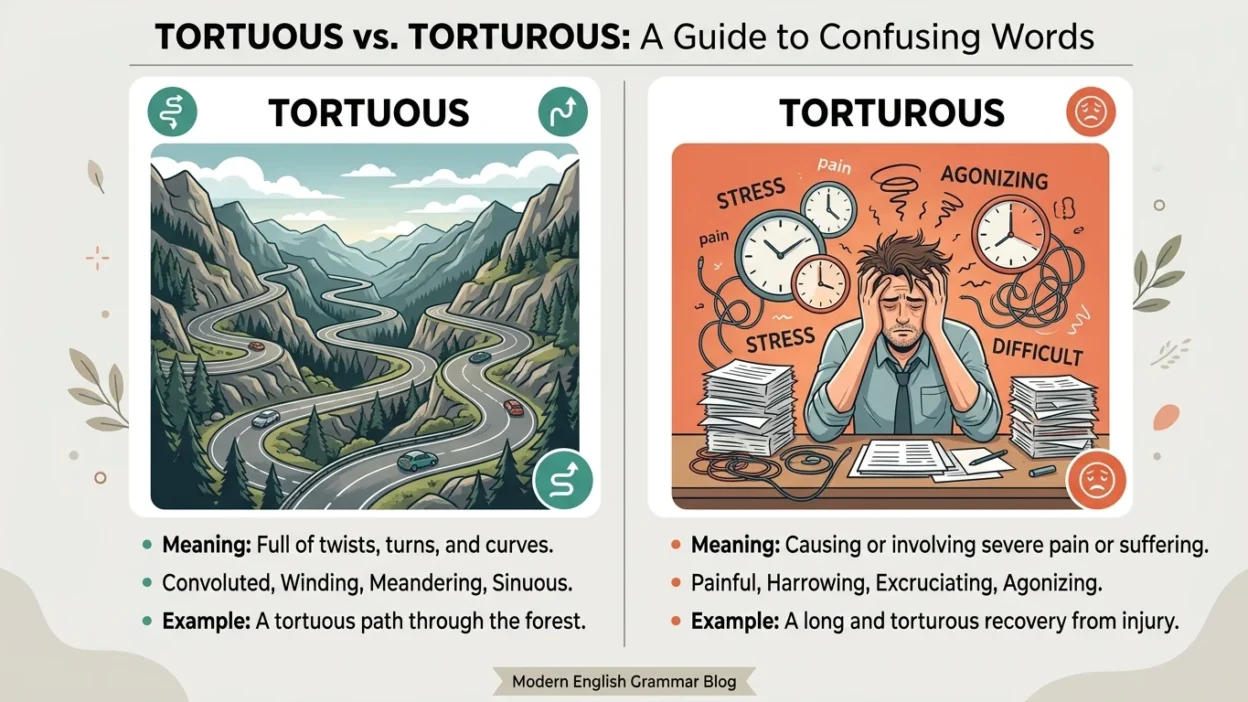
Tortuous usually describes something that is full of twists, bends, turns, or complicated indirect routes. It can describe a winding road, a complicated argument, or a process that takes an indirect path.
Torturous, on the other hand, describes something that causes severe physical or emotional pain, suffering, or distress. It comes from the idea of torture and is used for experiences that feel extremely painful or unbearable.
The difference becomes much easier when you connect each word with its core idea:
Tortuous = twisted or winding
Torturous = painful or tormenting
In this guide, you will learn the meanings of tortuous and torturous, how to use them correctly, their pronunciation, examples, common mistakes, an easy memory trick, and the difference between similar words.
Quick Answer: Tortuous vs Torturous
Tortuous means winding, twisting, complicated, or indirect.
Torturous means causing extreme pain, suffering, or distress.
Easy rule:
Tortuous = twists and turns
Torturous = torture and suffering
For example:
- We drove along a tortuous mountain road.
- The waiting period was torturous.
What Does “Tortuous” Mean?
Tortuous is an adjective used to describe something that has many twists, bends, turns, or complicated changes of direction.
It can describe something physical, such as a road or path, or something figurative, such as an argument, explanation, or process.
Tortuous for Winding Roads and Paths
When tortuous describes a physical route, it means the route is winding, twisting, or difficult to follow.
Examples:
- We followed a tortuous mountain road.
- The hikers took a tortuous path through the forest.
- The river follows a tortuous course through the valley.
- The narrow road was extremely tortuous.
In these examples, the word focuses on the shape or direction of the route.
Tortuous for Complicated Ideas or Processes
Tortuous can also be used figuratively to describe something that is complex, indirect, or difficult to follow.
Examples:
- The lawyer gave a tortuous explanation of the case.
- The negotiations followed a tortuous process.
- His argument was long and tortuous.
- The project took a tortuous route to completion.
Here, tortuous does not necessarily mean painful. It means the process or reasoning is complicated, indirect, or full of twists and turns.
What Does “Torturous” Mean?
Torturous is an adjective meaning causing extreme pain, suffering, anguish, or distress.
It is related to torture, which helps explain its meaning.
Examples:
- The injury caused torturous pain.
- The waiting was torturous.
- The experience was emotionally torturous.
- The long journey became torturous.
When you use torturous, the focus is on suffering or torment, not on physical twists and turns.
Tortuous vs Torturous: Comparison Table
| Word | Meaning | Common Uses | Example |
|---|---|---|---|
| Tortuous | Winding, twisting, complicated, or indirect | Roads, paths, arguments, processes | We drove along a tortuous road. |
| Torturous | Extremely painful or distressing | Experiences, pain, waiting, suffering | The wait was torturous. |
The easiest distinction is:
Tortuous = complicated or winding
Torturous = painful or distressing
Tortuous vs Torturous Examples
Examples of Tortuous
- The road through the mountains was tortuous.
- We followed a tortuous path through the forest.
- The river takes a tortuous route toward the sea.
- The negotiations were long and tortuous.
- His explanation was unnecessarily tortuous.
- The legal process was tortuous and complicated.
- The trail became increasingly tortuous as we climbed.
- The story follows a tortuous chain of events.
- The narrow streets formed a tortuous maze.
- Her reasoning was so tortuous that it was difficult to understand.
Examples of Torturous
- The pain was torturous.
- Waiting for the results was torturous.
- The experience was emotionally torturous.
- The heat made the journey torturous.
- The uncertainty became torturous.
- He described the recovery period as torturous.
- The sleepless night was torturous.
- The long delay was absolutely torturous.
- The physical discomfort became torturous.
- The prolonged uncertainty was torturous for everyone involved.
What Is the Difference Between Tortuous and Torturous?
The main difference is what kind of difficulty the word describes.
Tortuous describes twists, turns, complexity, or indirectness.
Torturous describes pain, suffering, or extreme distress.
Consider these two sentences:
The road was tortuous.
This means the road had many twists and turns.
The journey was torturous.
This means the journey was extremely painful, difficult, or distressing.
Both sentences can describe the same journey, but they emphasize different things.
For example:
The tortuous mountain road made the journey torturous.
Here, tortuous describes the winding road, while torturous describes the unpleasant experience.
Why Do People Confuse Tortuous and Torturous?
The confusion comes mainly from their similar spelling.
Both words begin with tort and contain several of the same letters:
tortuous
torturous
They are also both adjectives and can describe something difficult.
However, their endings provide a useful clue.
Tortuous is associated with twists and turns.
Torturous is associated with torture and suffering.
A Simple Memory Trick
The easiest way to remember the difference is to connect torturous with the word torture.
Tortuous
Think:
Tortuous → twists and turns
A tortuous road winds from one direction to another.
Torturous
Think:
Torturous → torture → pain
A torturous experience causes severe suffering or distress.
So remember:
Tortuous roads twist.
Torturous experiences hurt.
This simple association can help you choose the correct word quickly.
Tortuous vs Torturous in Sentences
Compare these examples:
The mountain road was tortuous.
The road was winding and full of turns.
The mountain journey was torturous.
The journey was extremely unpleasant or painful.
Another example:
The explanation was tortuous.
The explanation was complicated and indirect.
The experience was torturous.
The experience caused severe emotional or physical distress.
The words can occasionally appear in the same sentence:
The tortuous route made the long journey even more torturous.
The first word describes the route. The second describes the experience.
Is “Tortuous” a Negative Word?
Tortuous can be neutral or negative depending on context.
When describing a road, it can simply mean winding.
For example:
- The tortuous mountain road offered spectacular views.
Here, the word is mainly descriptive.
When describing reasoning, writing, or a process, it often has a negative suggestion because something tortuous may be unnecessarily complicated or difficult to follow.
For example:
- The report used a tortuous argument to reach a simple conclusion.
Here, the word suggests unnecessary complexity.
Is “Torturous” Always About Physical Pain?
No. Torturous can describe both physical and emotional suffering.
Examples of physical suffering:
- The injury caused torturous pain.
- The recovery process was torturous.
Examples of emotional suffering:
- Waiting for the decision was torturous.
- The uncertainty was torturous.
It can therefore describe any experience that causes intense distress or suffering.
Tortuous vs Torturous Pronunciation
Tortuous and torturous are pronounced differently.
Tortuous generally has three syllables.
Torturous generally has three syllables as well, but the internal sounds differ.
The difference in pronunciation is not always obvious to every listener, especially in rapid speech. Because the spellings are similar, it is still useful to learn the meanings rather than relying only on sound.
Common Mistakes with Tortuous and Torturous
Mistake 1: Using torturous for a winding road
Incorrect if you mean that the road has many bends:
- We drove along a torturous mountain road.
Better:
- We drove along a tortuous mountain road.
If you mean the road itself is winding, tortuous is the appropriate word.
Mistake 2: Using tortuous for extreme suffering
Incorrect if you mean something caused severe pain:
- The injury was tortuous.
Better:
- The injury was torturous.
If the focus is pain or suffering, choose torturous.
Mistake 3: Thinking tortuous means painful
Although a tortuous process can be frustrating or difficult, its basic meaning is winding, twisting, indirect, or complicated.
It does not directly mean “painful.”
Mistake 4: Thinking torturous means complicated
Torturous is about suffering or distress.
If you want to say that an argument is complicated and difficult to follow, tortuous is usually the better choice.
Tortuous vs Torturous vs Tortured
These three words are related in appearance but have different meanings.
Tortuous
Means winding, twisting, complicated, or indirect.
- The road was tortuous.
Torturous
Means causing extreme pain or suffering.
- The wait was torturous.
Tortured
Means subjected to torture, or, figuratively, deeply distressed or troubled.
- The prisoner was tortured.
- He gave a tortured explanation of what had happened.
A useful distinction is:
Tortuous = twists
Torturous = causes suffering
Tortured = experiences suffering
American vs British English
There is no major spelling difference between tortuous and torturous in American and British English.
Both varieties use:
tortuous for something winding, twisting, indirect, or complicated.
torturous for something that causes severe pain or suffering.
The meanings and standard spellings are essentially the same in both forms of English.
Similar Words to Tortuous
Depending on context, synonyms for tortuous include:
- Winding
- Twisting
- Meandering
- Circuitous
- Indirect
- Complicated
- Complex
- Intricate
- Convoluted
For example:
- The road was winding.
- The process was complicated.
- His argument was convoluted.
Similar Words to Torturous
Synonyms for torturous include:
- Painful
- Agonizing
- Excruciating
- Tormenting
- Distressing
- Unbearable
- Harrowing
- Miserable
- Agonizing
For example:
- The wait was agonizing.
- The experience was deeply distressing.
Final Verdict: Tortuous or Torturous?
The difference between tortuous and torturous becomes easy when you focus on what each word describes.
Tortuous means winding, twisting, indirect, or complicated. It can describe physical paths as well as complicated arguments and processes.
Torturous means causing severe pain, suffering, or distress. It describes an experience or condition that feels extremely unpleasant or painful.
The easiest rule:
Tortuous = twists and turns
Torturous = torture and suffering
So say:
a tortuous road
but:
a torturous experience
FAQs About Tortuous vs Torturous
What is the difference between tortuous and torturous?
Tortuous means winding, twisting, indirect, or complicated. Torturous means causing severe pain, suffering, or distress.
Is a road tortuous or torturous?
A road with many twists and turns is tortuous.
Example:
- We drove along a tortuous mountain road.
You could describe the journey as torturous if the journey itself was extremely unpleasant or painful.
Does tortuous mean painful?
Not usually. Tortuous primarily means winding, twisting, indirect, or complicated. It can imply difficulty, but it does not directly mean painful.
Does torturous mean complicated?
No. Torturous primarily means causing severe pain, suffering, or distress. For something complicated or difficult to follow, tortuous may be the appropriate word.
Is tortuous the same as torturous?
No. They are different words with different meanings. Tortuous relates to twists, turns, and complexity, while torturous relates to pain and suffering.
What is an easy way to remember tortuous vs torturous?
Remember tortuous = twists and turns and torturous = torture and suffering.
Can tortuous describe an argument?
Yes. Tortuous can describe an argument or explanation that is complicated, indirect, or difficult to follow.
Example:
- The lawyer presented a tortuous argument.
Can torturous describe emotional pain?
Yes. Torturous can describe intense emotional suffering as well as physical pain.
Example:
- The uncertainty was torturous.
Conclusion
The difference between tortuous vs torturous is mainly about the type of difficulty being described.
Tortuous means winding, twisting, indirect, or complicated. It can describe roads, paths, arguments, explanations, and processes.
Torturous means causing extreme pain, suffering, or distress. It can describe physical pain, emotional experiences, waiting, uncertainty, or other forms of severe suffering.
The easiest way to remember the difference is:
Tortuous = twists and turns.
Torturous = torture and suffering.
Once you connect tortuous with a winding road and torturous with an unbearable experience, you will be much less likely to confuse these two words.
Remember This
Tortuous = winding, twisting, indirect, or complicated.
Torturous = extremely painful or distressing.
A tortuous road twists.
A torturous experience hurts.
Tortuous = twists.
Torturous = torture.

Nancy Lisa is a passionate writer and contributor at DrameyHut, focused on uncovering the deeper meanings behind dreams. She creates engaging and insightful content that helps readers interpret their dreams and understand their subconscious thoughts. Her work inspires self-reflection, clarity, and a stronger connection to inner emotions.