Many English speakers use the phrase first priority to emphasize what matters most. However, some people argue that the expression is redundant because priority already means something that comes first in importance.
This often leads to confusion about whether first priority is grammatically correct or simply unnecessary.
If you’ve ever wondered about the proper first priority usage, this guide explains when the phrase is acceptable, why some style guides discourage it, and what alternatives you can use. You’ll also find examples, common mistakes, and an easy memory trick.
Quick Answer
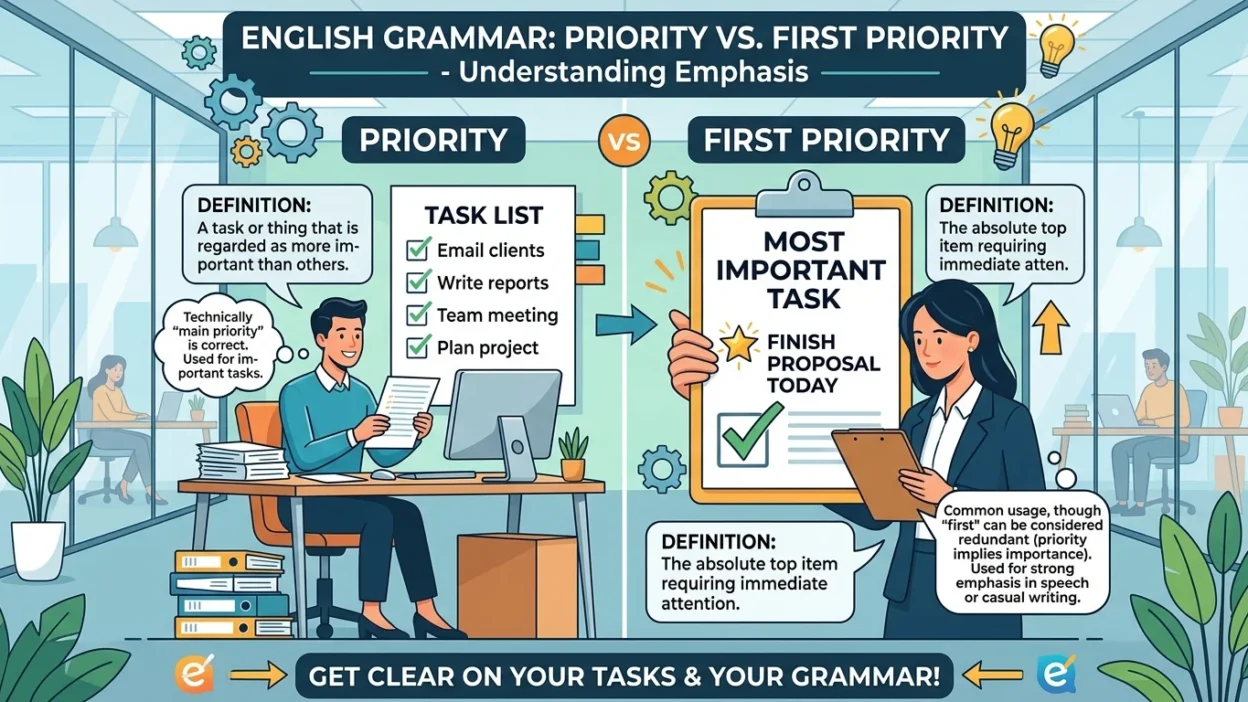
First priority is grammatically correct, but it is often considered redundant because priority already means the most important item. In formal writing, priority is usually enough. In everyday speech, first priority is widely accepted for emphasis.
Why People Confuse It
The confusion comes from the original meaning of priority, which means coming before all others in importance or order.
Because of this, some writers believe adding first repeats the same idea. Others use first priority to add emphasis, especially when several priorities are being discussed.
First Priority
First priority is a commonly used phrase that emphasizes the most important task or goal.
Meaning
It refers to the item that should receive the greatest attention before anything else.
Examples
- Customer safety is our first priority.
- Completing the project on time is my first priority.
- Your health should be your first priority.
- The company’s first priority is customer satisfaction.
- Public safety remains the government’s first priority.
Priority
Priority alone often conveys the same meaning more clearly.
Meaning
A priority is something that is more important than other things and deserves attention first.
Examples
- Safety is our priority.
- Education should be a national priority.
- Finding a solution is my priority.
- Quality remains our top priority.
- Time management is an important priority.
Comparison Table
| Feature | First Priority | Priority |
|---|---|---|
| Grammatically correct | ✅ Yes | ✅ Yes |
| Can sound redundant | ✅ Sometimes | ❌ No |
| Common in everyday English | ✅ Yes | ✅ Yes |
| Preferred in formal writing | Sometimes | ✅ Yes |
| Adds extra emphasis | ✅ Yes | ❌ Usually not |
When to Use Each
Use first priority when:
- You want to strongly emphasize what matters most.
- Speaking in conversations or presentations.
- Writing marketing or motivational content.
Use priority when:
- Writing formally.
- Avoiding redundancy.
- The context already makes the importance clear.
Examples
- Your safety is our first priority.
- Finishing the report is my first priority.
- The team’s first priority is customer service.
- Her first priority is spending time with family.
- Environmental protection should be our first priority.
- Safety is our priority.
- Education remains a national priority.
- Improving quality is the company’s priority.
- Health should always be a priority.
- Customer satisfaction is a top priority.
- Our priority is delivering excellent service.
- Reducing costs became the manager’s priority.
Common Mistakes
Many learners make these mistakes.
- Thinking first priority is always incorrect.
- Using first priority repeatedly in the same document.
- Confusing priority with preference.
Correct:
- Safety is our priority.
- Safety is our first priority.
Less preferred in formal writing:
- Safety is our first priority if priority alone communicates the meaning.
Memory Trick
Remember this simple rule:
Priority already means “most important.”
Add first only when you want extra emphasis.
American vs British English
There is no difference between American and British English.
Both varieties accept first priority, although many editors prefer simply priority or top priority in formal writing.
Similar Words
You may also use these expressions:
- Top priority
- Main priority
- Primary concern
- Main focus
- Chief objective
- Highest priority
- Key goal
- Primary objective
- Major concern
- Essential task
Final Verdict
First priority is not grammatically wrong, but many style experts consider it redundant because priority already implies first importance. In formal or academic writing, using priority or top priority is often clearer and more concise.
In everyday conversation, business communication, and speeches, first priority is widely understood and perfectly acceptable when you want to add emphasis.
Remember This
Use priority for clear, concise writing.
Use first priority when you intentionally want to stress that something comes before everything else.
FAQs
Is first priority grammatically correct?
Yes. It is grammatically correct, although some style guides consider it redundant.
Is first priority redundant?
It can be. Since priority already means something of highest importance, adding first may repeat the idea.
Should I say priority or first priority?
For formal writing, priority is usually the better choice. For emphasis in speech or business communication, first priority is acceptable.
Is top priority better than first priority?
Many editors prefer top priority because it sounds more natural in modern English.
Can I use first priority in business writing?
Yes. It is common in business, especially in mission statements and presentations.
Do British and American English use first priority differently?
No. Both varieties use the phrase in the same way.
What is another way to say first priority?
You can say top priority, highest priority, primary concern, or main focus.
Conclusion
The phrase first priority is common in modern English and is widely accepted in speech, business communication, and everyday writing. Although some editors view it as redundant, it is not considered a grammatical error and is often used to add emphasis.
For the clearest and most concise writing, especially in formal contexts, priority or top priority is usually the better choice. Understanding the subtle difference will help you choose the expression that best fits your audience and purpose.

Christopher Thomas is a passionate writer and dream researcher dedicated to exploring the meanings behind dreams. As an author at DrameyHut, he creates insightful and easy-to-understand interpretations that help readers connect with their subconscious mind. His work focuses on guiding individuals toward self-discovery, clarity, and a deeper understanding of their inner thoughts.