Loot vs lute is an interesting word pair because the two words look and sound similar, but they have completely different meanings. They can easily confuse English learners, especially because both words are pronounced with the same long “oo” sound.
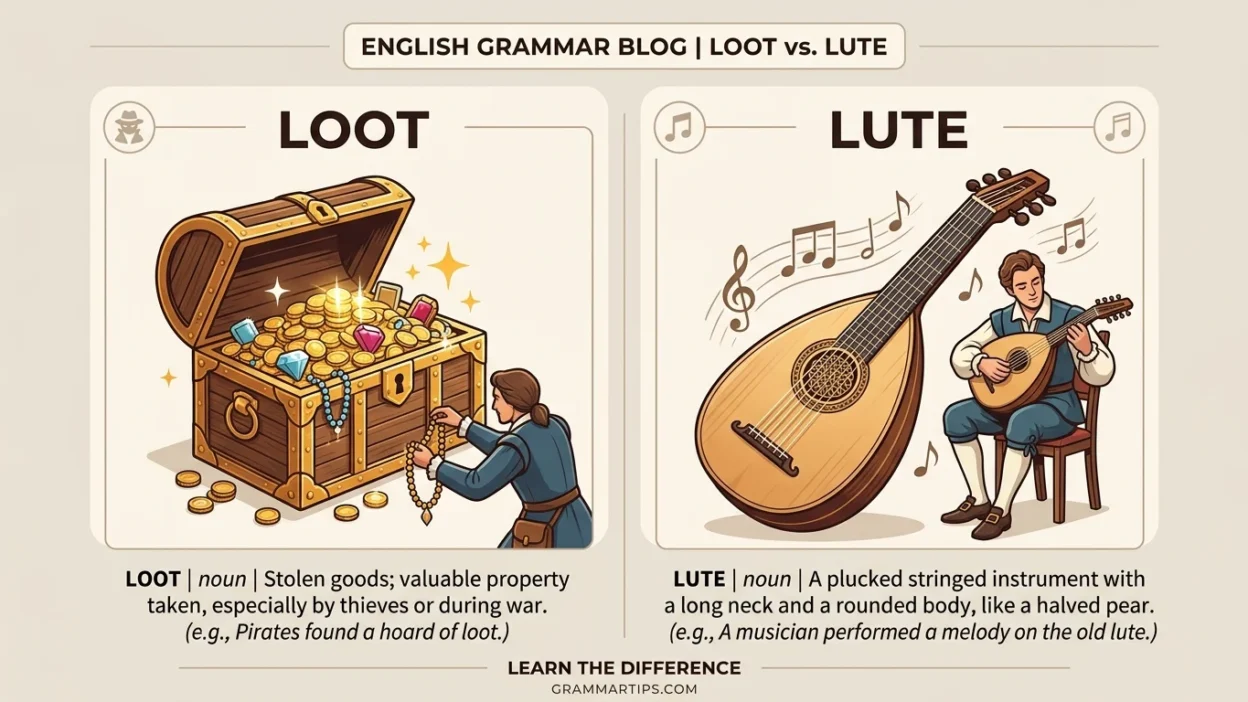
Loot is mainly related to stealing valuable goods, especially during a war, riot, or period of disorder. It can be used as both a noun and a verb. As a noun, loot means valuable things that have been stolen. As a verb, it means to steal goods or valuables.
Lute, on the other hand, is a musical instrument. It is a stringed instrument with a rounded body and a neck, historically associated with European music and particularly well known from the Renaissance and earlier periods.
Although loot and lute are pronounced similarly, their meanings, spellings, and uses are completely different.
In this guide, you will learn the difference between loot and lute, their meanings, pronunciation, examples, common mistakes, related words, and an easy trick to remember which word to use.
Quick Answer: Loot vs Lute
Loot means valuable goods that have been stolen, or the act of stealing such goods.
Lute is a musical instrument with strings and a rounded body.
Easy rule:
Loot = stolen valuables
Lute = musical instrument
What Does “Loot” Mean?
Loot can be used as both a noun and a verb.
As a noun, loot means money, goods, valuables, or other property that has been stolen, especially during war, conflict, riots, or other disorder.
Examples:
- The soldiers took loot from the city.
- The thieves escaped with valuable loot.
- The stolen jewelry was part of the loot.
- Police recovered the loot from the house.
The word often refers to valuable things obtained through theft.
Loot as a Verb
As a verb, loot means to steal goods or valuables, especially during a situation where normal law and order has broken down.
Examples:
- Several stores were looted during the riot.
- The thieves looted the abandoned building.
- The invading army looted the town.
- Criminals broke into the shops and looted them.
The verb can be used in different grammatical forms:
- loot
- loots
- looted
- looting
Loot in Modern Informal English
Loot can also be used informally to mean money, prizes, or valuable items, without necessarily emphasizing that they were stolen.
For example:
- I won some great loot in the game.
- The treasure chest contained plenty of loot.
- The players collected loot after defeating the enemy.
This usage is particularly common in video games, where “loot” refers to items, weapons, currency, equipment, or rewards collected by a player.
For example:
- The boss dropped some rare loot.
- We need better loot before entering the next area.
In this gaming context, loot does not necessarily mean stolen property.
What Does “Lute” Mean?
A lute is a stringed musical instrument.
It typically has a rounded or pear-shaped body, a neck, and strings that are played by plucking them with the fingers or a plectrum.
The lute has a long history and was especially important in European music during the Renaissance and earlier periods.
Examples:
- The musician played a beautiful melody on the lute.
- The museum displayed an old lute.
- He learned to play the lute.
- The composer wrote music for voice and lute.
The word lute is usually associated with historical, classical, folk, or early music.
Loot vs Lute: Comparison Table
| Word | Meaning | Part of Speech | Example |
|---|---|---|---|
| Loot | Stolen or valuable goods | Noun | The thieves escaped with the loot. |
| Loot | Steal goods or valuables | Verb | The criminals looted the store. |
| Lute | A stringed musical instrument | Noun | She played the lute beautifully. |
The key difference is simple:
Loot has to do with valuables or stealing.
Lute has to do with music.
Loot vs Lute Pronunciation
Loot and lute are pronounced the same in standard English.
They are homophones, meaning they have the same pronunciation but different spellings and meanings.
Both begin with an l sound and contain the long oo vowel sound.
Because they sound alike, context is especially important.
For example:
- The thieves stole the loot.
Here, the meaning clearly relates to stolen valuables.
- She played the lute.
Here, the context clearly relates to a musical instrument.
The spelling tells you which meaning is intended when you are reading.
Examples of “Loot”
Here are several examples using loot as a noun:
- The thieves divided the loot among themselves.
- Police recovered the stolen loot.
- The pirates hid their loot on the island.
- The robbers escaped with thousands of dollars in loot.
- The treasure was considered valuable loot.
- The players collected loot after completing the mission.
- The chest contained rare loot.
- The stolen jewelry was part of the loot.
Loot as a Verb
- The criminals looted several stores.
- The building was looted during the unrest.
- The invaders looted the city.
- The thieves entered the warehouse and looted it.
- Several businesses were looted overnight.
- The gang was accused of looting abandoned properties.
Examples of “Lute”
Here are examples using lute:
- The musician played the lute beautifully.
- She bought an antique lute.
- He has been learning to play the lute.
- The performer accompanied the singer on the lute.
- The museum has a collection of historic lutes.
- The composer wrote a piece for lute and voice.
- The sound of the lute filled the room.
- He carefully tuned the strings of his lute.
- The painting shows a musician holding a lute.
- She studied historical lute music.
Common Mistakes with Loot and Lute
Mistake 1: Using “lute” for stolen goods
Incorrect:
- The robbers escaped with valuable lute.
Correct:
- The robbers escaped with valuable loot.
Loot refers to stolen or valuable goods.
Mistake 2: Using “loot” for the musical instrument
Incorrect:
- He played the loot beautifully.
Correct:
- He played the lute beautifully.
A musical instrument is a lute.
Mistake 3: Confusing their spellings because they sound the same
Because loot and lute are homophones, you cannot rely on pronunciation to distinguish them when writing.
You need to remember their meanings:
Loot = valuables
Lute = music
Loot vs Lute in Sentences
Compare these sentences:
The thieves stole the loot.
The word loot refers to the valuable things that were stolen.
The musician played the lute.
The word lute refers to the stringed musical instrument.
Now compare:
The thieves stole the lute.
This sentence is also grammatically correct. Here, the thieves happened to steal a lute, the musical instrument.
This example shows why context matters. A lute can itself become loot if someone steals it.
For example:
The thieves stole an expensive lute, making the instrument part of their loot.
This sentence uses both words correctly.
Loot vs Lute: How to Remember the Difference
The easiest memory trick is:
Loot = valuables
Lute = instrument
Think of the extra e in lute as being connected to entertainment and music.
Another simple trick:
Loot is something you take.
Lute is something you play.
So:
Take the loot.
Play the lute.
This makes the distinction easy to remember.
Loot vs Lute vs Looting
These related forms are worth understanding.
Loot can be a noun:
- The thieves divided the loot.
Loot can also be a verb:
- The criminals loot stores.
Looting is the noun or present participle describing the act of stealing goods.
Examples:
- The police arrested several people for looting.
- The city experienced widespread looting.
Lute, meanwhile, refers to the musical instrument.
Its plural is:
lutes
Example:
- The museum has several historic lutes.
Is Loot Always Stolen?
Traditionally, loot refers to goods taken illegally or forcibly, particularly during conflict or disorder.
However, modern informal usage has broadened the word.
For example, in video games, loot often means rewards or collectible items obtained from enemies, treasure chests, quests, or other activities.
Therefore, the exact meaning depends on context.
In a historical sentence:
- The army carried away the loot.
The word likely refers to valuables taken by force or theft.
In a gaming sentence:
- The monster dropped rare loot.
The word refers to items or rewards obtained in the game.
Is a Lute a Guitar?
A lute and a guitar are both stringed instruments, but they are not the same instrument.
They have different historical development, construction, shapes, and playing traditions.
The lute generally has a rounded or pear-shaped body and a neck, while the modern guitar has a different body shape and construction.
They are related as members of the broader family of stringed instruments, but a lute is not simply another name for a guitar.
American vs British English
The meanings and spellings of loot and lute are essentially the same in American and British English.
Both varieties use:
loot for stolen goods or, informally, valuable rewards.
lute for the stringed musical instrument.
There is no major American versus British spelling difference to remember for this pair.
Similar Words to Loot
Depending on context, words related to loot include:
- Stolen goods
- Plunder
- Spoils
- Booty
- Treasure
- Valuables
- Gains
- Rewards
For example:
- The soldiers took plunder from the city.
- The thieves escaped with valuable loot.
Some of these words have specific historical or contextual nuances, so they are not always perfect substitutes.
Similar Words to Lute
Words related to lute include:
- Guitar
- Harp
- Mandolin
- Ukulele
- Lyre
- Banjo
- Stringed instrument
These are all associated with musical instruments, but they are not interchangeable with lute.
Final Verdict: Loot or Lute?
The difference between loot and lute is easy once you connect each word with its meaning.
Loot refers to stolen goods, valuables, or, in modern informal usage, valuable rewards such as items obtained in a video game. It can be both a noun and a verb.
Lute is a stringed musical instrument with a rounded body and a neck.
The two words are pronounced the same, making them homophones.
Remember this:
Loot = take it.
Lute = play it.
If you are talking about stolen valuables or game rewards, use loot.
If you are talking about a musical instrument, use lute.
FAQs About Loot vs Lute
What is the difference between loot and lute?
Loot means stolen or valuable goods and can also mean to steal or obtain valuable items. Lute is a stringed musical instrument.
Are loot and lute pronounced the same?
Yes. Loot and lute are homophones in standard English. They have the same pronunciation but different spellings and meanings.
Is loot a noun or a verb?
Loot can be both a noun and a verb. As a noun, it means stolen or valuable goods. As a verb, it means to steal goods or valuables.
What is a lute?
A lute is a stringed musical instrument with a rounded or pear-shaped body and a neck. It has a long history in European music.
Is loot always stolen?
Traditionally, loot refers to goods obtained through theft or force. In modern informal usage, especially in video games, it can also refer to valuable rewards or collectible items.
What is the plural of lute?
The plural of lute is lutes.
Example:
- The museum displayed several historic lutes.
Can a lute be loot?
Yes. A lute can become loot if someone steals it.
For example:
- The thief stole an expensive lute, making it part of his loot.
What is an easy way to remember loot vs lute?
Remember:
Loot = valuables.
Lute = musical instrument.
Or simply:
You take loot and play a lute.
Conclusion
Loot vs lute is a classic homophone pair. The two words sound the same but have completely different meanings.
Loot refers to stolen goods, valuables, or valuable rewards. It can also function as a verb meaning to steal goods. Lute refers to a stringed musical instrument traditionally associated with historical and classical music.
The easiest way to remember the difference is:
Loot = valuables
Lute = instrument
You can also remember the phrase “take the loot, play the lute.” Once you associate each word with its meaning, this confusing pair becomes much easier to use correctly.
Remember This
Loot = stolen goods, valuables, or rewards.
Lute = a stringed musical instrument.
Loot can be a noun or verb.
Lute is a noun.
Loot and lute sound the same.
Take the loot.
Play the lute.

Daniel Charles is a dedicated author and dream interpretation enthusiast at DrameyHut. He specializes in analyzing dream symbols and meanings, offering clear and insightful content for readers. His work aims to help individuals understand their subconscious thoughts, gain clarity, and explore the deeper messages hidden within their dreams.