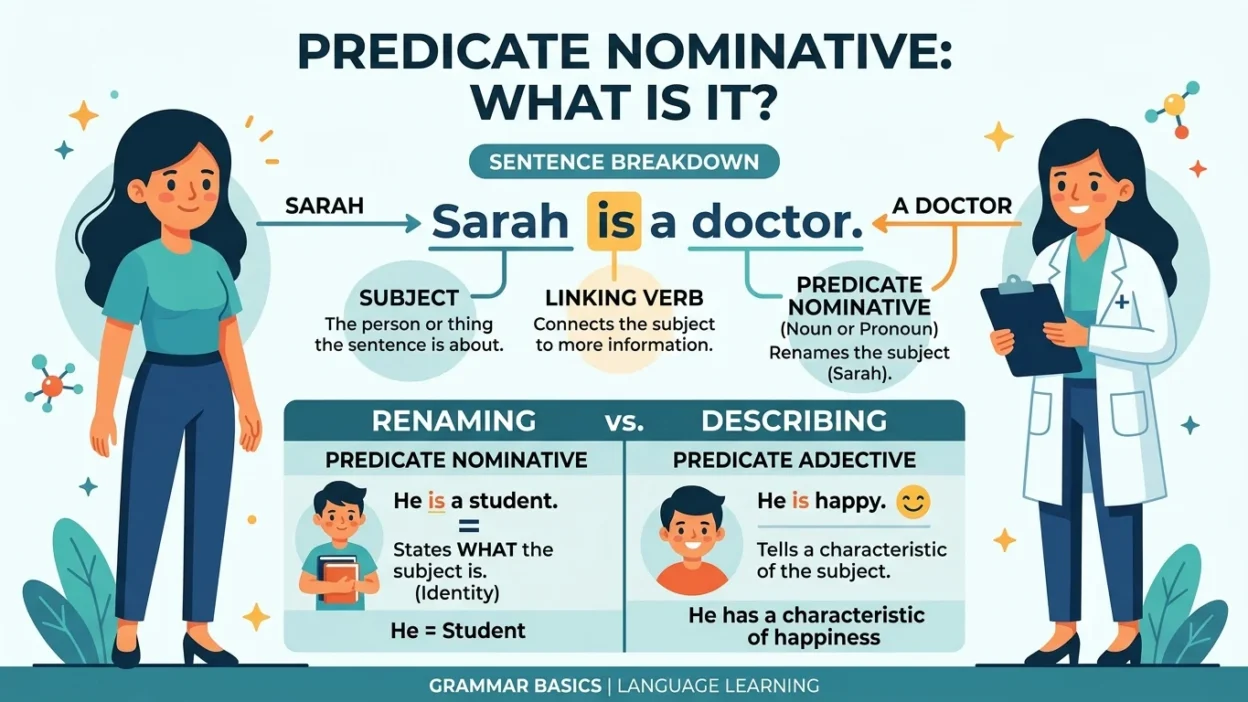
A predicate nominative is a noun, pronoun, or noun phrase that follows a linking verb and renames or identifies the subject of a sentence.
In simple terms:
Subject + linking verb + predicate nominative
For example:
Sarah is a doctor.
Here, Sarah is the subject, is is the linking verb, and doctor is the predicate nominative because it identifies who Sarah is.
Quick Answer
A predicate nominative is a word or phrase that comes after a linking verb and gives another name or identity to the subject.
Example
My brother is a teacher.
My brother = subject
is = linking verb
teacher = predicate nominative
The predicate nominative and the subject refer to the same person or thing:
My brother = teacher
What Is a Predicate Nominative?
A predicate nominative is a noun or pronoun that follows a linking verb and refers back to the subject.
Consider:
John is a student.
The word student tells us what John is. John and student refer to the same person.
Therefore:
John = subject
is = linking verb
student = predicate nominative
Another example:
The winner was Maria.
Maria identifies the winner, so Maria is the predicate nominative.
What Is a Linking Verb?
To understand predicate nominatives, you need to recognize linking verbs.
A linking verb connects the subject to information that describes or identifies it.
The most common linking verbs are forms of be:
- am
- is
- are
- was
- were
- be
- being
- been
Examples:
She is a doctor.
They are students.
He was the winner.
We were teammates.
Other verbs can sometimes function as linking verbs, including:
- become
- seem
- appear
- remain
- feel
- look
- smell
- taste
- sound
For example:
She became a teacher.
Here, teacher is a predicate nominative because it identifies the subject she.
Predicate Nominative Examples
Here are some straightforward examples:
My sister is a lawyer.
David is the captain.
That woman is my aunt.
The animal was a dog.
Her dream became a reality.
He seems like a professional.
The winner was James.
In each sentence, the predicate nominative identifies or renames the subject.
How to Identify a Predicate Nominative
Use these three steps.
Step 1: Find the subject
Ask:
Who or what is the sentence about?
Example:
Emma is a student.
The subject is Emma.
Step 2: Find the linking verb
The linking verb is:
is
Step 3: Look after the linking verb
The word that identifies or renames the subject is:
student
Therefore, student is the predicate nominative.
Predicate Nominative vs Predicate Adjective
This is one of the most important distinctions.
Both predicate nominatives and predicate adjectives come after linking verbs, but they do different jobs.
Predicate Nominative
A predicate nominative is a noun or pronoun that renames or identifies the subject.
Maria is a doctor.
Doctor is a noun and identifies Maria.
Predicate Adjective
A predicate adjective describes the subject.
Maria is kind.
Kind is an adjective describing Maria.
Compare:
Maria is a doctor. → Predicate nominative
Maria is kind. → Predicate adjective
Predicate Nominative vs Direct Object
These two can also be confused.
A direct object receives the action of a verb.
A predicate nominative follows a linking verb and identifies the subject.
Compare:
John became a doctor.
Doctor = predicate nominative.
The verb became links John with doctor.
Now compare:
John visited a doctor.
Doctor = direct object.
John performed an action, and the doctor received that action.
Easy Test
If the sentence essentially means:
Subject = noun after the verb
you probably have a predicate nominative.
For example:
John is a teacher.
John = teacher.
That makes teacher a predicate nominative.
Predicate Nominative vs Subject Complement
A predicate nominative is a type of subject complement.
A subject complement provides information about the subject after a linking verb.
There are two major types:
Predicate nominative → noun or pronoun
Predicate adjective → adjective
For example:
She is a doctor.
Doctor = predicate nominative.
She is intelligent.
Intelligent = predicate adjective.
Both are subject complements.
Predicate Nominative with Pronouns
A predicate nominative can also be a pronoun.
For example:
The winner was she.
In very formal traditional grammar, she is preferred because it functions as a subject complement after a linking verb.
However, in everyday modern English, people commonly say:
The winner was her.
The choice can depend on grammatical tradition, style, and context.
Similarly:
It was I.
is traditionally considered formal, while:
It was me.
is extremely common in everyday English.
Predicate Nominative and Subject-Verb Agreement
The subject, not the predicate nominative, determines the number of the verb.
For example:
The problem is the delays.
The subject is problem, which is singular, so we use is.
Not:
❌ The problem are the delays.
Similarly:
The delays are the problem.
The subject is now delays, which is plural.
This is important because the noun after the linking verb can sometimes be different in number from the subject.
Examples With Singular Subjects
My father is a doctor.
Sarah is the winner.
The dog is a poodle.
His brother became a pilot.
The building was a school.
The words doctor, winner, poodle, pilot, and school identify or rename the subjects.
Examples With Plural Subjects
They are students.
We are friends.
Those people are teachers.
The two men became partners.
These animals are wolves.
The predicate nominatives identify the plural subjects.
Predicate Nominative With “Become”
Become can function as a linking verb when it connects the subject to a new identity or state.
She became a doctor.
He became the president.
The caterpillar became a butterfly.
In each sentence, the noun after became identifies what the subject became.
Predicate Nominative With “Seem”
A noun can also follow seem in certain constructions.
He seems a professional.
However, this construction is less common in modern English. More natural alternatives include:
He seems like a professional.
or:
He seems to be a professional.
When analyzing grammar, the important idea is that the noun phrase identifies or characterizes the subject rather than receiving an action.
Predicate Nominative With “Remain”
Remain can function as a linking verb.
She remained a friend.
He remained the captain.
The building remained a museum.
The noun after remained identifies the subject.
Predicate Nominative With “Appear”
Appear can also function as a linking verb.
He appeared to be a doctor.
She appeared to be the winner.
The noun phrase identifies the subject through the linking construction.
Predicate Nominative in Questions
Predicate nominatives can appear in questions too.
Who is your teacher?
Here, teacher identifies the subject implied by the sentence.
Another example:
What is the problem?
Problem identifies what the subject what refers to.
Predicate Nominative in Passive-Looking Sentences
A sentence may look unusual but still contain a predicate nominative.
The winner was John.
Here:
The winner = subject
was = linking verb
John = predicate nominative
John identifies who the winner is.
Predicate Nominative vs Object Complement
These can sometimes look similar, but they have different structures.
Predicate Nominative
She is a teacher.
The noun follows a linking verb and identifies the subject.
Object Complement
They elected her president.
Her is the direct object, and president is an object complement that identifies what her role became as a result of the action.
The structure is:
Subject + action verb + object + object complement
This differs from:
Subject + linking verb + predicate nominative
Common Mistakes
Mistake 1: Thinking every noun after a verb is a predicate nominative
Not every noun after a verb is a predicate nominative.
She bought a book.
Book is a direct object, not a predicate nominative.
But:
She is a writer.
Writer is a predicate nominative.
Mistake 2: Confusing adjectives with predicate nominatives
He is happy.
Happy is a predicate adjective.
He is a teacher.
Teacher is a predicate nominative.
Mistake 3: Choosing the verb based on the predicate nominative
Remember that the subject controls subject-verb agreement.
The problem is the costs.
Not:
❌ The problem are the costs.
A Simple Trick to Find a Predicate Nominative
Ask:
Does the word after the linking verb rename or identify the subject?
If yes, it is probably a predicate nominative.
For example:
My mother is a nurse.
Ask:
Is my mother a nurse?
Yes.
Nurse identifies the subject, so it is a predicate nominative.
Another example:
The winner was Sarah.
Ask:
Is the winner Sarah?
Yes.
Therefore, Sarah is a predicate nominative.
Quick Comparison
| Grammar Term | Function | Example |
|---|---|---|
| Predicate nominative | Renames or identifies subject | She is a doctor. |
| Predicate adjective | Describes subject | She is kind. |
| Direct object | Receives action | She helped the doctor. |
| Object complement | Renames/describes object | They made her captain. |
Final Verdict
A predicate nominative is a noun, pronoun, or noun phrase that follows a linking verb and renames or identifies the subject.
The basic pattern is:
Subject + linking verb + predicate nominative
For example:
Michael is a teacher.
Michael = subject
is = linking verb
teacher = predicate nominative
The easiest test is to see whether the subject and the predicate nominative refer to the same person or thing:
Michael = teacher
Another example:
The winner was Sarah.
The winner = Sarah
Therefore, Sarah is the predicate nominative.
Remember:
Predicate nominative = noun or pronoun that identifies or renames the subject after a linking verb.
FAQs
What is a predicate nominative in simple terms?
A predicate nominative is a noun or pronoun that renames or identifies the subject after a linking verb.
John is a teacher.
Teacher is the predicate nominative.
What is an example of a predicate nominative?
My sister is a doctor.
Doctor is the predicate nominative because it identifies the subject, my sister.
How do I identify a predicate nominative?
Find the subject, find the linking verb, and then look for a noun or pronoun that renames or identifies the subject.
What is the difference between a predicate nominative and a predicate adjective?
A predicate nominative is a noun or pronoun that identifies the subject.
She is a doctor.
A predicate adjective is an adjective that describes the subject.
She is kind.
Is a predicate nominative a subject complement?
Yes. A predicate nominative is a type of subject complement.
Can a predicate nominative be a pronoun?
Yes.
The winner was she.
In formal traditional grammar, she is treated as the predicate nominative.
Does a predicate nominative always follow “is”?
No. It can follow other linking verbs.
She became a doctor.
He remained the captain.
What is the difference between a predicate nominative and a direct object?
A predicate nominative follows a linking verb and identifies the subject.
She is a teacher.
A direct object receives the action of an action verb.
She teaches students.
Does the predicate nominative determine subject-verb agreement?
No. The subject determines the verb’s number.
The problem is the costs.
The subject is problem, not costs.
Conclusion
A predicate nominative may sound like a complicated grammar term, but the concept is straightforward. It is a noun, pronoun, or noun phrase that follows a linking verb and identifies or renames the subject.
For example:
James is a teacher.
Here, James is the subject, is is the linking verb, and teacher is the predicate nominative.
The easiest way to remember the concept is:
Predicate nominative = renames the subject
Compare that with a predicate adjective:
James is kind.
Kind describes James, so it is a predicate adjective.
Once you learn to identify linking verbs and ask whether the word after them renames the subject, finding a predicate nominative becomes much easier.

Christopher Thomas is a passionate writer and dream researcher dedicated to exploring the meanings behind dreams. As an author at DrameyHut, he creates insightful and easy-to-understand interpretations that help readers connect with their subconscious mind. His work focuses on guiding individuals toward self-discovery, clarity, and a deeper understanding of their inner thoughts.