City, town, and village are all words used to describe places where people live, but they generally differ in size, population, services, and development.
The simplest distinction is:
City = larger and more developed
Town = medium-sized settlement
Village = smaller settlement
However, there is no universal population number that separates a city from a town or a town from a village. Definitions vary between countries and sometimes even between regions.
Quick Answer
| Word | General Meaning | Typical Characteristics |
|---|---|---|
| City | A large, developed settlement | Large population, extensive services, businesses, infrastructure |
| Town | A settlement smaller than a city | Moderate population, local businesses and services |
| Village | A small settlement | Small population, fewer services, often more rural |
For example:
New York City is a city.
A smaller regional settlement may be called a town.
A small rural community may be called a village.
The exact legal definitions depend on the country.
What Is a City?
A city is generally a relatively large and densely populated settlement with extensive infrastructure, businesses, public services, and transportation.
Cities often have:
- Large populations
- Hospitals and universities
- Shopping centers
- Offices and businesses
- Public transportation
- Government buildings
- Cultural institutions
- Major roads and infrastructure
For example:
Karachi is a major city.
Lahore is a large city.
London is a famous city.
The word city often suggests a more developed and densely populated urban environment.
What Is a Town?
A town is generally a settlement that is smaller than a city but larger or more developed than a village.
Towns often have many services found in cities, but on a smaller scale.
A town might have:
- Shops
- Schools
- Restaurants
- Banks
- Local government offices
- Healthcare facilities
- Markets
- Residential neighborhoods
For example:
We moved to a small town near the coast.
The town has a population of about 20,000 people.
There are several restaurants in the town center.
However, what qualifies as a town varies significantly from one country to another.
What Is a Village?
A village is generally a small settlement, often located in a rural area.
Villages tend to have fewer residents and fewer services than towns.
For example:
My grandparents live in a small village.
The village is surrounded by farmland.
There is a small market in the village.
A village may have a school, shops, a place of worship, and other basic facilities, but it usually has fewer services than a town or city.
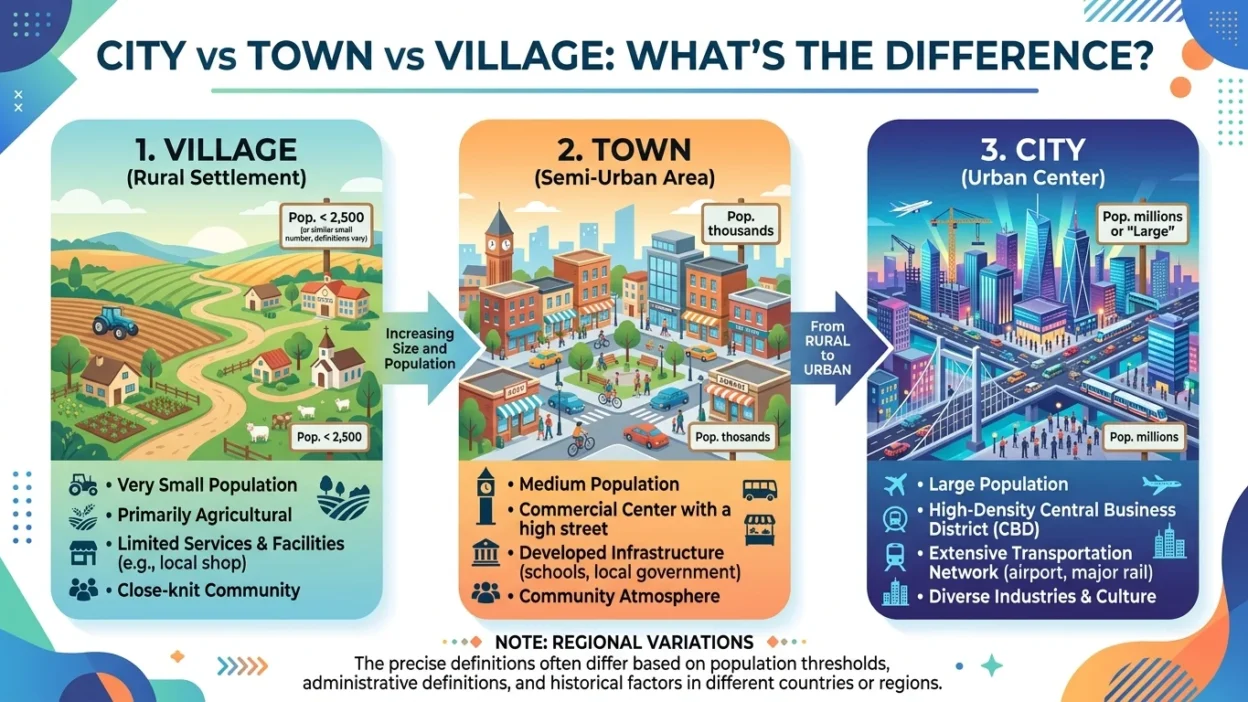
City vs Town vs Village
The general relationship can be visualized like this:
Village → Town → City
As you move from village to town to city, settlements generally become larger and more densely developed.
However, this is only a general pattern, not a universal legal rule.
Population Difference
Population is one of the most obvious differences, but it is not a reliable universal rule.
Generally:
Village: smaller population
Town: medium population
City: larger population
But there is no worldwide rule such as:
“A place with fewer than 10,000 people is a village.”
Different countries use different criteria.
Some places classify settlements based on legal status, while others consider population, infrastructure, historical status, or administrative functions.
Size Difference
In general:
Villages occupy smaller areas.
Towns are larger and have more developed neighborhoods and commercial areas.
Cities usually cover larger areas and may contain multiple districts or neighborhoods.
For example:
A village might consist of a small cluster of homes.
A town might contain several neighborhoods and a commercial center.
A city might contain dozens or hundreds of neighborhoods and districts.
Again, these are general descriptions rather than strict rules.
Services and Infrastructure
Another useful difference is the availability of services.
Village
A village may have:
A small school, local shops, a clinic, and basic community facilities.
Town
A town may have:
Schools, banks, restaurants, supermarkets, healthcare facilities, and local government offices.
City
A city may have:
Universities, major hospitals, airports, extensive public transportation, large shopping centers, corporate offices, and specialized services.
The larger the settlement, the more likely it is to offer a wider variety of specialized services.
City vs Town
A city is generally larger and more densely populated than a town.
For example:
She lives in a large city.
He lives in a small town.
However, the distinction is not always based purely on population.
In some countries, a settlement can officially be called a city because it has received city status, even if another settlement elsewhere has a larger population.
Town vs Village
A town is generally larger and more developed than a village.
Compare:
They live in a small village surrounded by farmland.
They moved to a nearby town with more shops and services.
A village may have a strong rural character, while a town often serves as a commercial or administrative center for nearby communities.
City vs Village
The difference between a city and a village is usually much more noticeable.
A city typically has:
- A much larger population
- Greater population density
- More businesses
- More transportation options
- More extensive infrastructure
- More specialized services
A village generally has:
- Fewer residents
- Fewer businesses
- Fewer services
- A smaller physical area
- A stronger rural character in many cases
Is a Town Always Bigger Than a Village?
Generally, yes, in everyday usage.
But there is no universal definition that applies everywhere.
A place officially classified as a town in one country might have fewer residents than a place classified as a village somewhere else.
Therefore, it is better to think of these words as general categories rather than fixed population levels.
Is a City Always Bigger Than a Town?
Not necessarily.
In everyday usage, cities are generally thought of as larger than towns.
But official classifications can be based on legal or historical status rather than population alone.
For example, a formally recognized city may have a smaller population than a large town elsewhere.
City, Town, and Village as Administrative Terms
The words can have different legal meanings depending on the country.
In some places, city, town, and village are official administrative designations.
In other places, they are mainly descriptive terms.
This means you should be careful when saying:
“A city must have more than 100,000 people.”
That statement is not universally true.
There is no single worldwide population threshold for becoming a city.
Urban vs Rural
Another helpful distinction is urban versus rural.
Cities are typically considered urban.
Towns can be urban or semi-urban depending on their size and location.
Villages are often associated with rural areas, although some villages may exist within or near larger urban regions.
So:
City → usually urban
Town → often urban or semi-urban
Village → often rural
Examples in Sentences
City
Lahore is a major city.
She works in the city.
The city has a large public transportation network.
Town
He grew up in a small town.
The town has a busy market.
We stopped in a nearby town for lunch.
Village
She was born in a small village.
The village is surrounded by mountains.
Everyone in the village knows each other.
City vs Town vs Village: Comparison Table
| Feature | City | Town | Village |
|---|---|---|---|
| General size | Large | Medium | Small |
| Population | Usually large | Usually moderate | Usually small |
| Density | Usually high | Moderate | Usually low |
| Services | Extensive | Moderate | Basic |
| Businesses | Many | Several | Few |
| Infrastructure | Extensive | Developed | More limited |
| Setting | Usually urban | Urban or semi-urban | Often rural |
| Transportation | Extensive | Moderate | Limited |
| Specialized services | Many | Some | Few |
Common Mistakes
Mistake 1: Thinking the words have universal population limits
There is no single global population rule.
A city in one country may have fewer residents than a town in another.
Mistake 2: Assuming every village is rural
Most villages are associated with rural areas, but settlements called villages can also exist within or near urban areas.
Mistake 3: Treating “city” and “town” as completely interchangeable
They can overlap in casual conversation, but city generally suggests a larger or more urban settlement.
Mistake 4: Assuming “town” always means a small place
A town can be quite large depending on the country and its legal classification.
City vs Town vs Village: Which Word Should You Use?
Use city when referring to a large urban settlement.
I live in the city.
Use town for a smaller settlement that is larger or more developed than a village.
I grew up in a small town.
Use village for a small community, especially one with a rural character.
My grandparents live in a village.
If the place has an official name or legal designation, use its established designation even if its population does not fit your expectations.
City vs Town vs Village vs Neighborhood
Don’t confuse these terms with neighborhood.
A neighborhood is generally a smaller area within a city, town, or sometimes village.
For example:
I live in a quiet neighborhood in the city.
The city contains neighborhoods.
A town can also contain neighborhoods.
So the relationship might look like:
City → neighborhoods
Town → neighborhoods
A neighborhood is not necessarily a separate settlement.
City vs Town vs Village vs Hamlet
A hamlet is generally an even smaller settlement than a village.
A simplified hierarchy might be:
Hamlet → Village → Town → City
But this is only a general way of thinking about settlement size. Actual classifications differ between countries.
Easy Way to Remember
Think of settlement size like this:
🏘️ Village → small community
🏙️ Town → medium-sized settlement
🌆 City → large urban settlement
The important word is generally.
These categories do not have universally fixed boundaries.
Final Verdict
The basic difference between city, town, and village is their general size, population, development, and services.
City = generally large and highly developed
Town = generally medium-sized
Village = generally small, often rural
However, there is no universal population threshold that determines whether a place is a city, town, or village. Legal and cultural definitions vary from country to country.
So, for everyday English, remember:
Village → Town → City
from smaller to larger.
But when discussing a specific place, its official classification may be more important than its population.
FAQs
What is the difference between a city, town, and village?
A city is generally a large urban settlement, a town is generally a medium-sized settlement, and a village is generally a small settlement.
Is a town bigger than a village?
Generally, yes. A town is usually larger and has more services and infrastructure than a village, although official definitions vary.
Is a city bigger than a town?
Generally, yes. Cities tend to have larger populations, greater density, and more extensive infrastructure, but there is no universal rule.
What is smaller, a town or a village?
A village is generally smaller than a town.
Does a city have to have a certain population?
No. There is no universal worldwide population requirement for a place to be classified as a city.
Is a village always rural?
No. Villages are often associated with rural areas, but a place called a village can also be located near or within a larger urban area.
What is the order from smallest to largest?
A common general order is:
Hamlet → Village → Town → City
However, this is not a universal legal hierarchy.
Can a town be bigger than a city?
Yes. Depending on the country’s legal definitions, a town can have a larger population than a city.
Is “city” a formal term?
In some countries, city is an official legal or administrative designation. In others, it can be used more descriptively.
Conclusion
City, town, and village all describe settlements, but they usually indicate different levels of size and development.
A village is generally a small community with fewer residents and services. A town is usually larger and provides more local services. A city is generally the largest and most developed of the three.
The easiest way to remember the general difference is:
Village = small
Town = medium
City = large
Just remember that these are general distinctions, not universal population rules. Different countries and regions may define cities, towns, and villages differently.

Christopher Thomas is a passionate writer and dream researcher dedicated to exploring the meanings behind dreams. As an author at DrameyHut, he creates insightful and easy-to-understand interpretations that help readers connect with their subconscious mind. His work focuses on guiding individuals toward self-discovery, clarity, and a deeper understanding of their inner thoughts.