Forgo and forego are two easily confused English words. They look almost identical, but they have different meanings.
The key difference is simple:
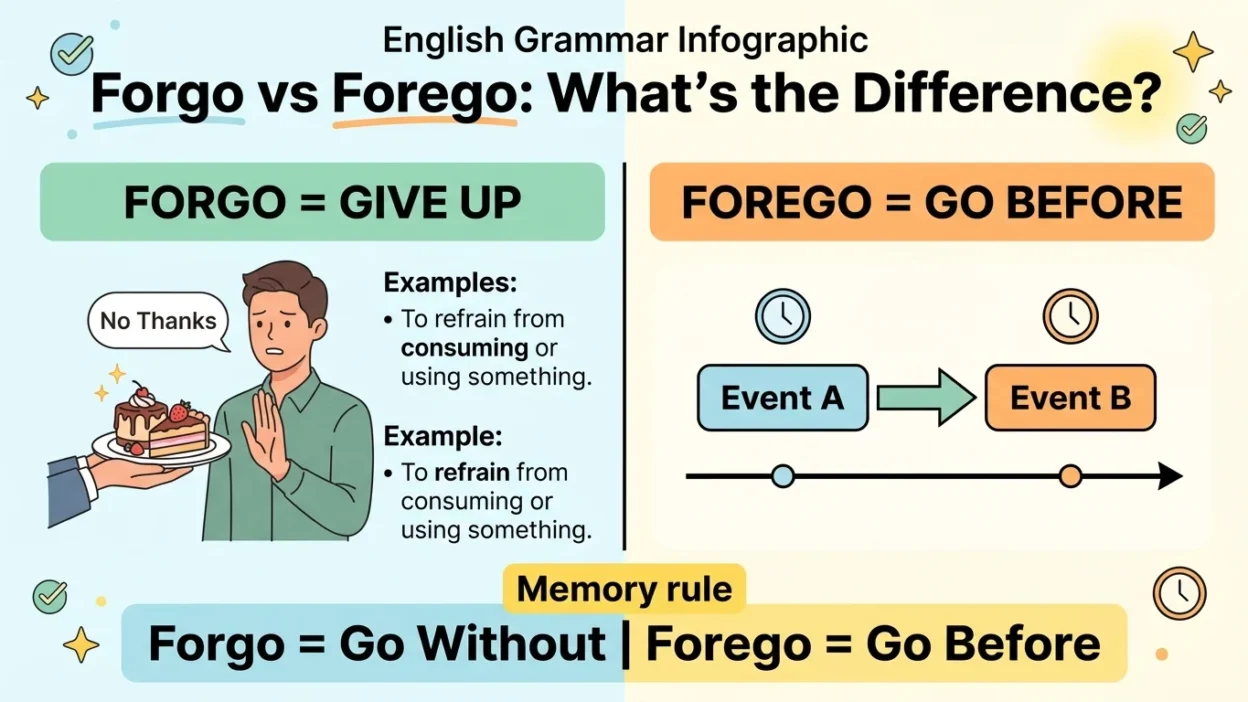
Forgo = to give up or do without something
Forego = to go before something or precede it
In modern English, forgo is much more commonly used. Forego is relatively rare and is mainly used when something comes before something else.
Quick Answer
Forgo
Forgo means to give up, skip, or decide not to have or do something.
I decided to forgo dessert.
This means I decided to do without dessert.
Forego
Forego means to go before or precede something.
A short introduction will forego the main presentation.
This means the introduction will come before the presentation.
Easy Rule
Remember:
Forgo = give up
Forego = go before
What Does “Forgo” Mean?
Forgo is a verb meaning to voluntarily give up, avoid, or do without something.
It often describes choosing not to take an opportunity, benefit, pleasure, or action.
For example:
She decided to forgo the opportunity.
He chose to forgo breakfast.
We had to forgo our vacation this year.
They agreed to forgo the usual ceremony.
In each case, something is being deliberately given up or skipped.
What Does “Forego” Mean?
Forego is a verb meaning to precede or come before something in time or position.
For example:
A brief introduction will forego the main speech.
The opening remarks forego the ceremony.
However, forego is much less common in modern English than forgo.
In many situations, writers prefer the clearer verb precede:
A brief introduction will precede the main speech.
Because of this, forego is a word you may encounter less frequently.
Forgo vs Forego: Main Difference
| Word | Meaning | Example |
|---|---|---|
| Forgo | Give up or do without | She decided to forgo dessert. |
| Forego | Go before or precede | The introduction will forego the presentation. |
The missing e makes a major difference in meaning.
Forgo Examples
Here are some common examples of forgo:
I decided to forgo coffee this morning.
She chose to forgo the expensive option.
He forwent his right to appeal.
They decided to forgo the traditional ceremony.
We had to forgo our plans because of the weather.
She forwent the opportunity to travel abroad.
The meaning is generally give up, skip, or do without.
Forego Examples
Forego is used when something comes before something else.
The introduction foregoes the main discussion.
A short speech forewent the ceremony.
The opening remarks forego the presentation.
However, these sentences can sound formal or unusual to modern readers. In most cases, precede is clearer:
The introduction precedes the main discussion.
A short speech preceded the ceremony.
Forgo vs Forego in Everyday English
If you are talking about giving something up, use forgo.
I will forgo dessert.
If you are talking about something coming before something else, use forego, although precede is often more natural.
The introduction precedes the main presentation.
This makes forgo the word you are much more likely to need in everyday writing.
The Confusion Between “Forgo” and “Forego”
The confusion exists because the words are nearly identical.
Compare:
forgo
forego
The only difference is the e, but their meanings are different.
A useful memory trick is:
Forgo has no extra e, and it means to give something up.
Forego contains fore, which can mean before.
So:
Forego → fore = before
This can help you remember its meaning.
Forgo vs Forego: Verb Forms
The verb forgo has an unusual past tense:
forgo → forwent → forgone
For example:
I forgo dessert.
I forwent dessert yesterday.
I have forgone dessert for several weeks.
The past tense is not “forgoed.”
Correct
She forwent the opportunity.
Incorrect
❌ She forgoed the opportunity.
Forgo vs Forgone vs Forwent
These forms are worth remembering because they are commonly confused.
Forgo
Present tense:
I will forgo the opportunity.
Forwent
Simple past:
She forwent the opportunity.
Forgone
Past participle:
He has forgone the opportunity.
So:
forgo → forwent → forgone
Forego Verb Forms
Forego follows a more familiar pattern:
forego → forewent → foregone
For example:
The introduction foregoes the presentation.
The introduction forewent the presentation.
The introduction has foregone the presentation.
However, because forego is uncommon, precede is often a better alternative.
Forgo vs Forego vs Precede
Precede is an important word to know because it often replaces forego in modern writing.
Forgo:
to give up
Forego:
to come before
Precede:
to come before
For example:
She forwent the meal.
Meaning: She gave up the meal.
The appetizer preceded the main course.
Meaning: The appetizer came before the main course.
In contemporary English, precede is generally clearer than forego when you mean “come before.”
Forgo vs Forego: Common Mistakes
Mistake 1: Using “forego” when you mean “give up”
❌ I decided to forego dessert.
✅ I decided to forgo dessert.
If you mean give up or do without, use forgo.
Mistake 2: Using “forgo” when you mean “come before”
❌ The introduction forgoes the main presentation.
If you mean that the introduction comes before the presentation, precedes is usually clearer:
The introduction precedes the main presentation.
Mistake 3: Writing “forgoed”
❌ She forgoed the opportunity.
✅ She forwent the opportunity.
The past tense of forgo is forwent.
Forgo or Forego an Opportunity?
When you mean give up an opportunity, the correct word is:
forgo
For example:
She decided to forgo the opportunity.
This means she chose not to take the opportunity.
Not:
❌ She decided to forego the opportunity.
Although forego is sometimes mistakenly used in this context, forgo is the appropriate word when the meaning is “give up.”
Forgo or Forego a Meal?
Use:
forgo a meal
because it means skip or do without a meal.
He decided to forgo breakfast.
She forwent lunch to finish her work.
Forgo or Forego the Benefits?
Use:
forgo the benefits
when you mean give up the benefits.
Employees may choose to forgo certain benefits.
Here, forgo means voluntarily give up.
Forgo vs Waive
Forgo and waive can sometimes have similar meanings, but they are not identical.
Forgo means to choose not to have or do something.
She forwent the opportunity.
Waive often means to voluntarily give up a right, requirement, claim, or fee.
He waived his right to a hearing.
So forgo is broader, while waive often has a more specific legal or formal meaning.
Forgo vs Give Up
In everyday English, give up is often a simpler alternative to forgo.
She decided to forgo dessert.
She decided to give up dessert.
Both can work, although forgo sounds more formal.
How to Remember Forgo vs Forego
Use this simple trick:
Forgo = Give Up
Think:
forgo = go without
If you forgo something, you choose to do without it.
Forego = Go Before
Think:
fore = before
If something foregoes another thing, it comes before it.
Because forego is uncommon, however, precede is usually the safer modern choice for this meaning.
Quick Comparison
| Word | Meaning | Example |
|---|---|---|
| Forgo | Give up or do without | I decided to forgo dessert. |
| Forwent | Past tense of forgo | She forwent the opportunity. |
| Forgone | Past participle of forgo | He has forgone the benefit. |
| Forego | Come before | The introduction will forego the speech. |
| Precede | Come before | The introduction will precede the speech. |
Final Verdict
The difference between forgo vs forego is easy once you focus on the meaning.
Forgo = give up, skip, or do without
Forego = come before or precede
For most modern writing, forgo is the word you will use when discussing giving something up:
She decided to forgo dessert.
When you mean come before, precede is usually a clearer and more common choice than forego:
The introduction preceded the presentation.
Also remember the unusual past forms:
forgo → forwent → forgone
So if you mean give up, choose forgo.
If you mean come before, think forego, but consider using precede for greater clarity.
FAQs
Is it forgo or forego?
Both are words, but they have different meanings. Forgo means to give up or do without something, while forego means to come before something.
Is “forgo an opportunity” correct?
Yes. Forgo an opportunity means to choose not to take or pursue an opportunity.
She decided to forgo the opportunity.
Does forgo mean give up?
Yes. Forgo means to voluntarily give up, skip, avoid, or do without something.
What does forego mean?
Forego means to precede or come before something. However, precede is much more common and is often clearer.
Is “forego” the same as “forgo”?
No. They have different meanings.
Forgo = give up
Forego = come before
What is the past tense of forgo?
The simple past tense is forwent.
She forwent the opportunity.
Is “forgoed” a word?
No, forgoed is not the standard past tense. Use forwent.
forgo → forwent
What is the past participle of forgo?
The past participle is forgone.
He has forgone the opportunity.
Is “forego” commonly used?
It exists, but it is relatively uncommon in modern English. Precede is usually preferred when you mean “come before.”
What is an easy way to remember forgo vs forego?
Remember:
Forgo = go without
Forego = go before
The word fore can remind you of before.
Conclusion
Forgo and forego look similar, but they should not be used interchangeably.
Forgo means to give up, skip, or do without something:
I decided to forgo dessert.
Forego means to come before or precede something:
The introduction foregoes the main presentation.
However, because forego is uncommon, precede is usually the better choice when you mean “come before.”
The most important distinction is:
Forgo = give up
Forego = come before
And remember the unusual forms of forgo:
forgo → forwent → forgone
Once you connect forgo with “give up” and forego with “go before,” this commonly confused pair becomes much easier to use correctly.

Daniel Charles is a dedicated author and dream interpretation enthusiast at DrameyHut. He specializes in analyzing dream symbols and meanings, offering clear and insightful content for readers. His work aims to help individuals understand their subconscious thoughts, gain clarity, and explore the deeper messages hidden within their dreams.