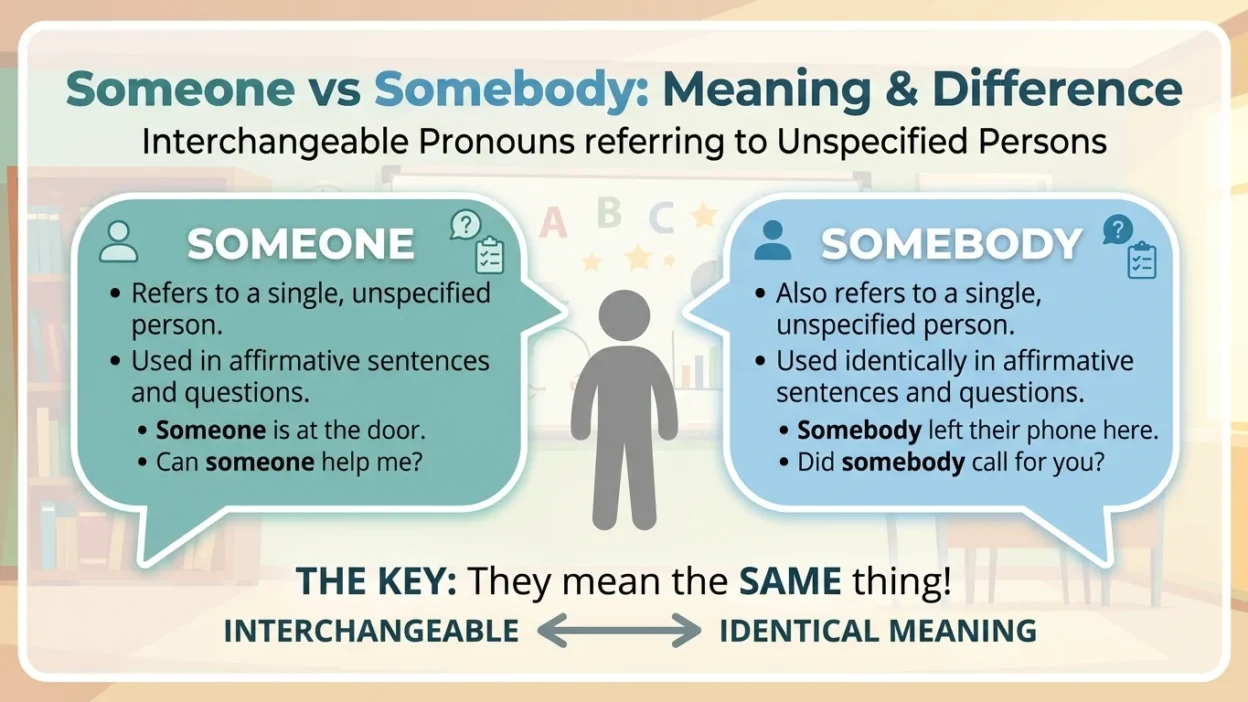
Someone and somebody are two common English words that mean almost exactly the same thing. Both refer to an unspecified person, so in many sentences, you can use either one without changing the basic meaning. For example, “Someone called you” and “Somebody called you” are both completely correct.
The main difference is usually one of style and tone, not meaning. Someone can sound slightly more neutral or polished, while somebody can sound a little more conversational or informal. However, the distinction is small, and both words are standard in American and British English.
In this guide, you will learn the difference between someone and somebody, when to use each one, how they behave grammatically, common mistakes, and plenty of examples to make the distinction easy to remember.
Quick Answer
Someone and somebody both mean an unspecified person. They are usually interchangeable. Someone can sound slightly more neutral, while somebody can sound slightly more conversational, but neither is more correct. Both can be used as singular pronouns and normally take a singular verb.
What Does “Someone” Mean?
Someone is an indefinite pronoun referring to an unspecified person.
For example:
Someone left a message for you.
We know that a person left the message, but we do not know or identify who that person is.
Someone can be used when:
- You do not know who the person is.
- The person’s identity is not important.
- You do not want to identify the person.
- You are referring to an unspecified individual.
Examples
Someone is waiting outside.
Someone took my umbrella.
I need someone to help me.
Someone has left the door open.
In all these examples, someone refers to an unspecified person.
What Does “Somebody” Mean?
Somebody also means an unspecified person.
For example:
Somebody left a message for you.
This has essentially the same meaning as:
Someone left a message for you.
Somebody can sometimes sound slightly more conversational, but it is not incorrect or inherently less formal.
Examples
Somebody is waiting outside.
Somebody took my umbrella.
I need somebody to help me.
Somebody has left the door open.
The meaning is practically identical to the corresponding sentences with someone.
Someone vs Somebody Comparison Table
| Feature | Someone | Somebody |
|---|---|---|
| Basic meaning | An unspecified person | An unspecified person |
| Grammar | Singular indefinite pronoun | Singular indefinite pronoun |
| Meaning difference | Usually none | Usually none |
| Tone | Slightly more neutral in some contexts | Slightly more conversational in some contexts |
| Formal writing | Very common | Also acceptable |
| Everyday speech | Very common | Very common |
| American English | Common | Common |
| British English | Common | Common |
Is Someone More Formal Than Somebody?
Not necessarily.
You may sometimes hear that someone is formal and somebody is informal, but this is too strong.
Both words are standard English.
For example:
Someone has sent you an email.
and:
Somebody has sent you an email.
Both are perfectly natural.
In some contexts, someone may feel slightly more neutral or polished:
Someone will contact you shortly.
But somebody is still grammatically correct:
Somebody will contact you shortly.
The difference is mainly one of style and personal preference.
When to Use “Someone”
Use someone when you want a neutral, natural way to refer to an unspecified person.
It is especially common in:
- Professional writing
- Formal communication
- General statements
- Everyday conversation
- Academic writing
Examples:
Someone from the company will contact you.
Someone needs to answer this question.
We need someone with experience in marketing.
Someone has forgotten their keys.
When to Use “Somebody”
Use somebody when you want to refer to an unspecified person in a natural, conversational way.
Examples:
Somebody left their phone here.
Somebody should tell him what happened.
Somebody called while you were away.
I need somebody to help me carry this.
Again, these sentences could use someone instead without changing the basic meaning.
Someone vs Somebody in Questions
Both words can be used naturally in questions.
Someone
Did someone call me?
Is someone waiting outside?
Does someone know the answer?
Somebody
Did somebody call me?
Is somebody waiting outside?
Does somebody know the answer?
Both versions are correct.
The choice often depends on personal preference and tone.
Someone vs Somebody in Negative Sentences
Both can also appear in negative constructions.
I don’t know anyone here.
I don’t know anybody here.
Notice something important here.
In standard English, anyone and anybody are generally preferred after a negative verb rather than someone or somebody.
For example:
I don’t know anyone.
is more natural than:
I don’t know someone.
Similarly:
I didn’t see anybody.
is more natural than:
I didn’t see somebody.
This is because anyone and anybody commonly occur in negative sentences.
Someone vs Somebody in Questions and Offers
The choice can sometimes affect the feeling of a sentence slightly.
Compare:
Would someone like some coffee?
and:
Would somebody like some coffee?
Both are correct.
Someone can sound slightly more neutral or polite in an offer.
However, somebody is also completely natural in ordinary conversation.
Are Someone and Somebody Pronouns?
Yes.
Both someone and somebody are indefinite pronouns.
They refer to a person whose identity is not specified.
Other indefinite pronouns include:
- anyone
- anybody
- everyone
- everybody
- no one
- nobody
These words refer to people without identifying a particular person.
Does Someone Take a Singular Verb?
Yes.
Even though someone can refer to one person whose identity is unknown, it is grammatically singular.
Correct:
Someone is calling you.
Incorrect:
Someone are calling you.
Similarly:
Someone has taken my seat.
Not:
Someone have taken my seat.
The same rule applies to somebody.
Somebody is waiting outside.
Somebody has opened the door.
Someone and Somebody With “They”
Modern English commonly uses singular they after someone or somebody when the person’s gender is unknown or irrelevant.
For example:
Someone left their phone on the table.
Somebody forgot their jacket.
Here, their refers to one unspecified person.
This is standard and widely accepted in contemporary English.
You do not need to say:
Someone left his or her phone on the table.
unless a particular style guide or context requires that construction.
Someone vs Somebody in Professional Writing
Both are acceptable in professional writing, but someone may sometimes sound slightly more neutral.
For example:
Someone from our support team will contact you shortly.
This sounds natural in a professional email.
You could also write:
Somebody from our support team will contact you shortly.
This is grammatically correct, but some writers may prefer someone because it has a slightly more neutral tone.
The difference is subtle, not a strict grammar rule.
15 Examples of Someone and Somebody
- Someone is waiting at the reception desk.
- Somebody left their bag in the meeting room.
- Someone called while you were away.
- Somebody has taken my seat.
- I need someone to help me with this project.
- I need somebody to help me move this table.
- Someone knows the answer.
- Somebody should tell her about the change.
- Did someone send this email?
- Did somebody call my name?
- Someone from the office will contact you.
- Somebody is knocking at the door.
- I think someone forgot their keys.
- Somebody has been using my computer.
- If someone needs help, please let me know.
Common Mistakes
Mistake 1: Thinking “somebody” is incorrect
Incorrect idea:
Somebody is not proper English.
This is false.
Somebody is a standard English word.
Mistake 2: Thinking someone and somebody have completely different meanings
They generally do not.
Someone called me.
and:
Somebody called me.
Both mean that an unspecified person called.
Mistake 3: Using a plural verb
Incorrect:
Someone are waiting outside.
Correct:
Someone is waiting outside.
The same applies to somebody:
Somebody is waiting outside.
Mistake 4: Using someone after a negative unnecessarily
Less natural:
I don’t know someone here.
Natural:
I don’t know anyone here.
Similarly:
I didn’t see anybody.
is generally more natural than:
I didn’t see somebody.
Mistake 5: Assuming “someone” always means formal
Someone can be used in casual conversation too.
Someone just called you.
There is nothing particularly formal about this sentence.
Someone vs Somebody vs Anyone vs Anybody
These four words are closely related.
| Word | Basic meaning | Example |
|---|---|---|
| Someone | An unspecified person | Someone called me. |
| Somebody | An unspecified person | Somebody called me. |
| Anyone | Any person or an unspecified person in questions and negatives | Did anyone call? |
| Anybody | Any person or an unspecified person in questions and negatives | Did anybody call? |
A useful pattern is:
Some words are common in positive statements.
Someone called.
Somebody called.
Any words are common in questions and negative statements.
Did anyone call?
I didn’t see anybody.
There are exceptions, but this pattern is very useful for learners.
Someone vs Somebody in American and British English
Both someone and somebody are standard in American and British English.
There is no major regional difference in meaning.
You will hear both in everyday conversations, television, books, professional communication, and informal writing.
British and American speakers may have individual preferences, but there is no general rule saying that one belongs to one variety of English.
Similar Words
Anyone
Anyone means any person or an unspecified person, especially in questions and negative sentences.
Does anyone know the answer?
Anybody
Anybody has essentially the same meaning as anyone.
I didn’t see anybody.
Everyone
Everyone means every person in a particular group or situation.
Everyone is ready.
Everybody
Everybody has essentially the same meaning as everyone.
Everybody enjoyed the party.
No one
No one means not a single person.
No one knows what happened.
Nobody
Nobody also means not a single person.
Nobody answered the phone.
A Simple Memory Trick
The easiest way to remember someone vs somebody is:
Someone = somebody.
They have essentially the same meaning.
Think of them as two different ways of saying:
an unspecified person
If you are unsure which one to choose, either is normally correct.
For professional writing, someone may feel slightly more neutral.
For casual conversation, somebody may feel slightly more conversational.
But this is a style preference, not a strict grammar rule.
Final Verdict
Someone and somebody are both correct.
Both mean an unspecified person, and they can usually replace each other without changing the basic meaning of a sentence.
Someone can sound slightly more neutral, while somebody can sound slightly more conversational, but the difference is small.
Both words are singular indefinite pronouns, so they normally take singular verbs:
Someone is here.
Somebody has called.
When you are writing a professional message, someone may be a natural default. In everyday conversation, somebody is equally acceptable.
FAQs About Someone vs Somebody
Is someone or somebody more correct?
Neither is more correct. Someone and somebody are both standard English words with essentially the same meaning.
Is someone more formal than somebody?
Someone can sound slightly more neutral in some contexts, but the difference is small. Somebody is also acceptable in formal writing.
Can someone and somebody be used interchangeably?
Yes. In most sentences, they can be substituted for each other without changing the basic meaning.
Is somebody grammatically correct?
Yes. Somebody is a standard indefinite pronoun.
Is someone singular or plural?
Someone is grammatically singular.
Someone is waiting.
However, singular they can be used when referring to someone whose gender is unknown.
Someone left their phone.
Is somebody singular?
Yes. Somebody is grammatically singular.
Somebody is calling.
Should I say someone or somebody in a professional email?
Both are correct. Someone may sound slightly more neutral, so it is a natural choice for professional communication.
Are someone and somebody the same as anyone and anybody?
No, although they are closely related.
Someone and somebody usually refer to an unspecified person in positive statements.
Anyone and anybody are especially common in questions and negative sentences.
Conclusion
Someone and somebody are two standard English indefinite pronouns that normally mean the same thing. Both refer to an unspecified person, and both can be used in everyday speech, professional writing, questions, and many other contexts.
The main difference is a slight difference in tone, with someone sometimes sounding more neutral and somebody sometimes sounding more conversational.
The important grammar rule is that both are singular. Say “someone is” and “somebody has,” not “someone are” or “somebody have.” When you need a negative or question form, anyone and anybody are often more natural. Once you understand these patterns, choosing between these words becomes very easy.
Remember This
Someone = somebody = an unspecified person.
Someone may sound slightly more neutral.
Somebody may sound slightly more conversational.
Both are correct.
Someone is calling.
Somebody is calling.
Both sentences mean essentially the same thin

Nancy Lisa is a passionate writer and contributor at DrameyHut, focused on uncovering the deeper meanings behind dreams. She creates engaging and insightful content that helps readers interpret their dreams and understand their subconscious thoughts. Her work inspires self-reflection, clarity, and a stronger connection to inner emotions.