Appal vs appall is a common spelling question because the two words have exactly the same meaning but differ in spelling depending on the variety of English being used.
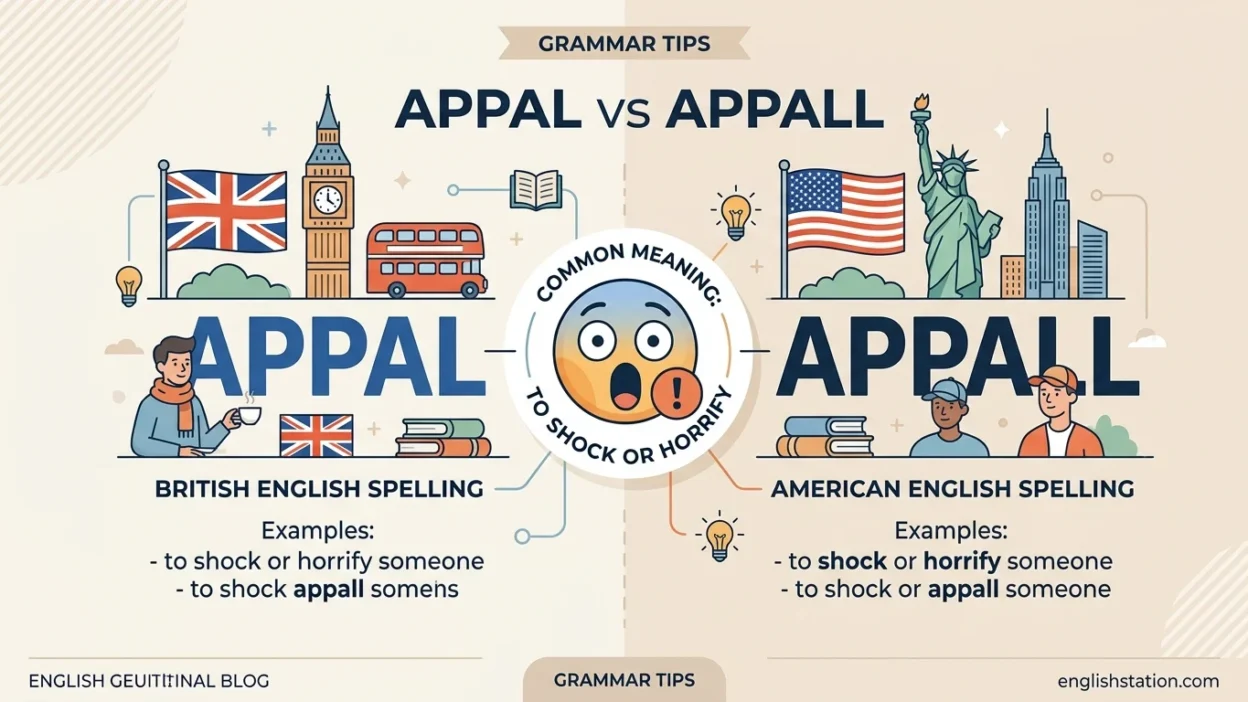
Both appal and appall are verbs meaning to shock, horrify, or deeply upset someone. The only major difference is their spelling. Appal is the standard British spelling, while appall is the standard American spelling.
For example, British English may say, “The news appalled her,” while the spelling of the base verb is appal. American English uses appall, as in “The news appalled her.”
The good news is that there is no difference in meaning, pronunciation, or grammatical function. The difference is mainly a matter of British vs American spelling conventions.
In this guide, you will learn the difference between appal and appall, how to use each spelling, their meanings, examples, pronunciation, common mistakes, and an easy way to remember which form belongs to which variety of English.
Quick Answer: Appal vs Appall
Appal and appall have the same meaning: to shock, horrify, or greatly dismay someone.
The difference is spelling:
Appal = British English
Appall = American English
Both are pronounced the same and have the same grammatical forms.
What Does “Appal” Mean?
Appal is a verb meaning to shock, horrify, or deeply disturb someone.
It is the standard spelling in British English and is also used in other varieties that generally follow British spelling conventions.
Examples:
- The cruelty of the act appalled everyone.
- The news appalled her.
- I was appalled by his behavior.
- The condition of the building appalled the inspectors.
The word usually describes a strong negative emotional reaction.
Appal Meaning
When something appals you, it makes you feel extremely shocked, horrified, or disturbed.
For example:
The level of violence appalled the community.
This means the violence caused the community to feel deeply shocked or horrified.
What Does “Appall” Mean?
Appall has exactly the same meaning as appal.
It means to shock, horrify, or greatly dismay someone.
The main difference is that appall is the standard spelling in American English.
Examples:
- The decision appalled many people.
- The report appalled the public.
- She was appalled by the amount of waste.
- His behavior appalled his parents.
Whether you write appal or appall, the meaning remains the same.
Appal vs Appall: Comparison Table
| Feature | Appal | Appall |
|---|---|---|
| Meaning | Shock or horrify | Shock or horrify |
| Spelling | British English | American English |
| Pronunciation | Same | Same |
| Part of speech | Verb | Verb |
| Past tense | Appalled | Appalled |
| Past participle | Appalled | Appalled |
| Present participle | Appalling | Appalling |
| Example | The news appalled her. | The news appalled her. |
The important thing to notice is that both forms become “appalled” and “appalling” when suffixes are added.
British English: Appal
In British English, the preferred spelling is:
appal
For example:
- The decision appalled the committee.
- She was appalled by what she saw.
- The conditions appalled the investigators.
- His lack of concern appalled me.
British spelling generally preserves the single l in the base form of this word.
American English: Appall
In American English, the preferred spelling is:
appall
Examples:
- The decision appalled the committee.
- She was appalled by what she saw.
- The conditions appalled the investigators.
- His lack of concern appalled me.
American English uses the double l in the base form.
Why Does Appal Have One L and Appall Have Two?
The spelling difference follows a broader pattern in British and American English.
Some British English words retain a single final l, while American English often uses a double l in the base form of certain verbs.
Compare:
- appal → appall
- enrol → enroll
- fulfil → fulfill
- instil → instill
However, spelling conventions can vary across individual words, so it is better to learn each word rather than assume that every British and American pair follows exactly the same pattern.
Appal vs Appall Pronunciation
Appal and appall are pronounced the same.
The spelling does not create a difference in pronunciation.
Both are pronounced with stress on the second syllable.
The noun appallment is not the usual form. The related noun is generally appalment in British usage and appallment is rare. More commonly, English speakers use words such as horror, dismay, or shock to express the noun idea.
The adjective appalling, however, is very common.
Examples:
- It was an appalling mistake.
- The conditions were appalling.
- The behavior was absolutely appalling.
Examples of Appal
Here are some examples using the British spelling appal:
- The news appalled everyone.
- The level of corruption appalled the public.
- She was appalled by his behavior.
- The report appalled the committee.
- The conditions in the building appalled the inspectors.
- His complete lack of empathy appalled me.
- The documentary appalled viewers with its disturbing images.
- They were appalled by the treatment of the animals.
- The discovery appalled the entire community.
- The shocking revelation appalled the investigators.
Examples of Appall
Here are examples using the American spelling appall:
- The news appalled everyone.
- The level of corruption appalled the public.
- She was appalled by his behavior.
- The report appalled the committee.
- The conditions appalled the inspectors.
- His lack of concern appalled me.
- The documentary appalled viewers.
- They were appalled by the treatment of the animals.
- The discovery appalled the community.
- The shocking revelation appalled the investigators.
Notice something important: once the verb is used in the past tense, both spellings become appalled.
Appal vs Appall in Different Forms
The spelling difference is most noticeable in the base form.
British English
- appal
- appals
- appalled
- appalling
American English
- appall
- appalls
- appalled
- appalling
This means that if you are writing in British English, you may write:
The situation may appal her.
In American English:
The situation may appall her.
But both varieties write:
The situation appalled her.
Common Mistakes with Appal and Appall
Mistake 1: Mixing spelling systems
If you are consistently using British English, it is better to write:
- The news appalled her.
The past tense does not reveal the difference, but the base form should be appal in British English.
In American English, use:
- The news may appall her.
Try to maintain consistency with your chosen variety of English.
Mistake 2: Thinking the words have different meanings
Appal and appall do not have different meanings.
They are spelling variants of the same verb.
Mistake 3: Thinking the pronunciation changes
Adding another l does not change the pronunciation.
Appal and appall are pronounced the same.
Mistake 4: Writing “appalled” differently
Both British and American English normally use:
appalled
So the double l appears when the suffix is added.
Is “Appal” Correct?
Yes. Appal is completely correct.
It is the standard British English spelling.
Example:
- The decision may appal many readers.
If you are following British spelling conventions, appal is the appropriate form.
Is “Appall” Correct?
Yes. Appall is also completely correct.
It is the standard American English spelling.
Example:
- The decision may appall many readers.
If you are following American spelling conventions, appall is the appropriate form.
Appal vs Appall: Which One Should You Use?
Your choice depends on the variety of English you are writing.
Use appal if you are writing primarily in:
- British English
- Australian English
- New Zealand English
- Other varieties that generally follow British spelling conventions
Use appall if you are writing in:
- American English
For international websites, either form can be correct. The most important thing is to choose one spelling system and use it consistently throughout your content.
Memory Trick for Appal vs Appall
Here is an easy way to remember the difference:
Appal = British English
Appall = American English
You can remember the American version by thinking:
American English likes the extra L: appall.
Another useful trick is to remember that the spelling difference disappears in common forms such as:
appalled
appalling
So if you see appalled, don’t assume it tells you whether the writer normally uses appal or appall.
Appal vs Appall vs Appalled
These forms are closely related but have different grammatical uses.
Appal/Appall is the base form.
- The news may appal her.
- The news may appall her.
Appalled is the past tense and past participle.
- The news appalled her.
- She was appalled by the news.
Appalling is the present participle and also functions as an adjective.
- The situation was appalling.
- It was an appalling mistake.
Similar Words to Appal and Appall
Several words have similar meanings.
Shock
To cause someone to feel surprised or disturbed.
- The news shocked everyone.
Horrify
To cause intense fear, disgust, or shock.
- The story horrified the audience.
Dismay
To cause someone to feel worried, disappointed, or distressed.
- The result dismayed the team.
Stun
To shock someone so strongly that they temporarily cannot react normally.
- The announcement stunned everyone.
Disturb
To upset or trouble someone emotionally.
- The images disturbed many viewers.
Among these words, appal/appall often suggests a particularly strong reaction of shock, horror, or disapproval.
Final Verdict: Appal or Appall?
Both appal and appall are correct.
The difference is regional spelling, not meaning.
Appal is the standard British English spelling.
Appall is the standard American English spelling.
Both mean to shock, horrify, or deeply dismay someone, and both are pronounced the same.
The forms appalled and appalling are used in both varieties.
The easiest rule:
British English → appal
American English → appall
Choose the spelling that matches the variety of English you are using and remain consistent.
FAQs About Appal vs Appall
Is appal or appall correct?
Both are correct. Appal is the standard British English spelling, while appall is the standard American English spelling.
What is the difference between appal and appall?
There is no difference in meaning. Both mean to shock, horrify, or deeply dismay someone. The difference is mainly the spelling used in British and American English.
Is appal British or American?
Appal is the standard British English spelling.
Is appall British or American?
Appall is the standard American English spelling.
Are appal and appall pronounced the same?
Yes. Appal and appall have the same pronunciation. The extra l in the American spelling does not change the sound.
Is “appalled” spelled the same in British and American English?
Yes. Both British and American English use appalled.
Is appalling spelled with two Ls?
Yes. The standard spelling is appalling in both British and American English.
Can I use appal in American English?
It may be understood, but appall is the standard American spelling. If you are writing for an American audience, use appall.
Conclusion
The difference between appal vs appall is simple because the two words have the same meaning. Both mean to shock, horrify, or deeply upset someone.
The only significant difference is spelling. Appal is the standard British English form, while appall is the standard American English form.
The easiest rule to remember is:
Appal = British English
Appall = American English
Both forms are pronounced the same, and both become appalled and appalling when used in their common inflected forms.
Remember This
Appal = British spelling
Appall = American spelling
Same meaning.
Same pronunciation.
Different spelling.
Appalled and appalling are spelled with double L in both varieties.

Nancy Lisa is a passionate writer and contributor at DrameyHut, focused on uncovering the deeper meanings behind dreams. She creates engaging and insightful content that helps readers interpret their dreams and understand their subconscious thoughts. Her work inspires self-reflection, clarity, and a stronger connection to inner emotions.