Die vs dice is a common English usage question, especially when talking about board games, gambling, probability, or rolling numbers. Many people use “dice” for both singular and plural, while traditional English grammar makes a distinction between die and dice.
The basic rule is simple: die is traditionally the singular form, while dice is traditionally the plural form. For example, you can roll one die or roll two dice. However, modern everyday English often uses dice as both a singular and plural noun, particularly in informal contexts.
There is also another meaning of die that has nothing to do with games. As a verb, die means to stop living. It can also be a noun referring to a tool used for cutting, shaping, or forming materials.
In this guide, you will learn the difference between die and dice, how to use each word correctly, their plural forms, examples, common mistakes, and an easy memory trick.
Quick Answer: Die vs Dice
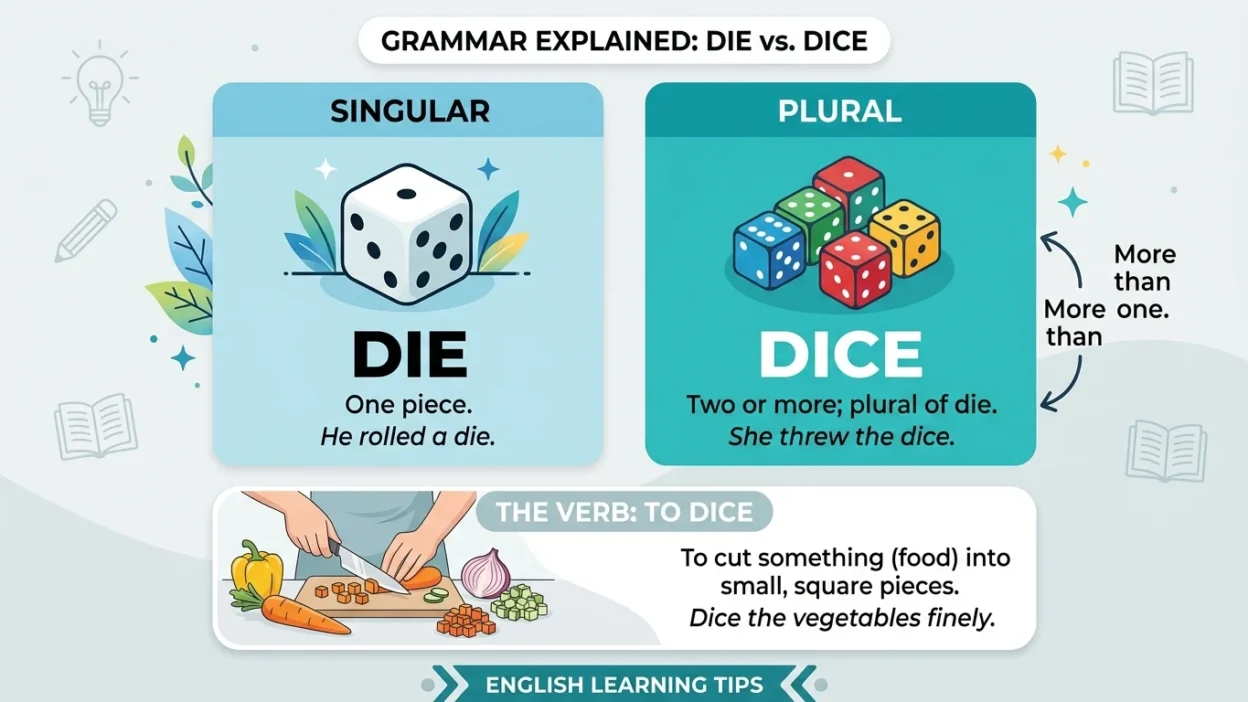
Die is traditionally the singular form of the noun for a small numbered cube used in games. Dice is traditionally its plural form.
One die, two dice.
However, in modern informal English, dice is also commonly used as a singular noun, especially when people say “a dice.”
Easy rule:
Die = one
Dice = two or more
What Does “Die” Mean?
The word die has several meanings, but one important meaning is the singular form of the gaming object.
A die is a small cube, usually with numbered sides, that is rolled in games to produce a random number.
For example:
- I rolled one die.
- The die landed on six.
- Pick up the die and roll it again.
- The game requires a single die.
When referring specifically to one gaming cube, die is the traditional singular form.
Die as a Verb
Die is also a very common verb meaning to stop living.
Examples:
- Plants can die without water.
- The character dies at the end of the movie.
- His old computer finally died.
- Flowers die without proper care.
The verb die is unrelated to the gaming noun in meaning.
Its forms include:
- die
- dies
- died
- dying
Notice that the present participle is dying, not “dieing.”
What Does “Dice” Mean?
Dice is traditionally the plural form of die when referring to gaming cubes.
Examples:
- I rolled two dice.
- The dice landed on different numbers.
- Shake the dice and roll them.
- We need three dice for this game.
So, traditionally:
One die
Two dice
Three dice
Dice as a Verb
Dice can also be a verb meaning to cut food into small cubes.
Examples:
- Dice the onions before adding them to the pan.
- She diced the tomatoes.
- Please dice the potatoes into small pieces.
- He is dicing the vegetables.
This meaning has nothing to do with gambling or board games.
Die vs Dice: Comparison Table
| Word | Traditional Meaning | Part of Speech | Example |
|---|---|---|---|
| Die | One gaming cube | Noun | Roll the die. |
| Dice | Two or more gaming cubes | Noun | Roll the dice. |
| Die | Stop living | Verb | Plants die without water. |
| Dice | Cut into small cubes | Verb | Dice the onions. |
| Dice | Modern singular gaming noun | Noun | Roll a dice. |
Is “Die” Singular or Plural?
Die is traditionally singular when referring to a gaming cube.
Example:
- I rolled one die.
The traditional plural is:
- I rolled two dice.
This follows a pattern found in some older English words borrowed from Latin or other languages where the plural changes the ending.
Compare:
- one die → two dice
- one mouse → two mice
- one goose → two geese
However, die → dice is especially important because modern English has changed how people use the word.
Can “Dice” Be Singular?
Yes. In modern informal English, “dice” is commonly used as both singular and plural.
You may hear:
- Roll a dice.
- I need a dice for this game.
- Pick one dice.
- Roll two dice.
Although “a die” is the traditional and grammatically precise singular form, “a dice” is widely understood and frequently used in everyday speech.
If you are writing formal, academic, technical, or carefully edited English, one die is the safest choice for a single gaming cube.
In casual conversation, a dice may sound perfectly natural to many speakers.
Die vs Dice in Probability
In mathematics and probability, the traditional distinction is particularly useful.
If you are describing a single six-sided cube, you can say:
- Roll a fair die.
- The probability of rolling a six on one die is 1/6.
When using multiple cubes:
- Roll two dice.
- The probability of getting a particular combination depends on the outcomes of both dice.
In mathematical writing, die for singular and dice for plural remains common and clear.
Examples of Die
Here are some examples using die as a singular gaming noun:
- Roll the die and move your piece.
- The die landed on four.
- I only need one die.
- The player picked up the die.
- What number did the die show?
- The die has six sides.
- Roll the die again.
- The probability of getting a six with one fair die is 1/6.
Remember that die can also be the verb meaning “stop living”:
- Some plants die in extremely cold weather.
- The battery will eventually die.
Examples of Dice
Here are examples using dice as a traditional plural noun:
- Roll the dice.
- The dice landed on five and two.
- We need two dice for this game.
- She threw the dice across the table.
- The dice showed different numbers.
- He rolled three dice at once.
- Put the dice back in the box.
- The game uses six sided dice.
Remember that dice can also be a verb:
- Dice the carrots into small pieces.
- She diced the onions.
- He is dicing the potatoes.
Common Mistakes with Die and Dice
Mistake 1: Using “dice” as the traditional singular
Less traditional:
- I rolled one dice.
Traditional and preferred in formal writing:
- I rolled one die.
However, “one dice” or “a dice” is common in informal modern English.
Mistake 2: Using “die” for multiple gaming cubes
Incorrect in traditional usage:
- I rolled two die.
Correct:
- I rolled two dice.
Mistake 3: Confusing the noun and verb meanings
Consider:
- Roll the die.
Here, die is a noun.
But:
- The plant may die.
Here, die is a verb meaning to stop living.
Mistake 4: Confusing “dice” with “die” when cooking
If you are cutting food into cubes, the correct verb is dice.
Example:
- Dice the onions.
You would not normally say:
- Die the onions.
Die vs Dice in American and British English
The traditional distinction between die and dice is understood in both American and British English.
In both varieties, die can be used as the singular noun for one gaming cube, while dice is the traditional plural.
However, everyday English increasingly uses dice as a singular noun as well.
This means that you may hear “a dice” in casual conversation in both varieties of English.
For formal writing, one die and two dice remain the clearest choices.
Die vs Dice vs Diced
These words are related but have different grammatical functions.
Die can be:
- A singular gaming noun
- A verb meaning to stop living
Dice can be:
- The traditional plural of die
- A verb meaning to cut into cubes
- A modern singular noun in informal usage
Diced is the past tense or past participle of the verb dice.
Examples:
- Roll the die.
- Roll the dice.
- Dice the onions.
- The onions have been diced.
A Simple Memory Trick
Use this easy rule:
Die = one
Dice = more than one
Think:
1 die → 2 dice
You can remember it like this:
One D.I.E. = one gaming cube.
More than one = dice.
There is one important exception to remember: dice is also commonly used as a singular noun in informal modern English.
For formal writing, however, stick with:
one die
two dice
Is “Roll the Dice” Correct?
Yes. “Roll the dice” is completely correct.
It is one of the most common expressions involving the word dice.
Examples:
- Let’s roll the dice.
- It’s your turn to roll the dice.
- He rolled the dice and moved his piece.
The phrase can also be used figuratively to mean taking a risk or making a risky decision.
For example:
- Starting a new business was a roll of the dice.
Is “Roll the Die” Correct?
Yes. “Roll the die” is correct when referring to one gaming cube.
Example:
- Roll the die and move three spaces.
If you are using multiple gaming cubes, use:
- Roll the dice.
So:
One cube → roll the die
Multiple cubes → roll the dice
Final Verdict: Die or Dice?
The traditional distinction is easy:
Die is singular.
Dice is plural.
So if you have one gaming cube, say:
I rolled one die.
If you have two or more, say:
I rolled two dice.
However, modern English commonly uses dice as a singular noun in informal contexts. Therefore, you may hear “a dice” in everyday speech.
For formal, academic, mathematical, or carefully edited writing, the safest rule is still:
One die, two dice.
Also remember that die and dice have unrelated verb meanings. Die means to stop living, while dice means to cut something into small cubes.
FAQs About Die vs Dice
Is die singular or plural?
Die is traditionally the singular form of the gaming noun. For example, “I rolled one die.” Its traditional plural is dice.
Is dice singular or plural?
Traditionally, dice is the plural of die. However, modern informal English also commonly uses dice as a singular noun.
Is it one die or one dice?
In traditional and formal English, one die is preferred. “One dice” or “a dice” is common in informal modern usage but is less traditional.
What is the plural of die?
When referring to a gaming cube, the traditional plural of die is dice.
Example:
One die → two dice
Can I say “two dies”?
Usually not when referring to gaming cubes. The traditional plural is dice, not “dies.”
However, dies can be the plural of die in certain technical contexts, such as manufacturing tools or semiconductor components.
What is the difference between die and dice?
Die is traditionally one gaming cube, while dice is traditionally two or more gaming cubes. Die can also mean to stop living, while dice can mean to cut food into small cubes.
Is “roll the dice” correct?
Yes. “Roll the dice” is correct and very common. It normally refers to rolling multiple gaming cubes, although “dice” may also be used as a singular noun in modern informal English.
Why do people say “a dice”?
Because modern English increasingly uses dice as a singular noun as well as a plural noun. Although a die is the traditional singular form, a dice is widely used and understood in informal contexts.
Conclusion
The difference between die vs dice is mainly about singular and plural usage.
Traditionally, die means one gaming cube, while dice means two or more. The simple rule is one die, two dice.
At the same time, modern English often uses dice as a singular noun, particularly in casual speech. So while “a die” is the traditional formal choice, “a dice” is not unusual in everyday English.
Finally, remember that these words have other meanings too. Die can mean to stop living, while dice can mean to cut food into small cubes.
Remember This
One die.
Two dice.
Roll the die.
Roll the dice.
Die = traditionally singular.
Dice = traditionally plural, but commonly singular in informal modern English.
Dice = also means to cut something into small cubes.

Christopher Thomas is a passionate writer and dream researcher dedicated to exploring the meanings behind dreams. As an author at DrameyHut, he creates insightful and easy-to-understand interpretations that help readers connect with their subconscious mind. His work focuses on guiding individuals toward self-discovery, clarity, and a deeper understanding of their inner thoughts.