The words fair and good are both common English adjectives, but they do not always mean the same thing. In some situations, they can describe something positively, which makes them easy to confuse. However, the meaning changes considerably depending on the context.
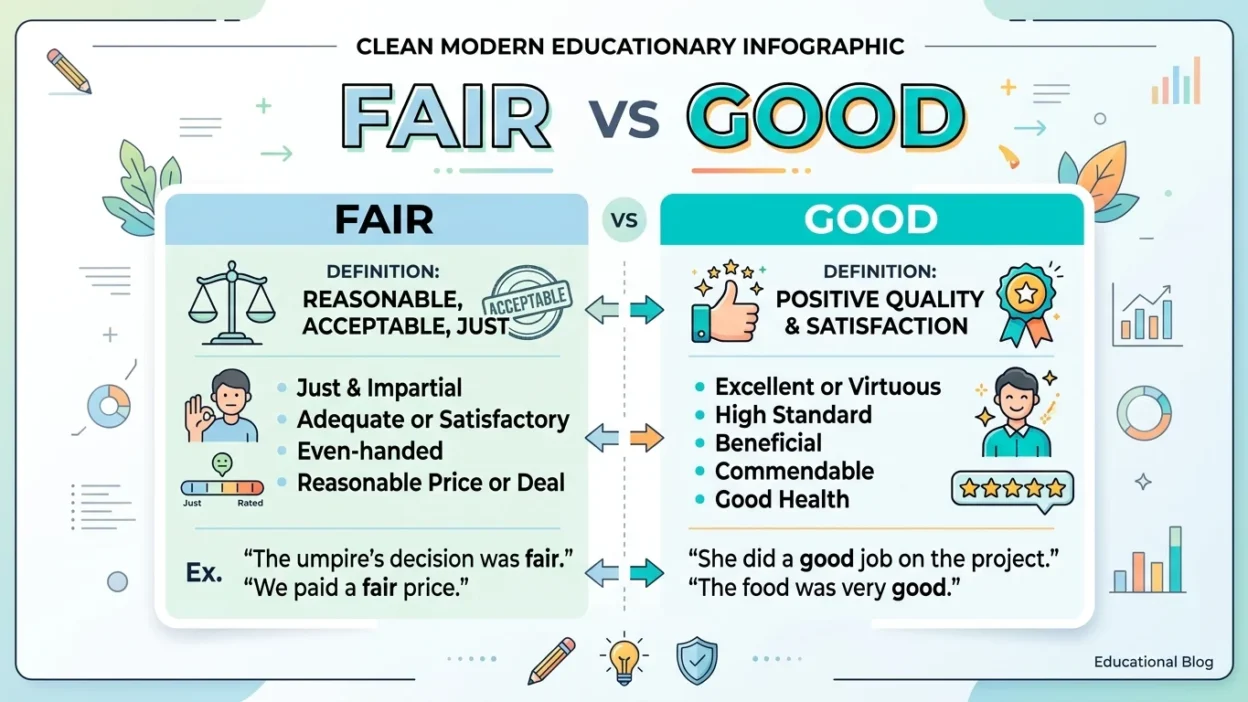
Good generally means satisfactory, positive, high in quality, or desirable. Fair can mean reasonable, just, acceptable, or moderately good. For example, if someone says, “The food was good,” they usually mean they liked it or thought it was satisfactory or enjoyable. If they say, “The food was fair,” they may mean it was acceptable but not particularly impressive.
The difference becomes even clearer when talking about fairness, rules, treatment, weather, skin tone, or quantity. In this article, we will explain fair vs good, their meanings, differences, examples, common mistakes, similar words, and when each word is the better choice.
Quick Answer
Good usually means positive, satisfactory, or high in quality. Fair can mean reasonable or just, but when used to describe quality, it often means acceptable or moderately good, not excellent. So, “good” is generally more positive than “fair” when rating quality.
Why People Confuse “Fair” and “Good”
The confusion comes from one important fact: fair can sometimes mean reasonably good.
For example:
The movie was fair.
This can mean the movie was acceptable but not especially impressive.
Meanwhile:
The movie was good.
This normally gives a more positive evaluation.
Both words can therefore be used to describe quality, but they communicate different levels of approval.
There is another important difference. Fair has several meanings that have nothing to do with quality.
For example:
That was a fair decision.
Here, fair means just or reasonable.
So, you need to consider the context before deciding what “fair” means.
What Does “Good” Mean?
Good is one of the most common adjectives in English. It can describe something that has positive qualities, meets expectations, works well, or provides satisfaction.
For example:
This is a good book.
The speaker thinks the book is enjoyable, useful, or of satisfactory quality.
“Good” can describe:
- Quality
- Performance
- Behavior
- Results
- Food
- Experiences
- Skills
- Character
- Conditions
- Ideas
Examples:
She is a good teacher.
He did a good job.
This is a good idea.
We had a good time.
The food was good.
The exact meaning depends on the noun or situation being described.
What Does “Fair” Mean?
Fair has several important meanings in English.
Fair means reasonable or just
The teacher gave everyone a fair chance.
Here, “fair” means equal and reasonable.
Fair means acceptable or moderately good
The movie was fair.
Here, “fair” suggests the movie was okay but not particularly impressive.
Fair means average
In some contexts, “fair” can describe something that is neither very good nor very bad.
His performance was fair.
This suggests that his performance was acceptable but not outstanding.
Fair can describe weather
We are expecting fair weather tomorrow.
Here, “fair” generally means pleasant, clear, or reasonably good weather.
Fair can describe skin or hair
She has fair skin.
He has fair hair.
In these examples, “fair” relates to light color, not quality.
Fair can mean a public event
We went to the county fair.
Here, fair is a noun referring to an event with entertainment, games, food, exhibitions, or commercial activities.
Fair vs Good: Comparison Table
| Word | Common meaning | Degree of quality | Example |
|---|---|---|---|
| Good | Positive or satisfactory | Generally positive | The movie was good. |
| Fair | Acceptable or average | Usually weaker than good | The movie was fair. |
| Excellent | Extremely good | Very high | The movie was excellent. |
| Poor | Below an acceptable standard | Low | The movie was poor. |
| Reasonable | Sensible or acceptable | Depends on context | That is a reasonable price. |
| Just | Fair and morally right | Positive in fairness | The decision was just. |
When fair and good are being used specifically to rate quality, good is generally the stronger positive evaluation.
Fair vs Good When Rating Quality
This is one of the most useful distinctions.
Imagine a restaurant asks you to rate your meal.
Excellent
The meal was outstanding.
Good
The meal was enjoyable and clearly satisfactory.
Fair
The meal was acceptable but had noticeable weaknesses.
Poor
The meal was unsatisfactory.
So, if someone says:
The service was good.
You can assume they were generally satisfied.
If they say:
The service was fair.
They may be saying that the service was acceptable but could have been better.
However, fair does not always have exactly the same strength everywhere. In some rating systems, fair can mean average rather than bad.
Fair vs Good in Everyday Conversation
In everyday conversation, good is much more common when expressing positive approval.
For example:
How was the movie?
It was good.
This sounds completely natural.
You could say:
It was fair.
But this sounds more like a lukewarm evaluation. The listener may understand that you did not think the movie was particularly impressive.
Similarly:
How was the restaurant?
It was good.
This indicates a positive experience.
It was fair.
This sounds like the restaurant was merely acceptable.
When to Use “Good”
Use good when you want to express a clearly positive evaluation.
Talking about quality
This is a good product.
Talking about performance
She gave a good performance.
Talking about behavior
He is a good person.
Talking about an experience
We had a good time.
Talking about an idea
That’s a good idea.
Talking about results
You got a good score.
In all these examples, “good” communicates a generally favorable judgment.
When to Use “Fair”
Use fair when you mean something is reasonable, just, or acceptable.
Talking about equal treatment
Everyone deserves a fair opportunity.
Talking about a decision
The judge made a fair decision.
Talking about a price
That’s a fair price.
Here, “fair” means reasonable rather than cheap or excellent.
Talking about quality
His performance was fair.
Here, the performance was acceptable or average.
Talking about weather
We had fair weather throughout the weekend.
Talking about appearance or color
She has fair skin.
The meaning of “fair” depends heavily on the context.
Examples of “Good”
- This is a good restaurant.
- She did a good job on the project.
- He is a good teacher.
- We had a good experience.
- That sounds like a good idea.
- The weather was good yesterday.
- This book is very good.
- You gave a good answer.
- The new system is working well and producing good results.
- He has a good understanding of the subject.
- The food at the restaurant was good.
- She received good feedback from her manager.
Examples of “Fair”
- The teacher gave every student a fair chance.
- That seems like a fair decision.
- They offered me a fair price for the car.
- His performance was fair.
- The weather remained fair throughout the afternoon.
- She has fair skin.
- He has fair hair.
- Everyone should receive fair treatment.
- The examination was fair and well designed.
- I think that’s a fair question.
- The team’s performance was fair but could have been better.
- We attended the local fair last weekend.
“Fair Enough” vs “Good Enough”
These expressions are similar in form but different in meaning.
Fair enough
Fair enough usually means:
- That is reasonable.
- I accept your point.
- That seems justified.
For example:
“I don’t think we should spend more money.”
“Fair enough.”
Here, the speaker accepts the other person’s reasoning.
Good enough
Good enough means something meets the required standard.
This answer is good enough for the assignment.
It does not necessarily mean excellent. It means sufficient.
So:
fair enough = reasonable or acceptable
good enough = sufficiently good
“Fair” Does Not Always Mean “Average”
It is important not to assume that fair always means mediocre.
Consider:
That was a fair decision.
This does not mean the decision was average. It means the decision was just and reasonable.
Similarly:
He received a fair price.
This means the price was reasonable.
So, “fair” can describe fairness rather than quality.
“Fair” vs “Excellent”
These words are almost opposites when describing quality.
The performance was fair.
This suggests acceptable or average quality.
The performance was excellent.
This indicates exceptionally high quality.
A useful scale is:
excellent → very good → good → fair → poor
This is not an absolute scale in every context, but it is a useful general guide when “fair” is being used as a quality rating.
Common Mistakes
Mistake 1: Assuming “fair” always means “good”
Not necessarily.
The price is fair.
This means the price is reasonable, not necessarily that the product itself is good.
Mistake 2: Assuming “fair” always means bad
“Fair” does not automatically mean bad.
If someone says:
The exam was fair.
They probably mean the exam was reasonable and properly designed.
Mistake 3: Using “fair” when you mean clearly positive
If you genuinely want to praise something, good is usually more natural.
The food was good.
sounds more positive than:
The food was fair.
Mistake 4: Confusing “fair” with “fairly”
Fair is an adjective.
The decision was fair.
Fairly is an adverb.
The test was fairly easy.
They have related forms but different grammatical functions.
Mistake 5: Thinking “fair” has only one meaning
“Fair” can mean reasonable, just, moderately good, light in color, pleasant weather, or a public event.
Context determines the meaning.
Memory Trick
Use this simple rule:
Good = positive quality
Fair = reasonable, just, or acceptable
When rating quality, remember:
Good is usually better than fair.
For example:
Good service = positive service.
Fair service = acceptable service, but probably not impressive.
For fairness:
Fair treatment = equal and reasonable treatment.
This distinction will help you choose the right word quickly.
American vs British English
Fair and good are used in both American and British English.
The meanings are generally the same.
Both American and British speakers can say:
That’s a fair price.
She’s a good teacher.
We had fair weather.
The service was good.
One difference can appear in specific rating systems, where fair may be formally defined as a particular level of quality. The exact scale can vary by organization, so context matters.
In everyday English, however, the basic distinction remains the same.
Similar Words
For “Good”
Depending on the context, similar words include:
- Great
- Excellent
- Fine
- Positive
- Satisfactory
- Pleasant
- Impressive
- High quality
For “Fair” meaning reasonable
Similar words include:
- Just
- Reasonable
- Equitable
- Impartial
- Unbiased
- Appropriate
- Acceptable
For “Fair” meaning moderately good
Similar words include:
- Average
- Adequate
- Acceptable
- Mediocre
- Passable
- Satisfactory
The correct synonym depends on which meaning of fair is intended.
Is “Fair” Better Than “Good”?
Usually, no, if you are talking about quality.
When “fair” is used as a quality rating, it generally indicates something acceptable or average, while “good” expresses a more positive evaluation.
For example:
The movie was good.
is generally more positive than:
The movie was fair.
However, when “fair” means just or reasonable, comparing it with “good” does not make sense in the same way.
Is Fair a Positive or Negative Word?
Fair is usually neutral to mildly positive, depending on context.
For example:
She received fair treatment.
This is clearly positive.
But:
His performance was fair.
This may sound lukewarm because it suggests the performance was only acceptable.
So, “fair” can be positive when discussing justice or reasonable treatment but less enthusiastic when rating quality.
FAQs
Is fair better than good?
When describing quality, good is generally better or more positive than fair. Fair often means acceptable or average, while good indicates a more favorable evaluation.
Does fair mean good?
Sometimes, but not exactly. When fair describes quality, it can mean reasonably good or acceptable. However, fair also commonly means just, reasonable, or impartial.
What is the difference between fair and good?
Good generally expresses positive quality. Fair can describe something reasonable or just, or it can mean acceptable or average when discussing quality.
Is “fair” a positive word?
It depends on context. “Fair treatment” is positive because it means just treatment. “A fair performance” can sound less positive because it may mean only average or acceptable.
Can I say “the food was fair”?
Yes, but it may sound like the food was merely acceptable rather than particularly good. If you enjoyed the food, “The food was good” is usually more natural.
What does “fair enough” mean?
“Fair enough” usually means that is reasonable or I accept your point. It is commonly used in conversations when someone acknowledges another person’s argument or decision.
What is another word for fair?
If fair means reasonable, alternatives include just, reasonable, impartial, equitable, and unbiased. If it means moderately good, alternatives include average, acceptable, adequate, and passable.
What is the opposite of fair?
The opposite depends on the meaning. If fair means just, the opposite can be unfair or unjust. If fair means moderately good, poor may be an opposite in a quality rating.
Final Verdict
Fair and good are both correct English words, but they are not interchangeable in every context.
When describing quality, good is generally more positive than fair. If something is good, it has positive or satisfactory qualities. If something is fair, it may be acceptable or average.
However, fair has several other meanings. It can describe something that is just, reasonable, impartial, pleasant in terms of weather, or light in color.
The easiest rule is:
Good = positive quality
Fair = reasonable, just, or acceptable
Always look at the context before deciding what “fair” means.
Conclusion
The difference between fair and good becomes clear once you focus on context. When rating quality, “good” usually expresses stronger approval, while “fair” often suggests that something is acceptable but not outstanding. For example, “The movie was good” is more enthusiastic than “The movie was fair.”
But “fair” is much broader than a simple quality rating. It can mean reasonable, just, or impartial, as in “a fair decision” or “a fair price.” It can also describe light coloring, pleasant weather, or a public event. Therefore, the right word depends on exactly what you want to say.
Remember This
Good = positive or satisfactory quality
Fair = reasonable, just, or acceptable
When comparing quality:
Good is generally more positive than fair.
When talking about justice:
Fair means reasonable and just.
Example:
The service was good.
The price was fair.
Here, “good” evaluates quality, while “fair” evaluates whether the price is reasonable.

Nancy Lisa is a passionate writer and contributor at DrameyHut, focused on uncovering the deeper meanings behind dreams. She creates engaging and insightful content that helps readers interpret their dreams and understand their subconscious thoughts. Her work inspires self-reflection, clarity, and a stronger connection to inner emotions.