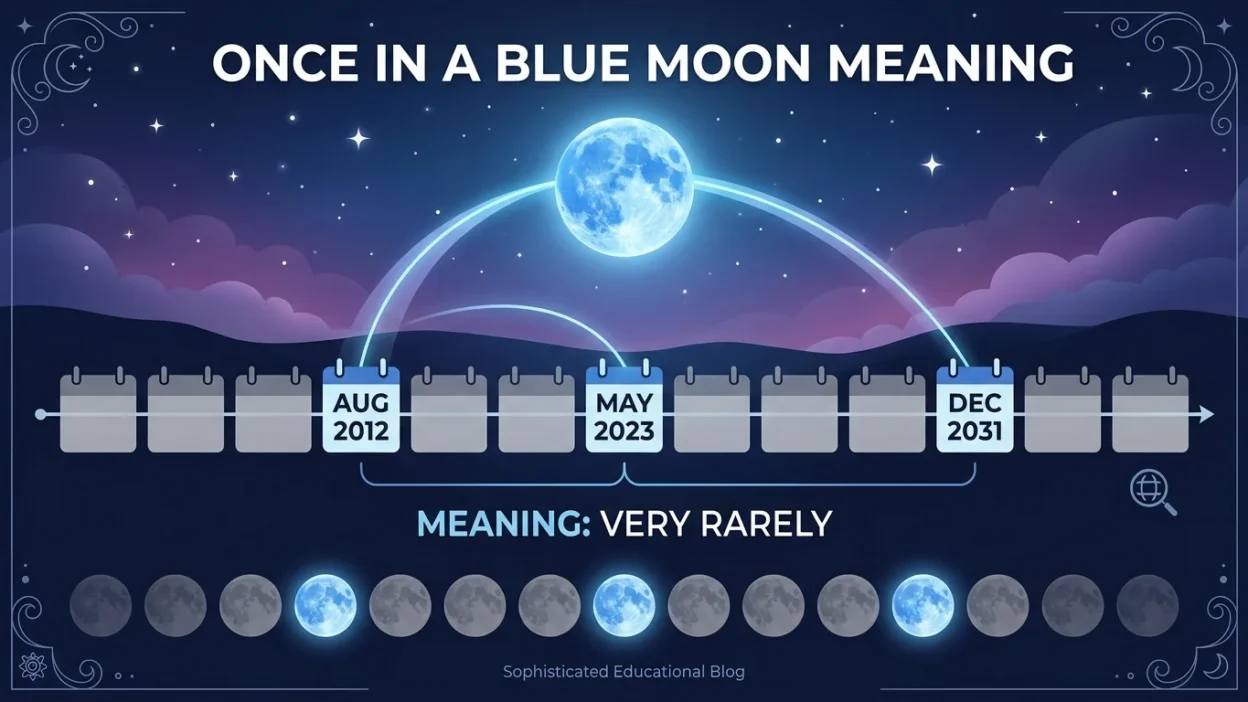
Have you ever heard someone say, “I only go there once in a blue moon” and wondered what they really meant? This colorful English idiom has nothing to do with someone literally waiting for the Moon to turn blue. Instead, “once in a blue moon” means very rarely or almost never.
The expression is commonly used in everyday English when something happens only occasionally. For example, if someone says, “I eat fast food once in a blue moon,” they mean they eat it very rarely. The phrase can describe habits, events, visits, conversations, opportunities, or almost anything that happens infrequently.
In this article, we will explain the once in a blue moon meaning, its origin, correct grammar, natural examples, similar expressions, common mistakes, and how to use this idiom confidently in everyday English.
Quick Answer
“Once in a blue moon” means very rarely or only occasionally. It describes something that does not happen often. For example, “I go to the cinema once in a blue moon” means that I go to the cinema very rarely.
What Does “Once in a Blue Moon” Mean?
The idiom “once in a blue moon” means very rarely or almost never.
It is used when an event happens infrequently.
For example:
I eat dessert once in a blue moon.
This means:
I eat dessert very rarely.
The expression does not usually indicate a precise amount of time. It simply emphasizes that something happens unusually infrequently.
You might use it when talking about:
- Rare habits
- Occasional visits
- Infrequent events
- Unusual opportunities
- Rare conversations
- Things you seldom do
Simple definition
Once in a blue moon = very rarely
Why Is It Called “Once in a Blue Moon”?
The expression comes from the idea of a blue Moon, a relatively rare astronomical occurrence.
However, the modern idiom does not mean that something happens literally every time there is a blue Moon. The phrase developed as a colorful way of describing something that happens very infrequently.
A particularly interesting point is that the term “blue moon” has had different meanings historically. The modern astronomical usage commonly refers to an extra full Moon occurring within a particular calendar period, while older uses of “blue moon” were associated with rarity in other ways.
Over time, “once in a blue moon” became an established English idiom meaning something happens only rarely.
Is “Once in a Blue Moon” an Idiom?
Yes.
“Once in a blue moon” is an English idiom.
An idiom is an expression whose overall meaning cannot always be understood simply by interpreting each individual word literally.
For example:
I visit my old school once in a blue moon.
You should not interpret this as literally visiting the school when the Moon is blue.
The intended meaning is:
I visit my old school very rarely.
How to Use “Once in a Blue Moon”
The idiom is usually used to describe something that happens very rarely.
A common structure is:
Subject + verb + once in a blue moon.
For example:
I eat out once in a blue moon.
Another structure is:
Once in a blue moon + clause
For example:
Once in a blue moon, I enjoy going to a large party.
The phrase can appear at the beginning or end of a sentence.
At the end
We go camping once in a blue moon.
At the beginning
Once in a blue moon, we go camping.
Both are correct.
When the phrase appears at the beginning as an introductory expression, a comma is commonly used.
Examples of “Once in a Blue Moon”
Here are natural examples showing how the idiom works in everyday English.
- I eat fast food once in a blue moon.
- She visits her hometown once in a blue moon.
- We go to the theater once in a blue moon.
- He calls me once in a blue moon.
- I drink soda once in a blue moon.
- They have a family reunion once in a blue moon.
- I watch television once in a blue moon.
- She cooks something elaborate once in a blue moon.
- We see snow here once in a blue moon.
- He takes a vacation once in a blue moon.
- I buy expensive clothes once in a blue moon.
- Once in a blue moon, I stay up all night watching movies.
- My brother visits us once in a blue moon.
- She gets the opportunity to travel abroad once in a blue moon.
- Once in a blue moon, we have dinner together as a whole family.
- I play video games once in a blue moon.
- They go out for a fancy meal once in a blue moon.
- He posts something on social media once in a blue moon.
“Once in a Blue Moon” in Conversation
The idiom is especially natural in casual conversation.
For example:
“Do you ever go to concerts?”
“Yes, but only once in a blue moon.”
The speaker means that concerts are something they attend very rarely.
Another example:
“Do you still talk to your old classmates?”
“Once in a blue moon.”
This means they communicate with them only occasionally.
The expression can therefore make ordinary conversations more colorful and natural.
Once in a Blue Moon vs Rarely
These expressions have very similar meanings.
Rarely is a straightforward adverb.
I rarely eat out.
Once in a blue moon is an idiomatic expression.
I eat out once in a blue moon.
Both indicate that something does not happen often.
The difference is mainly style.
“Rarely” is neutral and concise, while “once in a blue moon” is more colorful and conversational.
Once in a Blue Moon vs Occasionally
Occasionally means sometimes, but not frequently.
Once in a blue moon usually suggests an even lower frequency.
Compare:
I occasionally go to the cinema.
This means I go sometimes.
I go to the cinema once in a blue moon.
This suggests that I go extremely rarely.
So, “once in a blue moon” is generally stronger than “occasionally.”
Once in a Blue Moon vs Every Now and Then
Every now and then means from time to time or occasionally.
I visit my grandparents every now and then.
This suggests that the visits happen occasionally.
I visit my grandparents once in a blue moon.
This suggests that the visits are much less frequent.
Both expressions are natural, but once in a blue moon generally emphasizes greater rarity.
Once in a Blue Moon vs Once in a While
These expressions are related but not identical in strength.
Once in a while means occasionally.
I eat pizza once in a while.
Once in a blue moon means very rarely.
I eat pizza once in a blue moon.
The second sentence suggests that pizza is an unusually rare treat.
Comparison Table
| Expression | Meaning | Frequency | Example |
|---|---|---|---|
| Once in a blue moon | Very rarely | Extremely low | I travel abroad once in a blue moon. |
| Rarely | Not often | Low | I rarely travel abroad. |
| Occasionally | Sometimes | Moderate | I occasionally travel abroad. |
| Every now and then | From time to time | Moderate | I travel abroad every now and then. |
| Once in a while | Occasionally | Moderate | I travel abroad once in a while. |
| Often | Frequently | High | I often travel abroad. |
| Frequently | Many times | High | I frequently travel abroad. |
The exact frequency depends on the speaker and context, but once in a blue moon strongly suggests rarity.
Common Mistakes
Mistake 1: Taking the expression literally
Some learners think the phrase means something happens when the Moon is actually blue.
Usually, it does not.
I visit him once in a blue moon.
Simply means:
I visit him very rarely.
Mistake 2: Saying “once on a blue moon”
The established idiom is:
once in a blue moon
Not:
❌ once on a blue moon
The preposition in is part of the fixed expression.
Mistake 3: Changing the expression unnecessarily
The standard phrase is:
once in a blue moon
Avoid unusual variations such as:
❌ once during a blue moon
when you mean the idiom.
Mistake 4: Assuming it means exactly once
“Once” in this idiom does not necessarily mean literally one time.
The entire expression means very rarely.
For example:
I see him once in a blue moon.
This does not necessarily mean I have seen him only once.
It means I see him very infrequently.
Mistake 5: Using it for something that happens frequently
It would be strange to say:
❌ I go to work once in a blue moon.
if you go to work every day.
The idiom should be reserved for things that genuinely happen rarely.
Is “Once in a Blue Moon” Formal or Informal?
The expression is idiomatic and generally conversational.
It is perfectly normal in everyday speech and informal writing.
For example:
I eat out once in a blue moon.
In highly formal or academic writing, a simpler expression such as rarely or infrequently may be more appropriate.
For example:
The species is rarely observed in this region.
This sounds more formal than:
The species appears once in a blue moon.
Both could be understood, but their styles are different.
Can You Use “Once in a Blue Moon” in Professional Writing?
Yes, but use your judgment.
The idiom is familiar and understandable, so it can appear in less formal professional communication.
For highly formal documents, reports, academic papers, or technical writing, rarely, infrequently, or only occasionally may be clearer.
For example:
Customer complaints occur rarely.
is more formal than:
Customer complaints occur once in a blue moon.
The latter is more conversational.
Is “Once in a Blue Moon” Positive or Negative?
The expression itself is neutral.
Its emotional meaning depends on the situation.
For example:
I eat cake once in a blue moon.
This can be neutral or playful.
I see my old friends once in a blue moon.
This could sound slightly sad because the speaker rarely sees them.
He apologizes once in a blue moon.
This could sound critical or humorous.
So, the idiom simply describes rarity. The surrounding context determines whether that rarity is good, bad, or neutral.
American vs British English
“Once in a blue moon” is widely used in both American and British English.
The meaning is essentially the same:
very rarely
It is a familiar English idiom in both varieties.
There is no important difference in spelling or grammar between American and British usage.
The expression can be used in casual conversation, storytelling, informal writing, and other contexts where idiomatic language is appropriate.
Similar Expressions
Several expressions can communicate a similar idea.
Rarely
I rarely eat dessert.
Seldom
I seldom watch television.
“Seldom” is somewhat more formal or literary.
Hardly ever
I hardly ever go there.
This is very common in everyday English.
Almost never
I almost never drink coffee.
This emphasizes that something happens extremely infrequently.
Every now and then
I visit them every now and then.
This means occasionally and is generally less extreme than “once in a blue moon.”
Once in a while
We eat out once in a while.
This also means occasionally.
Few and far between
Opportunities like that are few and far between.
This describes things that are widely separated in occurrence or availability.
What Is the Opposite of “Once in a Blue Moon”?
The opposite would be an expression describing something that happens frequently.
Examples include:
- Often
- Frequently
- Regularly
- All the time
- Very often
- Every day
- Constantly
For example:
I go jogging once in a blue moon.
Opposite:
I go jogging regularly.
The first sentence indicates very low frequency, while the second indicates a consistent habit.
Is “Once in a Blue Moon” a Metaphor?
It is best described as an idiomatic expression.
The imagery of a blue Moon helps communicate the idea of rarity, but the expression has developed a conventional figurative meaning.
You should therefore learn it as a fixed idiom meaning:
very rarely
rather than trying to interpret it literally every time you hear it.
FAQs
What does “once in a blue moon” mean?
“Once in a blue moon” means very rarely or almost never. It describes something that happens only occasionally.
Is “once in a blue moon” an idiom?
Yes. It is a common English idiom used to describe something that happens very rarely.
What is an example of “once in a blue moon”?
An example is: “I go to the cinema once in a blue moon.” This means that I go to the cinema very rarely.
Does “once in a blue moon” mean once?
No. The expression does not necessarily mean something happens exactly one time. It means something happens very rarely.
Is “once in a blue moon” formal?
It is generally conversational and idiomatic. It is perfectly natural in everyday English, although rarely or infrequently may be preferable in highly formal writing.
What is another way to say “once in a blue moon”?
You can say rarely, seldom, hardly ever, almost never, once in a while, or every now and then, depending on the intended degree of frequency.
What is the opposite of “once in a blue moon”?
Opposites include often, frequently, regularly, and all the time.
Can “once in a blue moon” describe a person?
Yes. You can use it to describe something a person does very rarely.
He visits us once in a blue moon.
This means he visits us very rarely.
Final Verdict
“Once in a blue moon” means very rarely. It is a common English idiom used when something happens infrequently or only on rare occasions.
The expression is usually figurative rather than literal. You can use it for habits, visits, events, opportunities, conversations, and many other situations.
The easiest way to remember it is:
Once in a blue moon = very rarely
If you want a simple and direct word, use rarely. If you want a more colorful and conversational expression, once in a blue moon is an excellent choice.
Conclusion
The idiom “once in a blue moon” is a useful and memorable way to say that something happens very rarely. Although the expression uses imagery involving the Moon, its everyday meaning has nothing to do with literally seeing a blue Moon. Instead, it communicates the idea of an event that happens only occasionally.
You can use it naturally in sentences such as “I travel abroad once in a blue moon” or “She visits us once in a blue moon.” Just remember that “once” does not mean exactly one time here. The entire phrase works as a fixed idiom meaning very rarely.
Remember This
Once in a blue moon = very rarely.
Example:
I eat at expensive restaurants once in a blue moon.
Meaning:
I eat at expensive restaurants very rarely.
Do not take the expression literally, and remember the correct form:
once in a blue moon ✅
once on a blue moon ❌

Christopher Thomas is a passionate writer and dream researcher dedicated to exploring the meanings behind dreams. As an author at DrameyHut, he creates insightful and easy-to-understand interpretations that help readers connect with their subconscious mind. His work focuses on guiding individuals toward self-discovery, clarity, and a deeper understanding of their inner thoughts.