Moose and mousse look and sound similar, but they refer to completely different things. One is a large wild animal, while the other can be a food, dessert, or styling product. Because their spellings differ by only one letter and their pronunciations are very similar, these two words are easy to mix up, especially for English learners.
A moose is a very large deer-like mammal found mainly in northern regions of North America, Europe, and Asia. Mousse, on the other hand, is a light, soft preparation that can be a sweet dessert, a savory dish, or a hair-styling product. For example, you might say, “We saw a moose in the forest,” but “She put mousse in her hair.”
In this article, we will explain the difference between moose and mousse, including their meanings, pronunciation, grammar, examples, common mistakes, American and British English usage, related words, and a simple memory trick.
Quick Answer
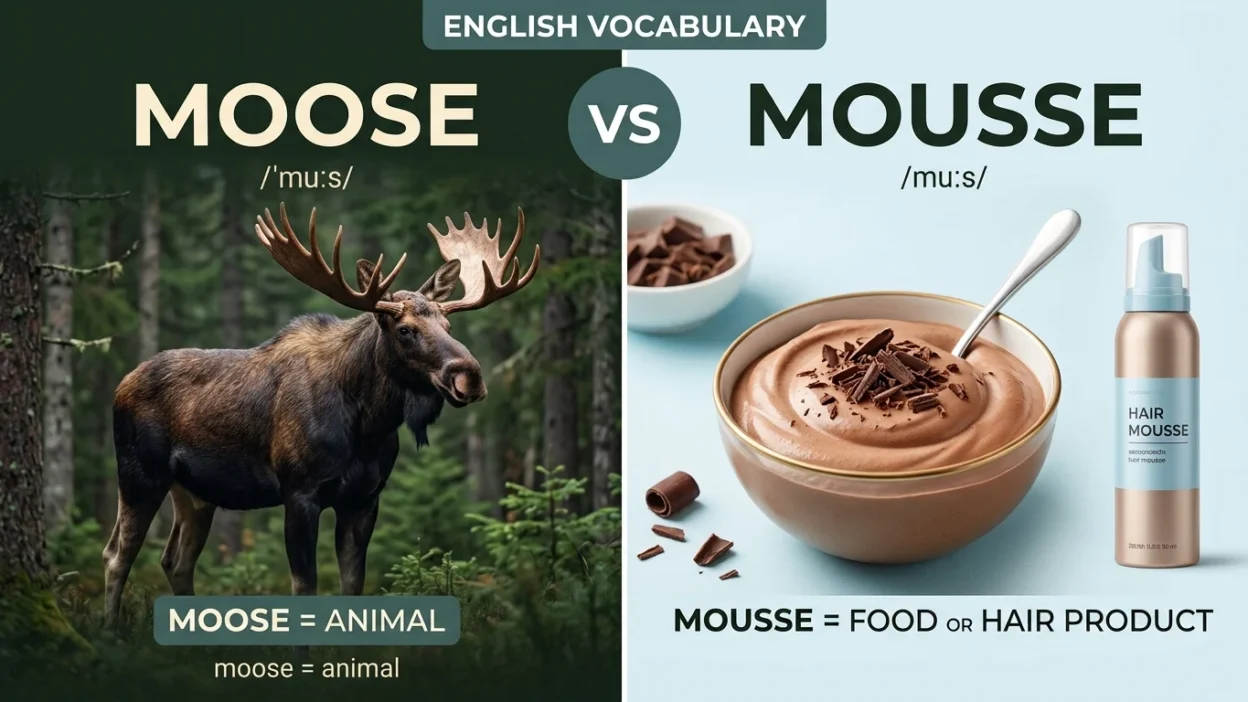
Moose is a large deer-like animal. Mousse is a light, airy food or a hair-styling product. They are pronounced similarly, but their meanings are completely different. Remember: moose = animal, while mousse = food or hair product.
Why People Confuse Moose and Mousse
The main reason for the confusion is their similar spelling and pronunciation.
Compare:
moose
mousse
The words look almost identical, and both have a pronunciation similar to the word “moves” without the final consonant.
However, their meanings have nothing in common.
One refers to an animal:
We saw a moose near the lake.
The other can refer to food:
She ordered chocolate mousse.
Or hair care:
He used mousse to style his hair.
The context usually makes the intended meaning clear.
What Does “Moose” Mean?
A moose is a very large member of the deer family.
Moose are known for their:
- Large bodies
- Long legs
- Large antlers in males
- Long faces
- Strong shoulders
- Preference for forest and wetland habitats
For example:
We saw a moose while driving through the forest.
The word moose is normally used as a noun.
One particularly useful grammar point is that the plural of moose is also moose.
So:
One moose
Two moose
Not:
❌ two mooses
This is an important distinction for English learners.
What Does “Mousse” Mean?
Mousse is a word borrowed from French and has several related uses in English.
Mousse as a dessert
A mousse can be a light, soft, airy dessert.
The most familiar example is chocolate mousse.
For example:
We had chocolate mousse for dessert.
Mousse can be made with ingredients that give it a light, creamy or airy texture.
Mousse as a savory dish
The word can also describe a light, whipped savory preparation.
For example:
The chef served a salmon mousse as an appetizer.
Mousse as a hair product
Mousse can also mean a light hair-styling product, usually sold as a foam.
For example:
She applied mousse to her hair before styling it.
So, unlike “moose,” which has one main everyday meaning, mousse can refer to food or a beauty and styling product.
Moose vs Mousse: Comparison Table
| Word | Meaning | Part of speech | Example |
|---|---|---|---|
| Moose | A large deer-like animal | Noun | We saw a moose in the forest. |
| Mousse | A light food preparation or dessert | Noun | The chocolate mousse was delicious. |
| Mousse | A hair-styling foam | Noun | She used mousse in her hair. |
| Mooses | Incorrect standard plural in most contexts | Noun | ❌ We saw three mooses. |
| Moose | Singular and plural form | Noun | We saw three moose. |
The simplest distinction is:
Moose = animal
Mousse = food or hair product
Moose and Mousse Pronunciation
In standard English, moose and mousse are pronounced the same or extremely similarly.
Both are commonly pronounced with the vowel sound found in “moon.”
So the difference is primarily in spelling and meaning, not pronunciation.
This makes the words examples of homophones or near-identical-sounding words depending on the pronunciation variety and linguistic analysis.
Because they sound alike, context is especially important when speaking.
For example:
I saw a moose.
The context tells us that the speaker means the animal.
But:
I bought some mousse.
The context could indicate a food or hair product.
Moose: Examples in Sentences
- We saw a moose near the road.
- The moose walked slowly through the forest.
- A large moose was standing beside the lake.
- The photographer captured a beautiful picture of a moose.
- Moose are much larger than most deer.
- We were surprised to see a moose in the distance.
- The moose disappeared into the trees.
- A male moose can have very large antlers.
- The guide warned us not to approach the moose.
- Several moose were feeding near the water.
- The children were excited when they saw a moose.
- We learned about moose during our wildlife tour.
Mousse: Examples in Sentences
- She ordered chocolate mousse for dessert.
- The chocolate mousse was light and creamy.
- He used hair mousse before styling his hair.
- The chef prepared a salmon mousse.
- I made strawberry mousse for the party.
- This mousse gives my hair more volume.
- The restaurant serves a delicious lemon mousse.
- She applied mousse to damp hair.
- The dessert menu included chocolate mousse.
- The chef decorated the mousse with fresh berries.
- He prefers mousse because it does not feel too heavy in his hair.
- We shared a bowl of chocolate mousse after dinner.
Moose vs Mousse in Context
Context makes these words easy to distinguish.
Consider:
The moose crossed the road.
Clearly, the sentence is about an animal.
Now compare:
The mousse was served after dinner.
This refers to food.
And:
She applied mousse before blow-drying her hair.
This refers to a styling product.
Even though the words sound alike, the surrounding words usually make the intended meaning obvious.
The Plural of Moose
One of the most common grammar questions is how to make moose plural.
The standard plural is:
moose
For example:
I saw one moose.
I saw three moose.
Several moose live in the area.
The form mooses is generally not used in standard English for the animal.
This is similar to other animal nouns whose singular and plural forms are identical, although the grammatical history of “moose” is different from words such as “sheep.”
Is “Mooses” Correct?
For ordinary English, use moose as both singular and plural.
✅ One moose
✅ Two moose
❌ Two mooses
If you are writing about multiple animals, moose is the standard choice.
For example:
We saw five moose near the lake.
Is “Mousse” Countable or Uncountable?
It depends on how the word is being used.
When referring to the substance or food generally, mousse can be treated as uncountable:
I love chocolate mousse.
When referring to separate servings or varieties, it can be treated as countable:
The restaurant offers three different mousses.
Similarly, when referring to different types or preparations, a plural form such as mousses can be used.
For hair products, you might say:
She bought a mousse for curly hair.
The exact grammar depends on whether you mean the product generally, a container, or a particular type.
Moose vs Deer
A moose is a member of the deer family, but it is much larger than most animals people commonly call deer.
A moose is recognizable by its large size and, in males, its broad antlers.
So:
A moose is a type of deer.
But:
A deer is not necessarily a moose.
The word “deer” is a broader category.
Mousse vs Foam
Hair mousse is generally a foamy styling product.
The word “foam” describes its physical texture, while “mousse” is the specific name of the styling product.
For example:
She put foam in her hair.
This could describe the substance generally, but:
She put mousse in her hair.
specifically identifies a hair-styling product.
Common Mistakes
Mistake 1: Writing “mousse” when you mean the animal
❌ We saw a mousse in the forest.
✅ We saw a moose in the forest.
The animal is spelled moose.
Mistake 2: Writing “moose” when you mean the dessert
❌ I ordered chocolate moose.
✅ I ordered chocolate mousse.
The dessert is spelled mousse.
Mistake 3: Writing “mooses” as the plural
❌ We saw several mooses.
✅ We saw several moose.
The singular and plural forms of moose are the same.
Mistake 4: Assuming the pronunciation tells you the spelling
Because the words sound the same, you cannot rely on pronunciation alone.
You need to use the context to choose the correct spelling.
Mistake 5: Confusing hair mousse with the animal
❌ I put moose in my hair.
Unless you are making a very unusual joke, the correct word is:
✅ I put mousse in my hair.
Memory Trick
Here is an easy way to remember the difference:
Moose has two O’s together before the S: MOOS E. Think of the big animal with its large antlers.
Mousse has “ousse,” like the French-looking spelling used for the food and hair product.
An even simpler trick is:
Moose = animal
Mousse = food or hair
If you see antlers, think moose.
If you see chocolate or hair, think mousse.
American vs British English
The words moose and mousse are used in both American and British English.
The spelling is the same in both varieties.
There is also no major difference in meaning.
However, moose is more strongly associated with North American wildlife in everyday usage, although the animal also occurs in parts of Europe and Asia under related names and classifications.
Mousse is used in both American and British English for desserts and hair products.
So, regardless of whether you are writing American or British English:
moose = animal
mousse = food or hair product
Similar Words
Moose
Related animal terms include:
- Deer
- Elk
- Reindeer
- Caribou
- Antlered animal
- Wildlife
Be careful with elk, because “elk” can refer to different animals depending on the variety of English.
Mousse
Related food terms include:
- Dessert
- Cream
- Pudding
- Whipped dessert
- Chocolate dessert
Related hair-care terms include:
- Hair foam
- Styling foam
- Hair product
- Styling product
- Volumizing product
Moose vs Elk
Moose and elk are both large members of the deer family, but they are different animals.
A moose is generally much larger and has a distinctive broad, palmate antler shape in adult males.
The term elk can also create confusion because British and American English do not always use the word in exactly the same way.
For ordinary vocabulary purposes, remember:
Moose = one specific large deer-family animal
Elk = a different deer-family animal
Moose vs Mousse: A Simple Sentence Test
If you are unsure which spelling to use, ask yourself:
Am I talking about an animal?
If yes:
moose
Am I talking about food or a hair product?
If yes:
mousse
Examples:
We saw a moose.
We ate mousse.
She used mousse in her hair.
This simple test works in most everyday situations.
FAQs
What is the difference between moose and mousse?
Moose is a large deer-like animal. Mousse is a light food preparation, dessert, or hair-styling product.
Are moose and mousse pronounced the same?
Yes. In standard English, they are generally pronounced the same or extremely similarly. Their spelling and meaning are different.
What is the plural of moose?
The standard plural is moose, not “mooses.”
One moose, two moose.
Is “mooses” correct?
For ordinary standard English, moose is the usual plural form when referring to the animal.
What is chocolate mousse?
Chocolate mousse is a light, airy chocolate dessert with a soft, creamy texture.
What is hair mousse?
Hair mousse is a lightweight foamy styling product used to help shape, hold, or add volume to hair.
Is mousse only a dessert?
No. Mousse can also refer to savory preparations and to a hair-styling product.
Is moose a type of deer?
Yes. A moose is a member of the deer family and is one of its largest members.
Final Verdict
Moose and mousse are completely different words despite sounding the same.
Moose means a large deer-like animal.
Mousse can mean a light, airy food preparation, such as chocolate mousse, or a foamy hair-styling product.
The most important grammar point is that the plural of moose is also moose:
one moose
two moose
The easiest memory rule is:
Moose = animal
Mousse = food or hair product
Once you connect each spelling with its meaning, you will have little trouble telling them apart.
Conclusion
The difference between moose and mousse is easy to understand once you focus on meaning rather than pronunciation. A moose is a large animal belonging to the deer family, while mousse is a light food preparation or a hair styling product. Because the two words sound the same, context plays an important role in choosing the correct spelling.
For English learners, the most useful thing to remember is that moose has an animal meaning, while mousse is associated with food and hair care. Also remember that the plural of moose remains moose, so you can correctly say, “We saw three moose in the forest.”
Remember This
Moose = animal 🫎
Mousse = food or hair product
Examples:
We saw a moose in the forest.
We ate chocolate mousse.
She used hair mousse.
And remember:
one moose → two moose
Not:
❌ two mooses

Daniel Charles is a dedicated author and dream interpretation enthusiast at DrameyHut. He specializes in analyzing dream symbols and meanings, offering clear and insightful content for readers. His work aims to help individuals understand their subconscious thoughts, gain clarity, and explore the deeper messages hidden within their dreams.