English learners often get confused between in front and infront because both look natural at first glance. Since many English words combine into a single word over time, it’s easy to assume that infront follows the same pattern. However, this is one spelling mistake that you should avoid.
Knowing the difference between in front vs infront will help you write more clearly and professionally. If you’re writing emails, essays, social media posts, or everyday messages, using the correct form improves your grammar and makes your writing more credible. This guide explains the difference with simple definitions, examples, and memory tips to help you remember the correct usage.
Quick Answer
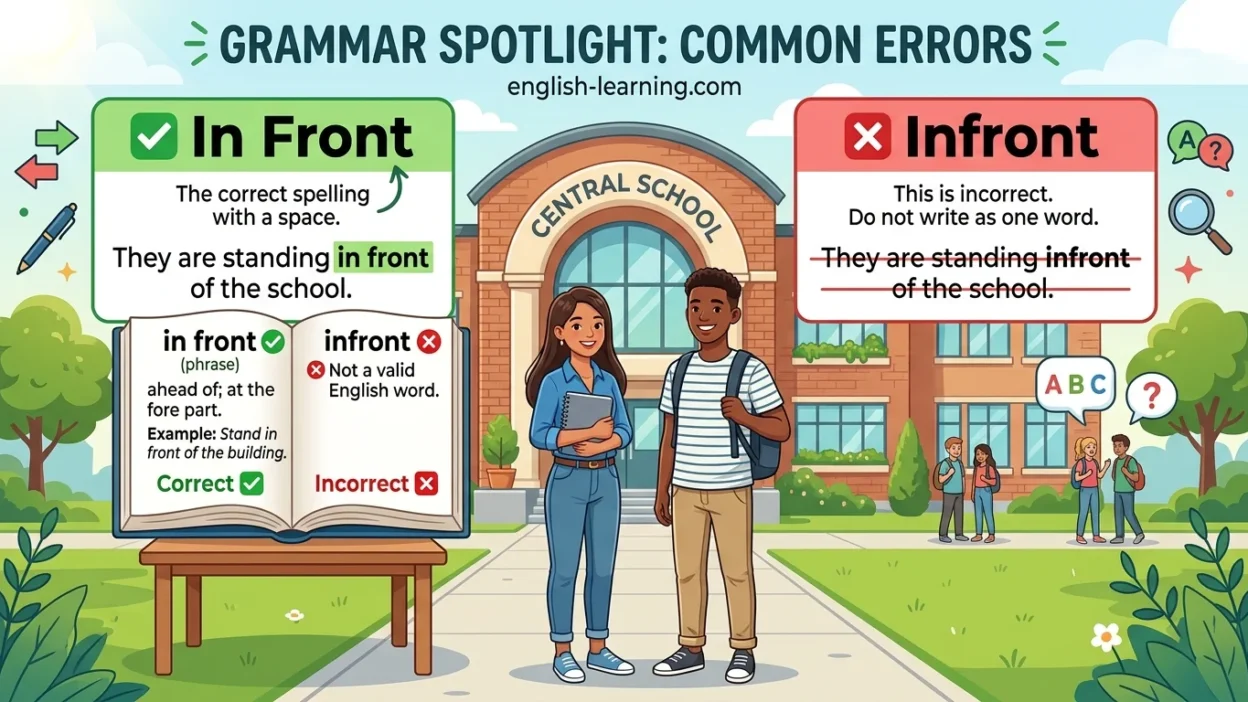
In front is the correct spelling. Infront is incorrect and is not accepted in standard English. Whenever you want to describe something positioned ahead of another person or object, always write in front as two separate words.
Why People Confuse It
Many people write infront because they pronounce the two words together in fast speech.
Another reason is that English has many compound words like inside, outside, and into, leading writers to think infront should also be one word.
Spell-checking is not always used, so the mistake often goes unnoticed.
In Front
In front is the correct expression in English.
It is a two-word phrase used to describe the position of a person or object that is ahead of someone or something else.
Meaning
In front means ahead of, before, or facing the front of something.
Examples
- The car stopped in front of the school.
- She stood in front of the mirror.
- Please wait in front of the building.
- The children gathered in front of the stage.
- A bicycle was parked in front of the house.
Infront
Infront is not a correct English word.
Although it appears frequently in text messages and online posts, it is considered a spelling mistake and should not be used in formal or informal writing.
Always replace infront with in front.
Comparison Table
| Feature | In Front | Infront |
|---|---|---|
| Correct spelling | ✅ Yes | ❌ No |
| Written as two words | ✅ Yes | ❌ No |
| Accepted in dictionaries | ✅ Yes | ❌ No |
| Suitable for formal writing | ✅ Yes | ❌ No |
| Common spelling mistake | ❌ No | ✅ Yes |
When to Use Each
Use in front whenever you describe the position of something that is ahead of another object or person.
Examples include:
- Giving directions
- Describing locations
- Writing stories
- Academic writing
- Business emails
- Everyday conversations
Never use infront, as it is always considered incorrect.
Examples
- My car is parked in front of the office.
- She stood in front of the class.
- The dog sat in front of the door.
- Please meet me in front of the café.
- A tree grows in front of our house.
- He walked in front of everyone.
- The teacher stood in front of the whiteboard.
- We waited in front of the cinema.
- The statue is in front of the museum.
- They took a photo in front of the castle.
- The bus stopped in front of the station.
- He stood in front of me during the concert.
Common Mistakes
These are mistakes many writers make.
- Writing infront as one word.
- Assuming it follows words like inside or outside.
- Forgetting the space between in and front.
- Using infront in academic or professional writing.
Correct:
- She stood in front of the gate.
Incorrect:
- She stood infront of the gate.
Memory Trick
Remember this simple sentence:
You stand in front of something, not infront of it.
Think of front as its own word. If front can stand alone, it also stays separate after in.
American vs British English
There is no difference between American and British English.
Both varieties use in front as two separate words.
Infront is considered incorrect in both.
Similar Words
You may also come across these related words and phrases:
- In front of
- Behind
- Opposite
- Ahead of
- Before
- Next to
- Beside
- Across from
- Near
- Close to
Final Verdict
The answer is straightforward.
In front is always the correct spelling.
Infront is a common spelling mistake that should never be used in standard English. Whether you’re writing professionally or casually, using in front ensures your writing is grammatically correct and easy to understand.
Remember This
Always write in front as two words.
Think:
I stood in front of the door. ✅
Never write:
I stood infront of the door. ❌
FAQs
Is infront a real word?
No. Infront is not recognised as a correct English word.
Which is correct, in front or infront?
In front is the correct spelling.
Why do people write infront?
People often combine the words because they are pronounced closely together in speech.
Is in front one word?
No. It is always written as two separate words.
Is in front correct in British English?
Yes. British English and American English both use in front.
Can I use infront in formal writing?
No. You should always use in front.
What does in front mean?
It means ahead of or at the front of someone or something.
Conclusion
The confusion between in front vs infront is common, but the rule is simple. In front is the only correct form and should always be written as two separate words. Infront is a spelling error that should be avoided in every type of writing.
Whenever you describe the position of a person or object, remember to leave a space between in and front. Following this simple rule will make your English look more accurate, natural, and professional.

Daniel Charles is a dedicated author and dream interpretation enthusiast at DrameyHut. He specializes in analyzing dream symbols and meanings, offering clear and insightful content for readers. His work aims to help individuals understand their subconscious thoughts, gain clarity, and explore the deeper messages hidden within their dreams.