Many English learners get confused between too bad and to bad because the words to and too sound exactly the same. Since they are homophones, it’s easy to choose the wrong spelling, especially when writing quickly. However, these two expressions are not interchangeable, and only one is grammatically correct in most situations.
Understanding the difference between too bad vs to bad will help you avoid a common grammar mistake. If you’re writing an email, text message, essay, or social media post, using the correct phrase makes your English sound more natural and professional.
This guide explains the meaning, correct usage, examples, and memory tricks in a simple way.
Quick Answer
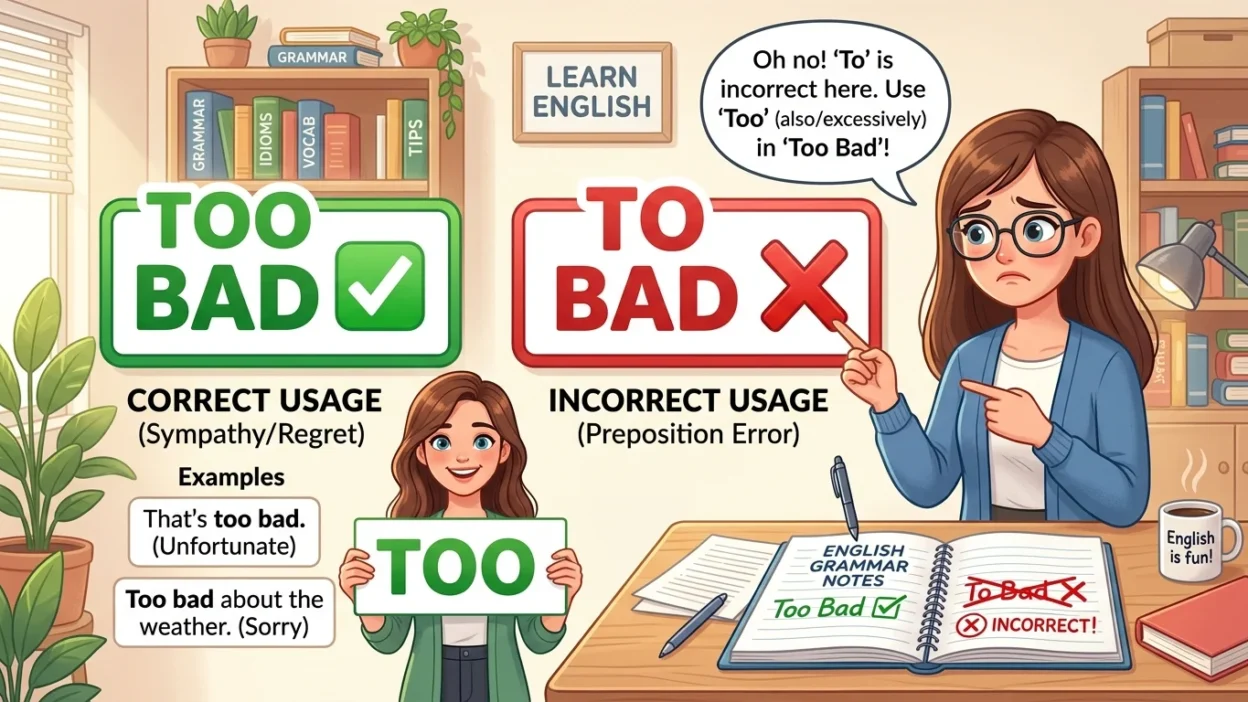
Too bad is the correct phrase when you mean unfortunate, sad, or a shame. To bad is almost always incorrect because to is a preposition or part of an infinitive and cannot replace too in this expression.
Why People Confuse It
The confusion happens because to and too are pronounced the same.
Many writers type the words based on sound rather than grammar, which leads to the incorrect phrase to bad. Since spell-checkers do not always catch context errors, the mistake often goes unnoticed.
Too Bad
Too bad is the correct expression.
It is used to say that something is unfortunate, disappointing, or a pity.
Meaning
Too bad means:
- That’s unfortunate.
- What a shame.
- That’s disappointing.
Examples
- It’s too bad that you couldn’t come.
- Too bad we missed the train.
- That’s too bad. I hope you feel better soon.
- It was too bad the concert was cancelled.
- Too bad the weather changed.
To Bad
To bad is not a correct English phrase in standard grammar.
The word to is a preposition or part of an infinitive, while bad is an adjective. They do not naturally form the expression people usually intend.
In very rare sentence structures, to and bad may appear next to each other by coincidence, but to bad should never be used instead of too bad.
Comparison Table
| Feature | Too Bad | To Bad |
|---|---|---|
| Correct English phrase | ✅ Yes | ❌ No |
| Means unfortunate or a shame | ✅ Yes | ❌ No |
| Used in everyday conversation | ✅ Yes | ❌ No |
| Accepted in formal writing | ✅ Yes | ❌ No |
| Common grammar mistake | ❌ No | ✅ Yes |
When to Use Each
Use too bad when expressing disappointment, sympathy, or regret.
Common situations include:
- Someone misses an event.
- A plan is cancelled.
- Something unfortunate happens.
- Responding with sympathy.
- Casual conversations.
Do not use to bad when you mean too bad.
Examples
- It’s too bad you couldn’t join us.
- Too bad the shop was closed.
- That’s too bad. Better luck next time.
- It was too bad that the game was postponed.
- Too bad we forgot the tickets.
- It’s too bad the meeting ended early.
- Too bad you missed the sale.
- That’s too bad for everyone involved.
- Too bad the weather ruined our picnic.
- It’s too bad she wasn’t selected.
- Too bad we arrived late.
- That’s too bad, but we can try again tomorrow.
Common Mistakes
Many learners make these errors.
- Writing to bad instead of too bad.
- Confusing to, too, and two.
- Forgetting that too means also or excessively, and in this phrase it forms the fixed expression too bad.
Correct:
- It’s too bad that you missed the flight.
Incorrect:
- It’s to bad that you missed the flight.
Memory Trick
Remember this simple rule:
Too has an extra O, and that extra O reminds you of extra feeling.
When something is unfortunate or a shame, always write too bad.
American vs British English
There is no difference between American and British English.
Both use too bad as the correct expression.
To bad is considered incorrect in both varieties of English.
Similar Words
You may also find these expressions useful:
- Too late
- Too early
- Too much
- Too many
- What a shame
- Unfortunately
- Sadly
- Regrettably
- That’s unfortunate
- It’s a pity
Final Verdict
The answer is simple.
Too bad is the correct phrase whenever you want to express disappointment or say that something is unfortunate.
To bad is almost always a grammar mistake and should be avoided. Remember that too is the correct word in this expression because it forms the established phrase too bad.
Remember This
Always write:
Too bad ✅
Never write:
To bad ❌
Think of too bad as another way of saying what a shame.
FAQs
Is too bad grammatically correct?
Yes. Too bad is a correct English expression used to show disappointment or sympathy.
Is to bad correct?
No. To bad is generally incorrect and should not replace too bad.
Why do people confuse too bad and to bad?
Because to and too sound exactly alike, making them easy to mix up in writing.
What does too bad mean?
It means unfortunate, a pity, or what a shame.
Is too bad formal or informal?
It is commonly used in everyday conversation but is also acceptable in most types of writing.
Do British and American English use too bad differently?
No. Both use too bad in the same way.
Can too bad express sympathy?
Yes. It is often used to politely respond when someone shares disappointing news.
Conclusion
The difference between too bad vs to bad is easy to remember once you know the role of too. Whenever you want to express that something is unfortunate, disappointing, or a shame, too bad is the only correct choice.
Although to and too sound identical, they have different grammatical functions. Keeping this distinction in mind will help you avoid a common writing mistake and make your English clearer and more accurate.

Nancy Lisa is a passionate writer and contributor at DrameyHut, focused on uncovering the deeper meanings behind dreams. She creates engaging and insightful content that helps readers interpret their dreams and understand their subconscious thoughts. Her work inspires self-reflection, clarity, and a stronger connection to inner emotions.